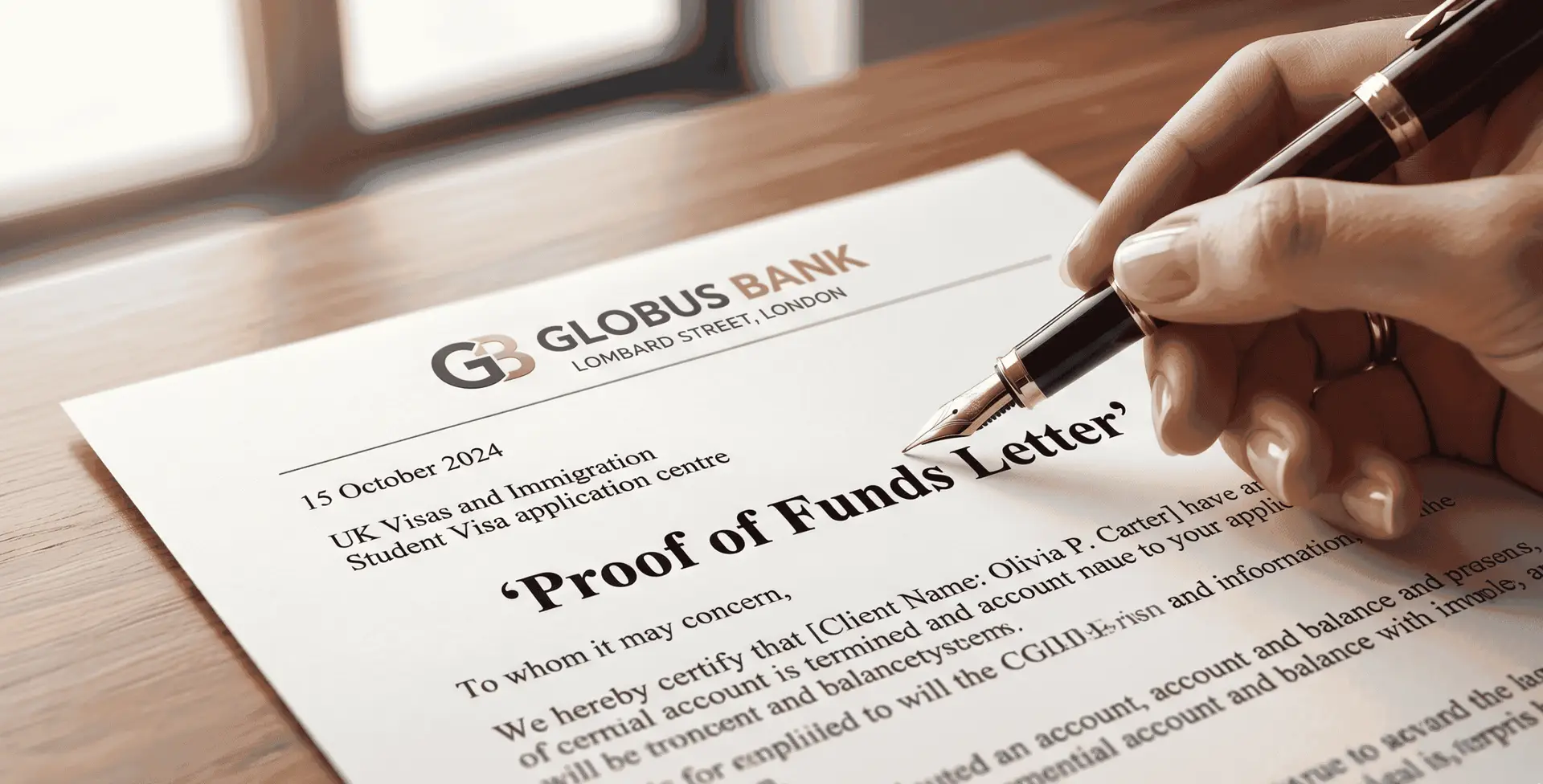
One Wrong Document Can Cost You Your Visa
Imagine spending six months preparing your university application — giving the GRE, writing your SOP, chasing recommendation letters — and then getting a student visa rejection because your proof of funds letter wasn’t formatted correctly. It happens more often than you’d think. And the brutal part is, it’s entirely preventable.
A proof of funds letter from your bank is not just a formality. It is the document that tells a foreign embassy or university: “This student has the financial backing to study here without becoming a burden on the state.” Get it right and your visa process moves smoothly. Get it wrong and you’re looking at delays, rejections, and months of wasted time.
This guide gives you exactly what you need — a plain-English explanation, a real step-by-step process for getting the letter from your bank, ready-to-use proof of funds letter templates, and the common mistakes that trip up even careful students. If you’re applying for a UK, US, German, or Canadian student visa in 2026, read this before you step into your bank branch.
What Is a Proof of Funds Letter?
A proof of funds letter is an official document issued by your bank, on the bank’s letterhead, confirming that you — or your financial sponsor — have enough money in your account to cover your education and living expenses abroad. Think of it as the bank vouching for your financial health in writing.
It is different from a bank statement, although many students confuse the two. A bank statement is a historical record of all transactions in your account. A proof of funds letter is a formal declaration — issued by a bank manager or authorised officer — specifically confirming your available balance as of a particular date, and stating that the funds are unencumbered (i.e., not pledged as collateral elsewhere).
Most embassies and universities want both documents together. But the proof of funds letter carries more weight because it is a forward-looking declaration, not just a transaction history. It answers the question: “Right now, today, does this student have the money?” The bank statement answers: “What has happened to this account over the past few months?” You need both — but the letter is what makes the difference.
Why Do Embassies and Universities Require a Proof of Funds Letter from Bank?
Every country that issues student visas has one core concern: they don’t want international students to run out of money mid-course, drop out, and remain in the country illegally. The proof of funds letter from bank is the primary tool they use to verify that this won’t happen with you.
For a UK Student Visa in 2026, the Home Office requires you to show you have enough funds to cover your tuition fee for the first year plus a fixed living cost amount — currently £1,334 per month for up to 9 months if studying in London (£1,023 outside London). This money must have been held in your account for a consecutive 28-day period before your visa application date. The proof of funds letter is how you confirm this to the Home Office.
For a US F-1 Student Visa, the requirements are set by each university in your I-20 document, but the principle is the same — you must demonstrate you can cover 12 months of tuition plus living costs. German universities and Blocked Accounts (Sperrkonto) follow a different mechanism, but the proof of funds letter is still required as supporting evidence in many applications. Understanding these requirements is essential before you approach your bank — read our full guide on the student visa process for 2026 to understand exactly what your target country expects.
How to Get a Proof of Funds Letter from Bank: Step-by-Step
This is the part most guides skip over too quickly. Getting the letter is not complicated, but there is a specific process that gets you a correctly formatted, embassy-acceptable document the first time — without having to make multiple trips back to the bank branch to get things corrected.
Step 1: Make Sure Your Account Balance Is Ready
Before you even walk into the bank, make sure the required funds have been sitting in the account for at least 28 consecutive days. For UK visas, this is a hard rule — the Home Office checks the 28-day balance window and a large deposit made two weeks before your visa application will raise red flags. The money needs to look settled and stable, not suddenly injected.
If the funds are coming from a parent or sponsor, they need to have been in their account for 28+ days — and you will also need a letter of sponsorship alongside the proof of funds letter confirming who is funding your education and their relationship to you. Don’t make the mistake of transferring everything to your own account at the last minute. Leave the funds where they have the longest, cleanest history.
Step 2: Visit Your Home Branch and Ask for the Branch Manager
Go to the branch where your savings or fixed deposit account is held — your home branch, not just any branch of the same bank. The proof of funds letter must be signed by an authorised bank officer, ideally the Branch Manager or a Senior Relationship Manager. A letter signed by a junior teller or without an authorised signature will likely be rejected by the visa officer.
When you arrive at the branch, don’t just ask for a “bank letter.” Be specific. Tell the officer: “I need an official proof of funds letter on bank letterhead for a student visa application. It needs to state my current balance, confirm the account has been active for at least 28 days, and include the bank’s stamp and the manager’s signature.” The more specific you are, the better document you’ll receive.
Step 3: Provide the Bank with the Right Details
The bank officer will need a few things from you to draft the letter correctly. Bring all of these to your branch visit:
- Your original national ID card or passport (for identity verification)
- Your account number and the type of account (savings, current, fixed deposit)
- The name and address of the university the letter is being prepared for (some banks include this in the letter)
- The specific amount you need the letter to mention (check your university’s or embassy’s minimum requirement)
- The exact date you need the letter issued on (it should be as close to your visa application date as possible)
- Whether you need the letter in English — in some countries, banks issue documents in the local language by default. For foreign visa applications, always request English.
Step 4: Verify the Letter Before You Leave the Branch
Before you walk out of the bank, check the letter carefully — right there at the counter. This is not the time to be polite and assume everything is fine. Check the following items against this list:
- ✅ Bank’s official letterhead with logo, address, and contact details
- ✅ Your full name (exactly as it appears on your passport)
- ✅ Your account number (partially masked is acceptable)
- ✅ The current available balance stated clearly in both numbers and words
- ✅ A statement that the funds have been maintained/held for the required period
- ✅ A statement that the funds are unencumbered (not pledged as loan collateral)
- ✅ The date of issue of the letter
- ✅ The branch manager’s or authorised officer’s signature
- ✅ The bank’s official rubber stamp or seal
If any of these elements are missing, ask the officer to correct it before you leave. A missing stamp or an unsigned letter will be rejected by a visa officer without a second look — and you’ll have to go back and start again.
Proof of Funds Letter Template: Copy, Edit, and Use
Not every bank knows exactly what format a student visa proof of funds letter should follow. Some banks have their own standard templates that work perfectly — but others issue vague, generic letters that embassy officers reject. If your bank asks you what the letter should say, or if you want to bring a draft for them to follow, use one of these proof of funds letter templates below.
These are designed to be used as a guide for the bank officer — not for you to type and print yourself. The letter must come from the bank on official letterhead with original signatures and stamps. What you’re doing by bringing this template is making sure the bank doesn’t leave out critical details.
Proof of Funds Letter Template 1 — Standard Student Visa Letter
This is a clean, widely accepted proof of funds letter sample suitable for UK, USA, Canada, and Australian student visa applications. Fill in the bracketed fields with the actual details.
[BANK NAME]
[Bank Branch Address]
[City, Country, PIN Code]
Tel: [Branch Phone Number]
Email: [Branch Email Address]
Date: [DD/MM/YYYY]
Ref No.: [Internal Bank Reference Number]
To Whomsoever It May Concern
Subject: Proof of Funds for Student Visa Application — [STUDENT’S FULL NAME]
This is to certify that [STUDENT’S FULL NAME], holding [National ID / Passport No.: XXXXXXXXX], is the holder of [Savings / Current / Fixed Deposit] Account No. [XXXXXXXXXX] at our branch.
As of the date of this letter, the available balance in the above-mentioned account stands at [CURRENCY AMOUNT in figures] ([CURRENCY AMOUNT in words]). We confirm that these funds have been maintained in the account for a continuous period of [XX] days and are freely available and unencumbered.
This letter is being issued at the request of the account holder for the purpose of supporting their student visa application to [COUNTRY / UNIVERSITY NAME] and is valid for 28 days from the date of issue.
For any further verification, please do not hesitate to contact us at the details mentioned above.
Yours sincerely,
[NAME OF BRANCH MANAGER / AUTHORISED OFFICER]
Designation: [Branch Manager / Senior Relationship Officer]
[Bank Name], [Branch Name]
[OFFICIAL BANK STAMP / SEAL]
Proof of Funds Letter Template 2 — Sponsored Student (Parent or Guardian as Sponsor)
This proof of funds letter example is for students whose funds are held in a parent’s or guardian’s account rather than their own. This is extremely common — and perfectly acceptable to embassies — as long as a separate sponsor declaration letter accompanies it. Use this template as your guide for the bank officer.
[BANK NAME]
[Bank Branch Address]
[City, Country, PIN Code]
Tel: [Branch Phone Number]
Email: [Branch Email Address]
Date: [DD/MM/YYYY]
Ref No.: [Internal Bank Reference Number]
To Whomsoever It May Concern
Subject: Proof of Funds on Behalf of Sponsored Student — [STUDENT’S FULL NAME]
This is to certify that [SPONSOR’S FULL NAME], holder of [National ID / Passport No.: XXXXXXXXX], is a valued account holder at our branch, maintaining [Savings / Current / Fixed Deposit] Account No. [XXXXXXXXXX].
As of the date of this letter, the available balance in the above-mentioned account stands at [CURRENCY AMOUNT in figures] ([CURRENCY AMOUNT in words]). These funds have been maintained continuously for a period of [XX] days and are freely available and unencumbered by any lien or charge.
We understand that [SPONSOR’S FULL NAME] intends to financially sponsor [STUDENT’S FULL NAME] (Relationship: [Father / Mother / Legal Guardian]) for their studies at [UNIVERSITY NAME], [COUNTRY], commencing [MONTH/YEAR]. The account holder has confirmed their commitment to funding the student’s tuition and living expenses for the duration of the programme.
This letter is issued solely for the purpose of the above-mentioned student visa application and is valid for 28 days from the date of issue.
Yours sincerely,
[NAME OF BRANCH MANAGER / AUTHORISED OFFICER]
Designation: [Branch Manager / Senior Relationship Officer]
[Bank Name], [Branch Name]
[OFFICIAL BANK STAMP / SEAL]
Print either of these templates, highlight the fields that need to be filled in, and bring it to your bank branch as a reference guide for the officer drafting your letter. Most bank managers appreciate the clarity — it saves their time and ensures you get a clean document on the first visit.
Common Mistakes That Will Get Your Proof of Funds Letter Rejected
Visa officers review hundreds of applications every week. They know exactly what a legitimate, well-prepared proof of funds letter looks like — and they spot problems instantly. Here are the mistakes that trigger rejection, and exactly how to avoid each one.
Mistake #1: Making a Large, Sudden Deposit Right Before Applying
This is the most common and most damaging mistake. A student realises they don’t have enough funds in their account, so their uncle or family friend transfers a large lump sum — say ₹20 lakh — two weeks before the visa application date. The visa officer sees this, questions where the money came from, and rejects the application for lack of genuine, stable financial evidence.
The rule of thumb is simple: funds should look like they belong there. The money should have been in the account for at least 28 consecutive days (mandatory for UK visas), and ideally 2–3 months for other countries. If funds are being transferred from a family member, do it early and be prepared to explain the source with supporting documents — ITRs, salary slips, fixed deposit receipts.
Mistake #2: Using a Dormant or Rarely Used Account
Some students use an old savings account that technically has the required balance but has had no activity in months or years. This raises a flag — an account with no movement for six months and a suddenly large balance looks suspicious to a visa officer. Use your primary, active account wherever possible — one that shows regular inflows (salary credits, pension transfers, interest credits) and outflows (monthly expenses).
If your most active account doesn’t have enough funds, and you need to use a separate savings or fixed deposit account, that’s fine — but accompany it with a detailed statement showing the account’s history, and consider asking your bank to include a note in the proof of funds letter confirming the account’s tenure and regular use.
Mistake #3: Missing the Bank Stamp or Manager’s Signature
A proof of funds letter without an official bank stamp is just a piece of paper. Embassies will reject it without reading the contents. The stamp and signature are what make the document legally valid. Always check — before you leave the bank counter — that the rubber stamp is clear and legible, and that the signing officer’s name and designation are printed below their signature (not just a scrawled signature with no identification).
If you are submitting the letter as part of a scanned or digital visa application (common for UK online visa applications), make sure the scan is high quality and all stamps and signatures are clearly visible. A blurry scan of an otherwise perfect letter will still cause problems in document review.
Mistake #4: Submitting a Letter That’s Too Old
A proof of funds letter has a short shelf life. Most embassies want a letter dated within 28 to 31 days of your visa application submission. Don’t request the letter in January if you plan to apply for your visa in March. By the time you submit, the letter will be out of date and you’ll need a new one. Time your bank visit so the letter is dated as close to your visa application date as possible — ideally within the same week.
Mistake #5: Funds Pledged as Loan Collateral
If the money in your account — or in a fixed deposit — is pledged as security against a home loan, personal loan, or any other credit facility, those funds are technically encumbered. An embassy will not accept encumbered funds as proof of financial capacity. If you are also taking an education loan to fund your studies, make sure you are clear about which funds are pledged (to the loan) and which are free. You may want to read our detailed guide on education loans for abroad studies to understand how loan and personal funds interact in a visa application.
Mistake #6: Getting a Letter in the Local Language Only
This is a small but surprisingly common mistake for students from Pakistan, India, and parts of the Middle East — where some bank branches issue official documents in Urdu, Hindi, or Arabic by default. For any foreign embassy or university, the proof of funds letter must be in English or accompanied by a certified English translation. Always explicitly request an English-language letter when you visit your branch.
What Else Goes With Your Proof of Funds Letter?
A proof of funds letter from bank is almost never submitted alone. Embassy checklist requirements typically pair it with several supporting financial documents. Submitting just the letter without these supporting materials leaves your financial picture incomplete — and incomplete applications get rejected or asked for resubmission.
Here is what typically accompanies a proof of funds letter in a complete student visa financial package:
- Bank statements for the last 3–6 months — showing transaction history, regular deposits, and balance maintenance. Must be officially printed or stamped by the bank, not a downloaded PDF in many cases.
- Sponsor’s income documents — salary slips, ITR/tax returns, pension statement, or business income proof for the person funding your education.
- Sponsor declaration letter — a separate signed document from the sponsor (parent or guardian) confirming they are funding your education. Required especially when funds are in a sponsor’s account, not the student’s.
- Fixed Deposit receipts — if part of your funds are in FDs rather than a savings account, include the original FD certificates or at minimum an official FD balance statement from the bank.
- Source of funds documentation — if there has been any large deposit into the account recently, have ready an explanation document with supporting evidence (sale of property, matured investment, salary accumulation).
If you are in the middle of arranging your study abroad finances and are exploring whether an education loan can supplement your available funds, our guide on education loans for abroad studies explains exactly how to combine personal funds and loan funds in your visa application without raising red flags.
Country-Specific Notes on Proof of Funds Requirements in 2026
Different countries have specific rules around proof of funds that go beyond the general guidance above. Here’s a quick breakdown of what you need to know for the most popular study destinations for students from South Asia.
United Kingdom 🇬🇧
The UK’s Student Visa (previously Tier 4) has the most clearly defined proof of funds requirement in 2026. You must show funds equal to your first year’s tuition fee plus £1,334 per month for up to 9 months if studying in London, or £1,023 per month outside London. The full amount must have been held continuously for 28 days — and the 28-day period must end no earlier than 31 days before your visa application date. Your proof of funds letter from bank must explicitly confirm this 28-day requirement has been met. For a complete guide to the UK visa process, see our UK Student Visa 2026 guide.
United States 🇺🇸
For the US F-1 Student Visa, the required amount is set by your specific university in your I-20 form — it represents 12 months of tuition plus living costs. There is no strict “28-day rule” as in the UK, but the bank statement and proof of funds letter should show that the funds have been available for at least 3–6 months. US consulate officers will often ask follow-up questions at the interview if funds look recently injected, so the same rule applies: keep the money stable and well-documented.
Germany 🇩🇪
Germany uses a unique system called a Blocked Account (Sperrkonto) for student visa proof of funds. You deposit a fixed amount (currently €11,208 per year for 2026) into a German blocked account — with providers like Fintiba, Expatrio, or Deutsche Bank — before applying for your visa. A proof of funds letter from your home bank may still be required as supporting evidence alongside the blocked account confirmation, depending on your German university’s requirements. Check with your university’s international office for the exact document list.
Canada 🇨🇦
For a Canadian Student Visa (Study Permit), you must show funds to cover your first year’s tuition plus CAD $10,000 for living expenses (or CAD $11,000 if studying in Quebec). The proof of funds letter from bank should state the available balance and confirm the funds are accessible. Canada does not have a strict holding-period rule equivalent to the UK’s 28-day requirement, but Immigration, Refugees and Citizenship Canada (IRCC) officers expect funds to look stable and consistent, not freshly deposited.
Frequently Asked Questions
Q1: Can I use a savings account for my proof of funds letter, or does it need to be a current account?
A savings account is perfectly acceptable — and in fact the most common account type used for student visa proof of funds letters. The type of account matters less than the balance, the stability of funds over the required period, and the clarity of the letter issued. Fixed deposit accounts are also widely accepted and often preferred because they show stable, long-term savings. What you want to avoid is using an account that is dormant, recently opened, or has an unstable history of large fluctuating balances.
Q2: Is a bank statement the same as a proof of funds letter?
No — and this is a critical distinction. A bank statement is a historical transaction record printed from your account. A proof of funds letter is a formal declaration issued by a bank officer, confirming your current available balance and explicitly stating that the funds are sufficient and unencumbered. Most embassies require both documents together. If you submit only a bank statement without the accompanying proof of funds letter, your financial evidence is considered incomplete.
Q3: How recent does a proof of funds letter need to be for a student visa application?
For most countries, the letter should be dated within 28–31 days of your visa application submission. For the UK specifically, the 28-day balance window must end no earlier than 31 days before your application date — so the letter should be issued as close to your application date as possible, ideally within the same week. Don’t request the letter months in advance and then use it for a later application — by the time you submit, it will be outdated and you’ll need to go back to the bank for a fresh one.
Q4: What if my bank refuses to issue a proof of funds letter in English?
This is rare with major banks, but it happens. If your bank insists on issuing the letter in a local language only, request that they issue it in both the local language and English simultaneously. If they cannot, obtain the local-language letter and take it to a certified translator who can produce an officially notarised English translation. Some embassies — particularly the UK Home Office — are very specific that translated documents must be accompanied by the original and a translator’s certificate. Check your embassy’s guidelines before submitting.
Q5: Can I use funds from my education loan as proof of funds for a visa application?
It depends on the country and the lender. For UK visas, you can use a loan from a regulated financial institution — but only if the loan letter explicitly states the funds have been released into your account and are available to you unconditionally. A loan sanction letter alone (promising future disbursement) is generally not accepted. The actual funds must be in your bank account during the 28-day window. For US visas, loan funds can be referenced in a sponsor letter or financial statement if they are confirmed and disbursable. Our guide to education loans for abroad studies explains how different loan types interact with visa financial requirements.
Get This Right and the Rest Gets Easier
The proof of funds letter is one of those documents that feels minor until it becomes the reason your visa gets rejected or delayed. Students who treat it as an afterthought — something to collect quickly the day before their visa appointment — often pay the price. Students who prepare it properly, with the right balance maintained for the right period and a correctly formatted letter from an authorised bank officer, move through the visa process with far less stress.
Use the templates in this guide as your starting point. Walk into your bank with a clear checklist. Verify every element of the letter before you leave the branch. And time the whole process so your letter is fresh — issued within 28 days of your actual visa application date.
Your study abroad dream is worth getting the paperwork right. Take an hour to do this properly and you’ll save yourself weeks of delays on the other side. For more help navigating the full study abroad application process — from university selection to visa documentation — explore the rest of our guides on StudyPathExp.com.
📩 Need personalised help reviewing your financial documents before your visa application? Our consultancy team works with students from India and Pakistan applying to universities in the UK, USA, Germany, and Canada — and we review proof of funds packages as part of our pre-visa consultation service.
Get in touch today — one document review can save you a rejection.
Disclaimer: Visa requirements, financial thresholds, and documentation rules change regularly. Always verify the current requirements directly with the embassy or high commission of your target country before submitting your visa application. The templates in this article are for guidance only and should be adapted based on your bank’s format and your specific embassy’s requirements.