You Paid Hundreds of Pounds — And You Can Get It Back
The moment you sit down to fill out a UK Student Visa application, one number stops you cold: the Immigration Health Surcharge. For a two-year Master’s programme, you’re looking at well over £1,000 — paid upfront, before your visa is even approved. For a longer course, it can climb past £2,000 or more. That’s a serious amount of money for any student, and it stings even more when you’re already stretching every pound to cover tuition, accommodation, and flights.
Now here’s the part that most students never find out until it’s too late: if your immigration health surcharge refund student visa situation qualifies — whether your visa was refused, you withdrew your application, or you overpaid — you are entitled to get that money back. The UK Home Office does issue refunds. The process is mostly automatic. But “mostly automatic” is doing a lot of heavy lifting in that sentence, and plenty of students miss out simply because they don’t know what to do when the money doesn’t show up.
This guide walks you through exactly who qualifies, how to claim, realistic timelines, and what steps to take if your refund goes quiet. Whether you’re still in the planning stage or already waiting on a payment that should have arrived weeks ago, you’re in the right place. You may also want to read our full guide on the UK Student Visa process for 2026 to understand where the IHS fits into your overall application.
What Is the Immigration Health Surcharge (IHS)?
The Immigration Health Surcharge (IHS) is a fee that most non-European Economic Area nationals must pay when applying for a UK visa that lasts longer than six months — including the Student Visa. Paying it gives you access to the UK’s National Health Service (NHS) on broadly the same terms as a UK resident: GP appointments, hospital treatment, accident and emergency — all covered during your stay.
As of 2026, the IHS rate for students is £776 per year (reduced rate — full adult rate is £1,035 per year). So for a two-year Master’s, that’s £1,552. For a three-year undergraduate degree, it’s £2,328. This fee is paid during the online visa application process — you pay it before you know if your visa will be granted.
To work out exactly how much you owe before you apply, use the official immigration health surcharge calculator on the UK Government’s website at gov.uk/immigration-health-surcharge. You input your visa type and course duration and it gives you the exact figure. Always run this calculation yourself before your application — never rely on a third-party estimate, as rates have increased several times in recent years and an outdated figure will cost you.
Who Is Eligible for an Immigration Health Surcharge Refund?
Not everyone who pays the IHS gets a refund — that’s important to be clear about upfront. The IHS is non-refundable in normal circumstances. But there are specific, clearly defined situations where the UK Home Office will return your money. Here are every scenario that makes you eligible.
Your Visa Application Was Refused
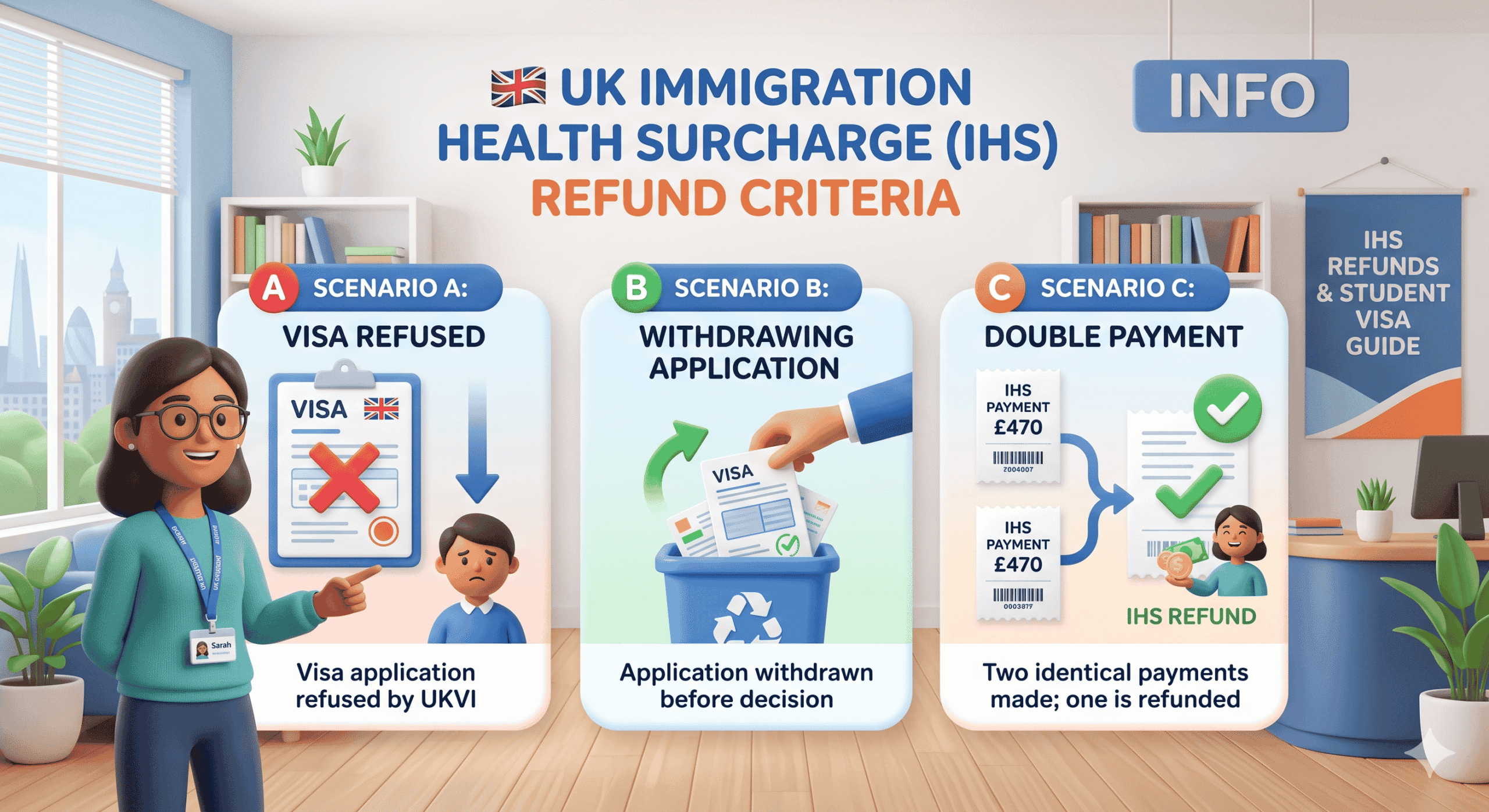
If you paid the IHS as part of your Student Visa application and your application was refused by the Home Office, you are automatically entitled to a full IHS refund. You did not get the visa. You cannot use the NHS. The fee should come back to you. This is the most common reason students receive an immigration health surcharge reimbursement — and the good news is that in this scenario, the refund is supposed to be issued automatically without you needing to chase it.
In practice, “automatically” can mean waiting up to 8 weeks. If you’re at the 8-week mark and nothing has arrived, you will need to take action — more on that in a later section.
You Withdrew Your Visa Application Before a Decision Was Made
If you withdrew your application before the Home Office made a decision — perhaps because your university offer was cancelled, you changed your plans, or you found a different route — you are also entitled to an IHS refund. The same automatic refund process applies. Keep a copy of your withdrawal confirmation email as evidence in case you need to follow up.
You Paid the IHS Twice (Duplicate Payment)
Online payment systems are not infallible. If you accidentally paid the immigration health surcharge twice during a single application — or paid it during an earlier application attempt before switching to a new one — you are entitled to a refund of the duplicate payment. This happens more than you’d expect, especially when the application system times out and students restart the process without realising the first payment went through. Check your bank statement carefully if you think this might have happened to you.
Your Visa Was Granted for a Shorter Period Than You Paid For
Occasionally, the Home Office grants a visa for a shorter duration than what was applied for — for example, granting 18 months when you applied for 24 months. In this case, you will have paid IHS for the full 24-month period but only received 18 months of leave. You may be entitled to a partial immigration health surcharge reimbursement for the difference. This is less straightforward than the other scenarios and may require you to contact the IHS team directly to resolve.
You Are Exempt From the IHS But Paid It Anyway
Certain categories of applicants are exempt from the IHS entirely — including some government-sponsored students, students from specific countries with bilateral healthcare agreements, and applicants for certain visa types. If you fall into an exempt category but paid the surcharge during your application, you are entitled to a full refund. Always check the exemption list on gov.uk before you pay — but if you’ve already paid and you’re exempt, don’t worry. You can claim it back.
Who Is NOT Eligible for a Refund
It’s worth being equally clear about who cannot claim the IHS back. If your visa was granted and you used it to enter the UK, the IHS is non-refundable — even if you left early, your course was cancelled after arrival, or you changed your visa type while in the UK. The fee is considered earned the moment you enter the country and access NHS entitlement. There is no partial refund for leaving early in standard circumstances. Similarly, if your visa was refused for the second time on an appeal or administrative review, you will have been refunded from the original refusal — there is no additional refund for the review costs.
Step-by-Step Guide: How to Claim Your Immigration Health Surcharge Refund
The good news is that for most eligible scenarios — visa refusal and application withdrawal — the process to claim immigration health surcharge money back requires very little active effort from you. The Home Office’s system is designed to initiate the refund automatically. The bad news is that “automatic” doesn’t always mean “fast” or “guaranteed without follow-up.”
Here is exactly what happens and what you need to do at each stage.
Step 1: Understand That the Refund Is Processed Automatically
When the Home Office refuses your visa or processes your withdrawal, the system is supposed to automatically trigger a refund of your IHS payment to the same card or bank account you used when you paid. You do not need to fill out a separate refund form in the first instance. You do not need to call anyone immediately. The system handles it.
What this means practically: do not cancel or close the card or bank account you used to pay the IHS until the refund has arrived. This is one of the most common reasons refunds fail to reach students — the original payment card has expired or been cancelled in the weeks between the application and the refusal decision. If your card has changed, make a note of it now so you can provide the updated details if you need to follow up.
Step 2: Wait the Standard Processing Period
Once your visa is refused or your withdrawal is confirmed, the standard refund processing window is 6 to 8 weeks. During this time, you don’t need to do anything. The refund will appear on the statement of whichever card or account was charged during your original visa application payment.
Keep your original IHS payment confirmation email safe during this period. It contains your IHS reference number — a unique identifier that starts with “IHS” followed by a string of numbers. You will need this reference number if you ever need to contact the Home Office about your refund. Without it, resolving any issues becomes significantly slower.
Step 3: Check Your Bank Statement Carefully at the 6-Week Mark
At the six-week point, log into your bank account and search for any transaction from UKVI or IHS or the Home Office. Refunds don’t always appear with a clear, obvious description — some banks show them as generic credits. Cross-reference the exact amount you paid against your statement for any incoming credit of that same value.
If the refund has arrived — great. The process is complete. If you can see the credit but it’s less than what you paid, that partial discrepancy needs to be investigated. And if nothing has arrived by week eight, it’s time to take action.
Step 4: Submit a Formal Refund Request (If Not Received by Week 8)
If 8 weeks have passed and your IHS refund has not arrived, you need to formally contact the Home Office. The primary channel for this is the official IHS refund request form, available on the gov.uk website. You can find it by searching “IHS refund” on gov.uk. The form asks for:
- Your IHS reference number (from your original payment confirmation email)
- Your full name as it appeared on your visa application
- Your date of birth
- The email address used during the visa application
- Your visa application reference number (GWF number — also on your application confirmation)
- The amount paid and the date of payment
- Your bank account details for the refund (in case the original payment card is no longer active)
Once submitted, the Home Office is supposed to respond within 28 days. Keep a copy of everything you submit — take a screenshot of the completed form and the confirmation page so you have a record of when you made your formal request.
How Long Does the IHS Refund Take?
The official Home Office position is that IHS refunds are processed within 6 to 8 weeks of the visa refusal or application withdrawal. In practice, many students receive their refund faster — sometimes within 3 to 4 weeks. But “up to 8 weeks” is the timeframe you should plan around, not the best-case scenario.
If you submitted a formal refund request after the 8-week automatic window, add another 28 days on top of that for the Home Office to process and respond to your request. So in a worst-case scenario where the automatic refund fails and you need to submit the form, you could be waiting 12 to 14 weeks from your original visa decision before the money arrives. That’s not ideal when you’re managing finances across borders, so set a firm calendar reminder for the 8-week mark from your refusal date and don’t let it slip.
International bank transfers — particularly for students from Pakistan, India, or other countries where the original payment was made via an international card — can add a few extra days of processing time on top of the Home Office’s own timeline. Factor in an additional 3–5 business days for the credit to clear once the Home Office has issued it.
What to Do If Your IHS Refund Still Hasn’t Arrived
You’ve waited 8 weeks. You’ve submitted the formal refund request. Another 4 weeks have passed. Still nothing. This is frustrating — but it’s not the end of the road. Here is your escalation path, in the right order.
Check the Status of Your Formal Request First
Before you call anyone, go back to the email confirmation you received when you submitted your refund request form. Some requests are processed with a follow-up email asking for additional information or updated bank details — particularly if the original payment card is no longer valid. Check your inbox (and spam folder) for any correspondence from the Home Office or UKVI that you may have missed.
Contact the IHS Team Directly
The dedicated contact for IHS refund queries is the IHS customer support team, reachable through the official UKVI contact centre. The immigration health surcharge refund contact number for queries from within the UK is 0300 790 6268. If you are calling from outside the UK — for example, if your visa was refused and you never travelled — the international number is +44 203 875 4669. Lines are open Monday to Friday, 9am to 5pm UK time.
When you call, have the following ready before the call connects — the agent will ask for all of this to verify your identity and locate your case:
- Your IHS reference number (format: IHS followed by digits)
- Your GWF (visa application) reference number
- Your full name and date of birth
- The email address on your original application
- The date your visa was refused or withdrawn
- Your current bank details for the refund (especially if your original card has changed)
Note down the name of the agent you speak to, the date and time of the call, and any reference number they give you for the call itself. If you call back later, this information will help trace your previous contact and avoid starting from scratch.
Submit a Complaint If the Delay Is Unreasonable
If you have followed all the steps above — waited 8 weeks, submitted the formal request, contacted the IHS team directly — and you are now beyond 16 weeks from your original refusal date with no resolution, you have grounds to make a formal complaint to the Home Office. This is not an aggressive step — it’s a legitimate mechanism that often moves stalled cases forward far faster than further chasing.
You can submit a formal complaint via the UKVI complaints procedure page on gov.uk. Include a clear timeline of every step you’ve taken, every reference number you hold, and copies of all correspondence. A well-documented complaint submitted through the official channel typically receives a response within 20 working days.
Contact Your MP (If You Are in the UK)
This sounds extreme, but it is a genuinely effective last resort for students who are physically in the UK and dealing with a prolonged, unresolved IHS refund case. Members of Parliament (MPs) have the ability to make formal casework representations to the Home Office on behalf of constituents — and Home Office responses to MP casework enquiries are typically prioritised over standard queries. Find your local MP at parliament.uk and contact their constituency office by email with a summary of your case and all reference numbers.
Using the Immigration Health Surcharge Calculator Before You Apply
One of the most preventable IHS-related problems is simply not knowing how much you’ll be charged before you get to the payment screen. Students regularly get a shock when they reach the payment stage of their visa application — because they budgeted based on an outdated figure, or they forgot to account for dependants applying alongside them.
The immigration health surcharge calculator on gov.uk is the only reliable tool for this. It asks you three things: your visa type (Student), the length of your visa, and whether you have any dependants joining you. It then calculates the exact total for your application. For 2026 students, the calculation is £776 per year per person (student rate). For a 2-year Master’s with no dependants, that’s £1,552. For a 3-year undergraduate with one dependant partner, that figure climbs substantially.
Always run this calculation before you sit down to complete your online application. Know the number. Budget for it. And make sure the card you’re paying with has the funds available — a failed IHS payment at the checkout stage of your visa application can cause complications with your application timeline. If you’re also managing education loan finances alongside your visa application, our guide to education loans for abroad studies covers how to structure your finances during the visa process.
IHS Refunds for Dependants: What You Need to Know
If you applied for a UK Student Visa with dependants — a spouse, partner, or children — you will have paid the IHS for each of them individually in addition to your own payment. If your main visa application is refused, the IHS for all dependants covered under that application should also be refunded automatically alongside yours. The same 6–8 week timeline applies to their payments.
However, if your dependants applied separately under their own sub-applications, their IHS refunds are processed separately from yours. Don’t assume that because your own refund has arrived, theirs has too. Check each person’s payment separately, and if a dependant’s refund is missing, contact the IHS team with their individual IHS reference number — not yours.
For families managing multiple simultaneous UK visa applications, keeping a simple spreadsheet of each applicant’s IHS reference number, GWF number, payment amount, payment date, and refund status is genuinely helpful. It sounds like admin overkill — but when you’re chasing a missing refund across three separate applications six weeks after a refusal, you’ll be grateful for it.
Your Money Is Coming — But You Have to Know Your Rights
Getting a UK Student Visa refused is genuinely hard — emotionally and financially. You’ve invested months of preparation and a significant amount of money, and it’s natural to feel like you’ve lost it all. But the IHS refund is yours by right. The Home Office knows it. The system is designed — however imperfectly — to return it to you.
What separates the students who get their money back quickly from the ones who wait months is simply knowing the process. Mark your calendar for 8 weeks from your refusal date. Keep your IHS reference number safe. Don’t cancel your payment card. And if the money doesn’t arrive, follow the escalation steps in this guide without hesitation.
If you’re now rebuilding your plans for a future UK application — whether that means reapplying with stronger financial documents or exploring other routes — our guides on opening a UK student bank account and the full UK Student Visa process for 2026 are the best places to start. A refused visa is a setback, not a full stop.
📩 Need help navigating a UK visa refusal, reapplication, or understanding your rights around IHS refunds? Our consultancy team works with students from Pakistan and India through every stage of the UK visa process — including what to do after a refusal.
Get in touch today. Let’s work out your next move together.
Frequently Asked Questions
Q1: Do I need to apply separately to claim my immigration health surcharge refund, or is it automatic?
It is automatic in most cases — when your visa is refused or you withdraw your application, the Home Office system is designed to trigger the IHS refund to your original payment card without you needing to fill out a form. However, if the refund has not arrived within 8 weeks of your visa decision, you should then submit a formal refund request via the gov.uk form. Think of the automatic process as the first attempt, and the formal request as the backup you use if the first attempt fails.
Q2: I withdrew my UK Student Visa application. How long will my immigration health surcharge reimbursement take?
The same timeline applies as for a visa refusal — up to 6 to 8 weeks from the date your withdrawal was confirmed. Keep the withdrawal confirmation email you received from UKVI as evidence of the date your application was officially withdrawn. This date is the starting point for the 8-week countdown, not the date you submitted your withdrawal request. If you’re at 8 weeks and nothing has arrived, submit the formal refund request form on gov.uk immediately and keep your IHS reference number handy.
Q3: I paid the immigration health surcharge but my original card has now expired. Will I still get my refund?
Yes, but you may need to provide updated bank details to receive it. If the card you paid with has expired or been cancelled, the automatic refund will typically fail — and the Home Office will need to reprocess it to a new account. This is one of the main reasons refunds get delayed. The fix is to contact the IHS team directly using the immigration health surcharge refund contact number (+44 203 875 4669 from outside the UK, or 0300 790 6268 from within the UK) and provide your updated bank account details. Have your IHS reference number and GWF application number ready before you call.
Disclaimer: IHS rates, refund timelines, and Home Office contact details are subject to change. Always verify the most current information directly on gov.uk before taking action. This article is intended as a general educational guide and does not constitute legal or immigration advice. For complex visa cases, consult a registered UK immigration adviser.