The Yale University transfer acceptance rate sits somewhere between 1% and 3% in any given year — making it statistically harder to transfer into Yale than to get into most medical schools in the world. If you are reading this from Lagos, Seoul, Lahore, Berlin, or São Paulo, that number is not meant to discourage you. It is meant to calibrate you. Because the students who successfully transfer to Yale are not the ones who simply had the best grades. They are the ones who understood exactly what Yale was looking for, built a case around it, and submitted a strategically constructed application by the March 1st deadline.
This guide is written for serious applicants — students currently at universities outside the United States who are considering the transfer route, as well as domestic students who want the full picture before they begin. We are going to cover the real Yale university transfer acceptance rate data, the hidden realities that do not appear on the Yale admissions website, the specific requirements for international applicants, and the financial aid picture that makes Yale genuinely accessible to students from every economic background worldwide.
Yale University Transfer Acceptance Rate: Year-by-Year Data (2020–2025)
Yale does not publish a single clean Yale university transfer acceptance rate on its admissions page. The number has to be calculated from the Common Data Set reports and admissions office announcements Yale releases each cycle. Here is what the data actually looks like over the last five years.
| Application Year | Transfer Applicants | Transfer Admitted | Acceptance Rate |
|---|---|---|---|
| 2020–2021 | ~1,100 | ~26 | ~2.4% |
| 2021–2022 | ~1,050 | ~22 | ~2.1% |
| 2022–2023 | ~1,200 | ~20 | ~1.7% |
| 2023–2024 | ~1,300 | ~18 | ~1.4% |
| 2024–2025 | ~1,350 | ~17 | ~1.3% |
The trend is clear: the Yale university transfer acceptance rate has been declining over the past five years as application volumes have risen while available spots have stayed flat or contracted. For context, Harvard’s overall freshman acceptance rate in 2024 was approximately 3.6% — meaning the Yale transfer acceptance rate is now lower than Harvard’s freshman rate. That is how competitive this process has become.
Why does the Yale university transfer acceptance rate fluctuate year to year? Yale operates a residential college system — 14 residential colleges that each house a specific number of students. Transfer seats open up only when current Yale students take leaves of absence, withdraw, or when a residential college has physical capacity for additional students. In years where fewer Yale students take gap semesters or leaves, fewer transfer spots exist. This is structurally different from most universities, where transfer admission is tied to a department’s enrollment target. At Yale, it is tied to beds. That is the reality the Yale transfer acceptance rate reflects — and it is why even exceptionally qualified applicants get waitlisted or rejected in years when capacity simply does not exist.
The practical implication: do not build your entire academic plan around a Yale transfer. Apply simultaneously to other highly selective institutions with stronger transfer pipelines — Columbia, University of Chicago, Georgetown, and select UK institutions are worth including in your portfolio.
What Reddit Doesn’t Tell You About the Yale University Transfer Acceptance Rate
The transfer forums are full of advice that is either outdated, US-centric, or simply wrong about Yale’s specific process. Here are the realities that most guides skip entirely — realities that directly affect your chances of beating the Yale university transfer acceptance rate.
The Eli Whitney Students Program: The Path Most International Adults Miss
The Eli Whitney Students Program is Yale’s degree program for non-traditional students — adults who have been out of formal education for several years, often due to military service, family responsibilities, professional careers, or circumstances that interrupted their academic path. Named after the Yale alumnus and inventor, the program admits a small cohort each year into Yale College alongside traditional undergraduates.
This matters for international readers because the Eli Whitney pathway operates outside the standard Yale university transfer acceptance rate pool entirely. Applicants apply as non-traditional students, not as transfers in the conventional sense — which means a different admissions committee, different criteria, and a different competitive landscape.
If you are 24 or older, have had a gap of two or more years since your last formal enrollment, and have a compelling reason for that gap, the Eli Whitney program deserves serious research alongside the standard transfer application. The admissions criteria evaluate maturity, purpose, and demonstrated ability to thrive in an academically rigorous environment — criteria that often favor international applicants with substantial real-world experience.
The Harsh Truth About International Credit Transfer
This is the section that most international applicants learn about only after they have already enrolled — and it creates genuine frustration. Yale’s credit transfer evaluation for students from non-US institutions is among the strictest in the American university system.
Yale does not simply accept a transcript and award credit equivalencies based on course titles or grade conversions. The Yale Registrar’s Office requires you to submit the actual course syllabus for each course you are hoping to transfer — the full document, with learning objectives, weekly topic breakdown, assessment structure, and assigned readings. For students from universities in India, China, Nigeria, Pakistan, Egypt, Brazil, or anywhere outside North America and Western Europe, this means locating syllabi from two or three years ago, often from professors who may no longer be at the institution, having them officially translated if they are not in English, and submitting them for individual evaluation.
The evaluation outcome is unpredictable. A course called “Advanced Calculus” at a top-ranked Indian IIT may receive full credit equivalency. The same course title at a less internationally recognized institution may receive no credit at all, or be granted only elective credit rather than fulfilling a distributional requirement. Yale’s faculty committees make these decisions on a course-by-course basis, and the process can take weeks after enrollment begins.
Practical preparation step: Before you even apply, start collecting your syllabi now. Request them from your university’s academic registry, not just from individual professors. Get them officially stamped if possible. This preparation signals seriousness and saves you significant stress post-admission.
The Sophomore vs. Junior Transfer Reality: Two Years Minimum
Yale requires all transfer students — regardless of how many credits they bring — to complete a minimum of two full academic years in residence at Yale before graduating. This is non-negotiable and it has a significant implication for how you should think about the Yale university transfer acceptance rate in relation to your own timeline.
If you have completed three years at your home university, you cannot enter Yale as a senior and graduate in one year. You will enter as a junior at most and complete two full years at Yale. This means Yale is typically a two-year commitment for transfer students, regardless of your prior academic history. For international students weighing the financial and visa implications, this is a critical planning factor — you are budgeting for two years of Yale tuition and living costs, not one.
It also means that Yale strongly prefers applicants who are applying after one year of college — entering as sophomores — because this gives them the full two years of required residence without credit transfer complexity. If you have completed two or more years at your home institution, your application needs to make an exceptionally compelling case for why Yale specifically, and why now.
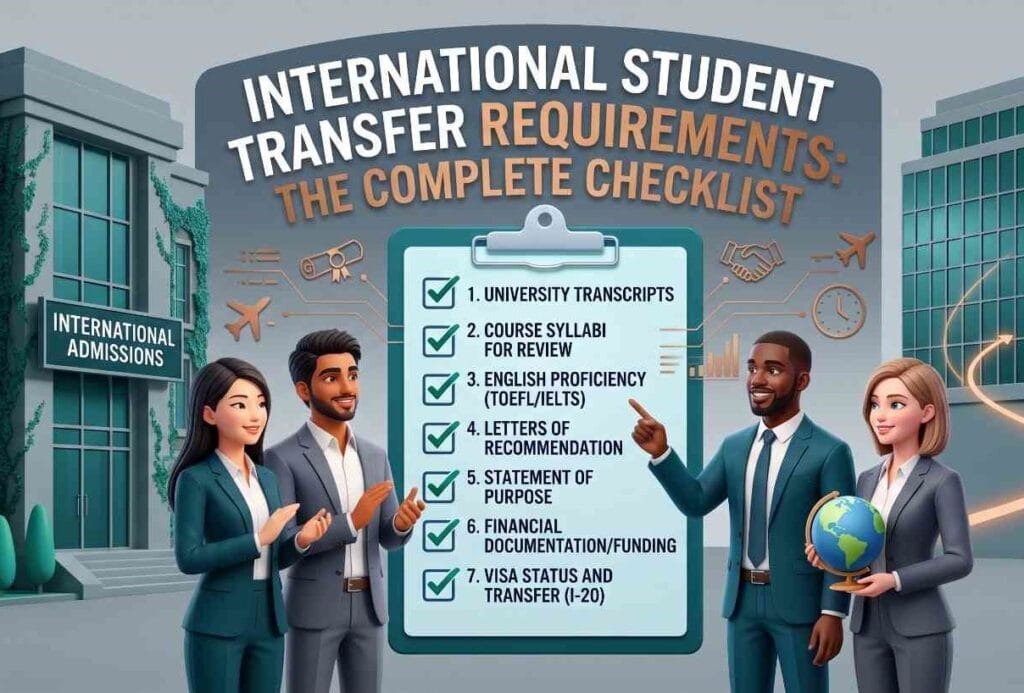
International Student Transfer Requirements: The Complete Checklist
Yale’s transfer application requirements for international students go beyond what a domestic applicant submits. Understanding these requirements in full is the first step toward submitting a competitive application — regardless of what the Yale university transfer acceptance rate looks like in any given year.
Academic Documentation
- College Official’s Report: A report completed by your Dean of Students or equivalent academic official at your current institution. This is not a letter of recommendation — it is an official institutional evaluation of your standing, conduct, and eligibility to return. Many international applicants underestimate this document. Yale admissions officers read it carefully. If your institution does not have a Dean of Students, contact Yale’s transfer admissions office early to clarify the correct institutional contact.
- Mid-Term Academic Report: A grade report from your current semester, submitted by your institution. This is required even if your current semester is not yet complete at the time of the March 1st application deadline. It demonstrates your current academic trajectory and signals whether your performance has been consistent or is trending upward.
- Official Transcripts: Full transcripts from every post-secondary institution you have attended, with certified English translations if the originals are not in English. Notarized translations are preferred.
- Course Syllabi: For every course you wish to have evaluated for credit transfer, you must submit the original syllabus. This applies specifically to courses taught outside the US system.
- Two Academic Recommendations: Both must come from professors who have taught you at the university level — not from high school teachers, not from professional mentors. Yale is specific about this. At least one recommendation should be from a professor in your intended field of study at Yale.
English Proficiency Requirements
Yale requires proof of English proficiency from all applicants whose first language is not English and who have not completed at least three years of full-time study in English-medium institutions. The accepted tests and competitive score benchmarks are as follows.
- TOEFL iBT: Yale does not publish a strict minimum, but competitive applicants consistently score 100 or above. A score of 110+ is strong. Register at ets.org/toefl.
- IELTS Academic: A band score of 7.0 or above overall, with no individual band below 6.5, is the competitive benchmark. Band scores of 7.5+ are considerably stronger. See ielts.org for test locations and dates.
- Duolingo English Test: Yale now accepts the Duolingo English Test. A score of 120 or above is competitive. Visit englishtest.duolingo.com for details.
One important note for students at English-medium universities in countries like India, Nigeria, Pakistan, Singapore, or South Africa: you may be eligible for a waiver of the English proficiency requirement if your entire university instruction has been in English. Contact Yale’s undergraduate admissions office directly to confirm waiver eligibility before you invest time and money in an additional standardized test.
The Transfer Essays: Where International Applicants Win or Lose
Yale’s transfer application includes the Common App transfer essay plus Yale-specific short answer questions. The transfer essay prompt asks why you are transferring and why you want to transfer specifically to Yale. For international applicants, this essay carries enormous weight — it is your opportunity to explain the academic gap between what your current institution offers and what Yale uniquely provides.
The strongest transfer essays from international applicants do three things. First, they name specific Yale resources — a particular seminar, a research lab, a professor’s ongoing project, a residential college community — that are genuinely unavailable at the applicant’s current institution. Second, they demonstrate that the applicant has thrived academically in their current environment, not that they are escaping a bad situation. Third, they articulate a clear intellectual trajectory that requires Yale specifically to fulfill.
A generic essay about “Yale’s prestige” or “world-class faculty” will not move the needle. An essay that references a specific professor’s ongoing research, explains how your prior academic work prepares you to contribute to it, and articulates why a specific Yale program is the next step in your development — that essay gets read twice.
Need-Blind Financial Aid for International Transfer Students: Yale’s Global Commitment
This section matters more than almost anything else in this guide for students applying from outside the United States — and it is one of the most powerful arguments for applying despite the low Yale university transfer acceptance rate. Yale University is one of a tiny number of American universities — fewer than seven — that is completely need-blind in its admissions process for all students, including international students, including transfer students. Your financial need has absolutely no impact on your probability of admission.
Beyond need-blind admissions, Yale meets 100% of demonstrated financial need for every admitted student, every year, for all four years of enrollment. There are no merit scholarships at Yale — the university does not offer aid based on academic achievement, athletic performance, or any other non-need criterion. Every dollar of Yale financial aid is needs-based, and every admitted student who demonstrates financial need receives a grant package covering the full gap between what their family can contribute and what Yale costs.
For international transfer applicants, this is transformative. A student admitted from a middle-income family in Indonesia, Ghana, or Jordan who demonstrates financial need can expect a Yale grant package that makes their total cost of attendance comparable to — or lower than — what they are currently paying at their home institution. Yale’s financial aid office uses its own need assessment formula for international applicants, which accounts for the purchasing power and income norms of the student’s home country.
The key requirement: You must submit the CSS Profile, the Yale Financial Aid application, and your family’s most recent tax documentation by the application deadline. Missing the financial aid deadline means missing the aid package entirely — Yale does not process late financial aid applications for transfer students.
For students currently on financial aid at their home institution, Yale’s Office of Undergraduate Financial Aid will work with you to coordinate any scholarship or government funding you are receiving. Contact them directly at the point of application to understand how your current funding interacts with Yale’s aid package.

Your Action Plan: Three Things to Do Before the March 1st Deadline
The Yale university transfer acceptance rate is low, but low acceptance rates do not mean random outcomes. The students who get in are almost always the ones who started preparing earliest and built the most deliberate application. Here is what to do right now, regardless of when your intended transfer year is.
1. Build Your Academic Case Starting This Semester
Your current semester’s grades matter as much as your cumulative GPA. Yale receives your mid-term report as part of the application — it is a real-time snapshot of your academic performance at the moment you are asking to join Yale’s student body. A strong upward trajectory is viewed positively. A declining trajectory, even from a high baseline, raises questions.
Beyond grades: pursue research, independent study, or substantive projects in your field this year. Yale wants transfer students who are already operating at a high academic level — not students who plan to start doing serious intellectual work once they arrive at Yale. If your university offers undergraduate research opportunities, publication, or conference participation, pursue them actively this semester.
2. Start Your Syllabus Collection and Credit Evaluation Research Now
Contact your university’s academic registry today and request official copies of the syllabi for every course you have completed. Do not wait until you have been admitted — the syllabus collection process for international students can take weeks, particularly if courses were taught by visiting faculty or if your institution has changed its course documentation systems.
Simultaneously, use the Yale course catalog to identify which Yale courses your completed coursework might satisfy. This research helps you understand how many Yale credits you will realistically need to complete, and gives you specific named courses to reference in your transfer essay. For international students planning to fund their education with external scholarships or loans alongside Yale aid, read our guide on education loans for studying abroad to understand your full funding picture.
3. Draft Your “Why Yale” Essay with Surgical Specificity
Open the Yale course catalog, the Yale faculty directory, and the Yale undergraduate research opportunities page. Spend two hours going deep — not browsing, but genuinely researching. Find three to five specific things at Yale that directly connect to your intellectual interests and that do not exist in the same form at your current institution.
Write one paragraph about each one. Then build your transfer essay around this research. The goal is an essay that could only have been written by you — because it is built on the intersection of your specific academic background and Yale’s specific resources. Generic essays about Yale’s “community” or “intellectual environment” fail because they could have been written by anyone. Specific essays about Yale’s School of the Environment, the Jackson School of Global Affairs, the Cowles Foundation, or a specific professor’s published research succeed because they demonstrate genuine preparation.
The Yale university transfer acceptance rate is brutally selective. But the students sitting in Yale classrooms right now who transferred in from universities in Johannesburg, Mumbai, Beijing, and Beirut got there through exactly this kind of preparation. The Yale transfer acceptance rate rewards the prepared. The deadline is March 1st. The work starts today.
Disclaimer: Acceptance rate figures are based on publicly available Common Data Set reports and institutional announcements. All admissions requirements should be verified directly with Yale’s Office of Undergraduate Admissions, as policies may be updated between application cycles.