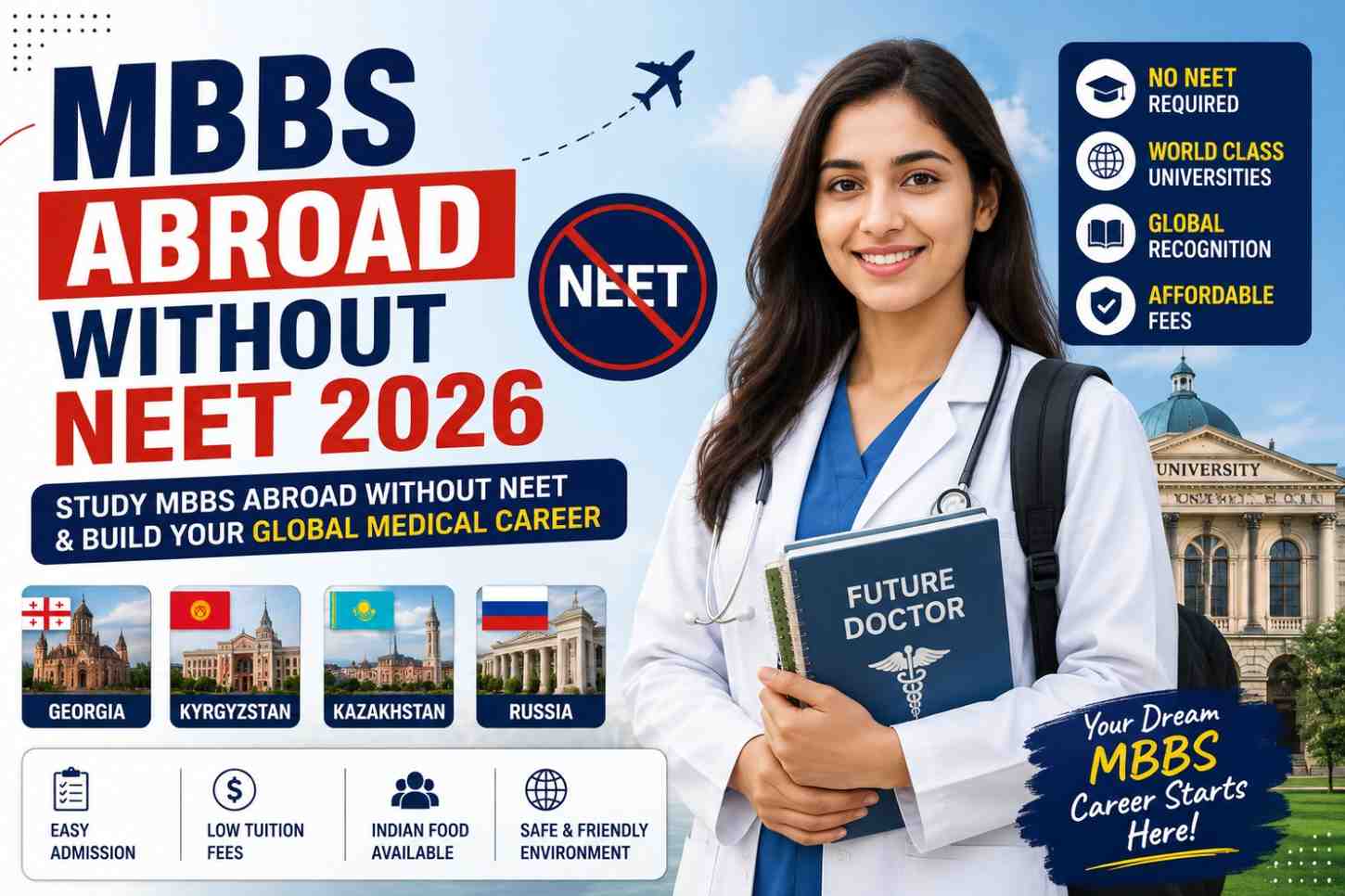
You worked hard. You scored well in Biology, Chemistry, and Physics. But NEET — that one exam — stood between you and your dream of becoming a doctor. It’s one of the most frustrating situations a medical aspirant can face, and thousands of Pakistani and Indian students deal with it every single year.
Here’s what most students don’t realise: NEET is a requirement for medical admissions in India. It is not a global requirement. Dozens of countries have their own medical education systems that don’t require NEET at all — and many of them offer fully WHO-recognised MBBS degrees at a fraction of what private medical colleges charge at home.
This guide covers everything you need to know about MBBS abroad without NEET in 2026 — the best countries, the real costs, the eligibility rules, what PMDC and NMC say about foreign degrees, and how to avoid the mistakes that derail students every year.
🌍 Can You Do MBBS Abroad Without NEET?
Yes — absolutely. NEET is a national entrance examination mandated by the National Medical Commission (NMC) of India for admission to medical colleges within India. It is not required by foreign universities. Countries like China, Russia, Bangladesh, the Philippines, Kazakhstan, Kyrgyzstan, and Ukraine have their own admission criteria — and none of them ask for NEET scores.
For Pakistani students, the Pakistan Medical and Dental Council (PMDC) has its own set of requirements for students pursuing MBBS abroad — but NEET is not among them. What matters for Pakistani students is that the foreign university is recognised by PMDC and that the student clears the PMDC screening test upon return.
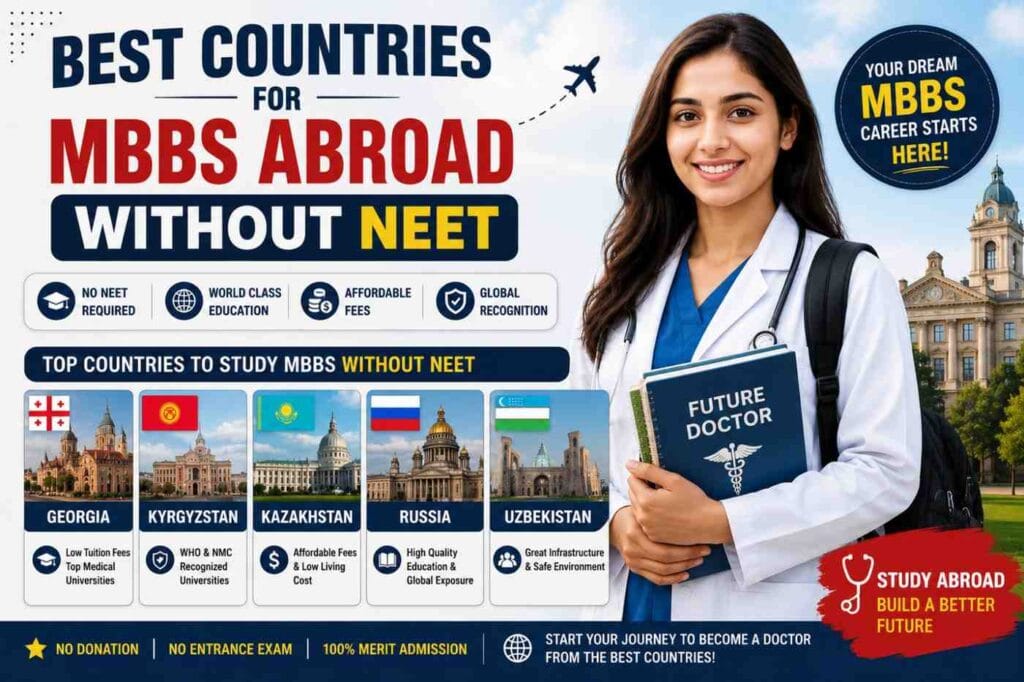
🏆 Best Countries for MBBS Abroad Without NEET in 2026
Not all countries are equal when it comes to MBBS abroad. Recognition status, quality of clinical training, language of instruction, and post-graduation opportunities all vary significantly. Here are the most popular and credible options for Pakistani and Indian students in 2026.
🇨🇳 1. China — The Most Popular Destination
China remains the number one destination for South Asian students pursuing MBBS abroad without NEET. With over 45 Chinese medical universities approved by the NMC (India) and recognised by PMDC (Pakistan), the combination of affordable fees, English-medium instruction, and strong clinical exposure makes it a genuinely strong option.
Top universities: China Medical University (Shenyang), Jilin University, Wuhan University, Dalian Medical University, Huazhong University of Science and Technology.
One important thing to check: not all Chinese medical universities are on the approved list. Always verify that your chosen institution appears on the NMC’s approved list (for Indian students) or the PMDC recognised list (for Pakistani students) before applying.
🇷🇺 2. Russia — European Standard, Asian Fees
Russia is one of the oldest and most established destinations for MBBS abroad. Russian medical degrees have been recognised globally for decades, and the country’s medical universities are known for strong theoretical training and modern simulation labs.
Top universities: First Moscow State Medical University (Sechenov), Kazan Federal University, Saint Petersburg State Medical University, Russian Peoples’ Friendship University (RUDN), Bashkir State Medical University.
Note: The ongoing geopolitical situation (Russia-Ukraine conflict) has created some complications for students from certain countries regarding banking, remittances, and travel. Verify the current situation before committing to Russia in 2026.
🇧🇩 3. Bangladesh — Closest, Most Affordable
Bangladesh is the most geographically and culturally close option for both Pakistani and Indian students. The medium of instruction is English, living costs are among the lowest of any MBBS abroad destination, and the clinical training in Bangladesh’s large public hospitals is considered quite strong.
Top universities: Dhaka Medical College, Sir Salimullah Medical College, Shaheed Suhrawardy Medical College, Chittagong Medical College, Rajshahi Medical College.
🇵🇭 4. Philippines — English Medium, US-Style Curriculum
The Philippines is one of the few countries where medical education follows a US-style curriculum — which makes FMGE/USMLE preparation significantly easier for students planning to practise in India or eventually target the USA. English is the official language of instruction, and the clinical training in Philippine hospitals is considered among the best in Asia.
Top universities: University of Santo Tomas (UST), University of the Philippines Manila, Cebu Institute of Medicine, AMA School of Medicine, Our Lady of Fatima University.
🇰🇿 5. Kazakhstan — Emerging & Affordable
Kazakhstan has emerged as a strong MBBS abroad destination over the last five years. Its universities offer English-medium programmes, modern campuses, and lower fees than China or Russia. The country is politically stable, Muslim-majority (which matters for halal food and lifestyle considerations), and visa-friendly for South Asian students.
Top universities: Kazakh National Medical University (KazNMU), Astana Medical University, South Kazakhstan Medical Academy, Semey Medical University.
🇰🇬 6. Kyrgyzstan — Budget-Friendly Option
Kyrgyzstan is the most budget-friendly MBBS abroad destination available to South Asian students. It’s especially popular among students from Pakistan’s smaller cities who need an affordable, PMDC-recognised pathway into medicine. The lifestyle is simple, the country is safe, and the fees are among the lowest globally.
Top universities: International School of Medicine (ISM Bishkek), Osh State University Medical Faculty, Kyrgyz State Medical Academy, Asian Medical Institute.
📊 Country Comparison Table — MBBS Abroad Without NEET 2026
| 🌍 Country | Duration | Annual Fees (USD) | Medium | NMC ✅ | PMDC ✅ | NEET Needed |
|---|---|---|---|---|---|---|
| 🇨🇳 China | 6 yrs | $3,500–$6,000 | English | ✅ | ✅ | No |
| 🇷🇺 Russia | 6 yrs | $4,000–$8,000 | English | ✅ | ✅ | No |
| 🇧🇩 Bangladesh | 5+1 yrs | $3,000–$5,000 | English | ✅ | ✅ | No |
| 🇵🇭 Philippines | 5.5 yrs | $4,000–$7,000 | English | ✅ | ⚠️ Check | No |
| 🇰🇿 Kazakhstan | 6 yrs | $3,500–$5,500 | English | ✅ | ✅ | No |
| 🇰🇬 Kyrgyzstan | 6 yrs | $2,500–$4,500 | English | ⚠️ Some | ✅ | No |
| 🇬🇪 Georgia | 6 yrs | $4,000–$7,000 | English | ✅ | ⚠️ Check | No |
📋 Eligibility Requirements for MBBS Abroad Without NEET
While NEET is not required, every country has its own eligibility criteria. Here are the standard requirements that apply across most destinations.
For Pakistani Students
- FSc Pre-Medical (Part I and Part II) or A-Levels equivalent with Biology, Chemistry, and Physics
- Minimum 60% aggregate in Physics, Chemistry, and Biology combined
- MDCAT score — Pakistan’s own medical entrance test — is required for PMDC registration purposes upon return, but not for admission abroad itself
- Age: Typically 17 to 25 years at the time of admission
- Valid Pakistani passport
- NOC (No Objection Certificate) from PMDC — required before departure for PMDC-regulated institutions
For Indian Students
- 10+2 / Class 12 with Physics, Chemistry, and Biology as core subjects
- Minimum 50% aggregate in PCB (60% for reserved categories varies)
- Minimum age: 17 years at the time of admission
- Valid Indian passport
- NMC eligibility certificate — required after graduation to appear in FMGE
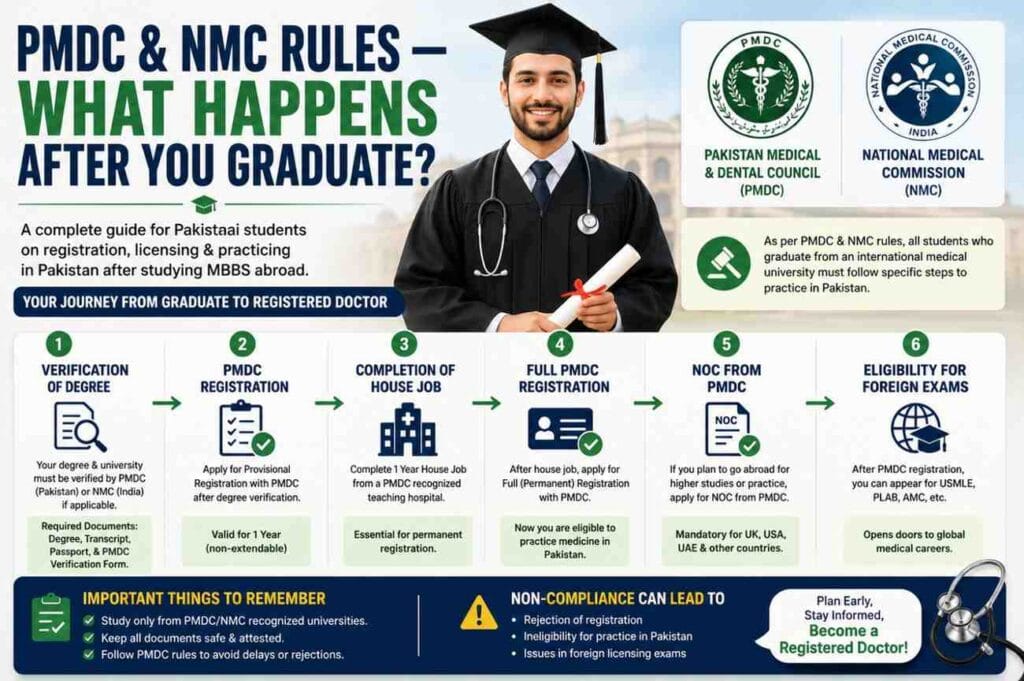
🏥 PMDC & NMC Rules — What Happens After You Graduate?
This is the section most students skip — and it’s the most important one. Getting your MBBS degree abroad is only half the journey. What happens when you come back home determines whether that degree actually translates into a career.
For Pakistani Students — PMDC Screening Test
After completing your MBBS from a PMDC-recognised foreign university, you must clear the PMDC Screening Examination to register as a medical practitioner in Pakistan. This is a written examination covering all the core subjects of your MBBS programme.
The PMDC screening test is offered twice a year. The pass rate varies, but students who maintain strong academic performance throughout their foreign degree and prepare specifically for the screening exam generally perform well. It is not an impossible exam — but it requires dedicated preparation of at least 3 to 6 months post-graduation.
For Indian Students — FMGE / NMC Screening Test
Indian students who complete MBBS abroad must clear the Foreign Medical Graduate Examination (FMGE), now referred to as the NMC Screening Test. This is a computer-based examination of 300 MCQs covering all major medical subjects.
The FMGE pass rate has historically been around 15–20% — which is low. However, this number is heavily skewed by students who were inadequately prepared or who graduated from low-quality institutions. Students from top-ranked universities in China, Russia, and the Philippines who prepare specifically for FMGE consistently achieve pass rates above 60–70%.
💰 Total Cost of MBBS Abroad Without NEET Realistic Budget
Fees listed by universities are often just tuition. The real cost includes accommodation, food, health insurance, travel, visa fees, and incidentals. Here is an honest total cost breakdown for the most popular countries.
| Country | Annual Tuition | Annual Living Cost | Total Per Year | Full Course Total |
|---|---|---|---|---|
| 🇨🇳 China | $3,500–$6,000 | $2,000–$3,500 | $5,500–$9,500 | $33,000–$57,000 |
| 🇷🇺 Russia | $4,000–$8,000 | $2,500–$4,000 | $6,500–$12,000 | $39,000–$72,000 |
| 🇧🇩 Bangladesh | $3,000–$5,000 | $1,500–$2,500 | $4,500–$7,500 | $27,000–$45,000 |
| 🇰🇿 Kazakhstan | $3,500–$5,500 | $2,000–$3,000 | $5,500–$8,500 | $33,000–$51,000 |
| 🇰🇬 Kyrgyzstan | $2,500–$4,500 | $1,500–$2,500 | $4,000–$7,000 | $24,000–$42,000 |
✅ Pros & Cons of MBBS Abroad Without NEET
| ✅ Advantages | ❌ Challenges |
|---|---|
| No NEET required — admission based on FSc/12th marks only | Must clear PMDC/FMGE screening test to practise at home |
| Significantly cheaper than private medical colleges in Pakistan/India | Risk of fake/unrecognised universities — agents can mislead |
| WHO-recognised degrees from established universities | Language barrier in clinical years (some countries) |
| International clinical exposure and diverse patient cases | Distance from family for 5–6 years is challenging |
| Pathways to practise in multiple countries after graduation | Living abroad requires adaptation — weather, food, culture |
| Application process is faster — decisions in 2–4 weeks | Currency fluctuation can affect total cost unpredictably |
📝 Step-by-Step Admission Process for MBBS Abroad Without NEET
🚨 Common Mistakes to Avoid
Agents lie. Students have paid full fees to unrecognised universities and spent 6 years on a degree that couldn’t be registered. Verify on the official NMC/PMDC website yourself — every time.
Pakistani students who leave without PMDC NOC find their degree unregistrable upon return. This is non-negotiable. Don’t board the plane without it.
Many students treat the PMDC/FMGE screening as an afterthought. Start preparing for it from your 4th year onwards — not after graduation. It’s a comprehensive exam and failing it delays your career by months.
Tuition is only part of the bill. Budget realistically for living costs, annual flights home, health insurance, books, and equipment. Underfunded students struggle academically and personally.
❓ Frequently Asked Questions
Is MBBS abroad without NEET valid in Pakistan?
Yes provided the university is on PMDC’s approved list, you obtained a PMDC NOC before departing, and you clear the PMDC Screening Examination after graduation. The degree itself is valid the screening test is the final gateway to registration.
Which is the best country for MBBS without NEET?
China is the most popular choice due to the combination of affordable fees, English medium instruction, WHO recognition, and NMC/PMDC approval. Kazakhstan is a rising alternative for students who prefer a Muslim majority environment. The Philippines is strongest for students planning to eventually attempt USMLE or FMGE given its US style curriculum.
Can I practise medicine in Pakistan after MBBS from China?
Yes if your Chinese university is PMDC-recognised, you obtained your NOC before leaving, and you clear the PMDC Screening Examination after graduation. Thousands of Pakistani doctors practise today with Chinese MBBS degrees.
What is the minimum percentage required for MBBS abroad without NEET?
Most countries require a minimum of 50% to 60% aggregate in Physics, Chemistry, and Biology at FSc/12th grade level. China and Bangladesh typically require 60%+. Russia, Kazakhstan, and Kyrgyzstan generally accept 50%+ for most universities.
How do I verify if a university is PMDC-recognised?
Visit the PMDC official website and check their published list of recognised foreign medical institutions. The list is updated periodically. Do not rely on agents or third-party websites — always check the primary source directly.
Is MBBS from Kyrgyzstan recognised in Pakistan?
Yes — for certain universities. PMDC has recognised several Kyrgyz medical universities. Always verify the specific university (not just the country) on PMDC’s list before applying, as not all Kyrgyz institutions are approved.
What is the FMGE pass rate for Indian students from China?
The overall FMGE pass rate is around 15–20% nationally, but this includes students from unrecognised or low-quality institutions. Students from top NMC-approved Chinese universities who prepare specifically for FMGE report pass rates significantly higher often 50–70%+. University quality and personal preparation are the two biggest factors.
Planning to fund your MBBS abroad? Our detailed guide on education loans for studying abroad covers how to structure your loan application for a medical degree including documentation requirements and bank options available to Pakistani students. And if you’re weighing multiple countries, our complete study abroad guide for Pakistani students covers the full picture from visa to budgeting.
Disclaimer: University recognition lists and regulatory requirements change periodically. All information in this article is accurate as of August 2026. Always verify current recognition status on the official PMDC and NMC websites before applying to any foreign medical institution.