You’ve got an offer letter from a university in the US, UK, Canada, or Australia. You want an SBI education loan to fund it. The first thing you search for is the SBI education loan abroad university list — and then you spend the next hour clicking through the SBI website, finding nothing useful, and ending up more confused than when you started.
That’s a frustrating experience. And it happens to thousands of Indian students every year.
Here’s the honest answer upfront: SBI does not maintain one publicly downloadable, exhaustive list of approved foreign universities the way some students expect. What they do have is a set of criteria that determines whether your specific university and course qualifies for their abroad education loan schemes. Once you understand those criteria, you can figure out in about ten minutes whether your institution is covered, without waiting in a branch queue for someone to check manually.
This guide covers the complete picture — the SBI education loan abroad university list framework, which countries and institutions are typically approved, both main loan schemes for abroad studies, eligibility conditions, interest rates for 2026, required documents, and how to check your specific university’s status before you apply.
Why There Is No Single SBI Education Loan Abroad University List
This is the first thing to understand clearly, because it saves you a lot of time. Unlike some private lenders that maintain pre-approved institution lists on their websites, SBI evaluates foreign university eligibility on a case-by-case basis using defined criteria. Your university doesn’t need to be on a fixed list. It needs to meet SBI’s assessment standards.
SBI considers a foreign university eligible for their education loan schemes if it meets these general conditions:
- The institution is recognised and accredited by the relevant educational authority in that country
- The course is a full-time, regular programme leading to a degree, diploma, or certificate
- The course is job-oriented — professional, technical, or applied in nature
- The institution has a track record of graduate employability
- The university is ideally ranked in a recognised global ranking system such as QS World University Rankings, Times Higher Education, or US News
In practice, this means the vast majority of accredited universities in the USA, UK, Canada, Australia, Germany, Ireland, New Zealand, and other major study destinations qualify under the SBI education loan abroad university list framework. The universities that typically don’t qualify are unaccredited institutions, diploma mills, or lesser-known private colleges with no verifiable academic standing.
📌 Quick Rule of Thumb
If your university appears in the QS World University Rankings, THE Rankings, or is accredited by a recognised body in its country (like AACSB for business schools, ABET for engineering, etc.), it almost certainly qualifies for an SBI education loan abroad. Your SBI branch will verify this during your loan application.
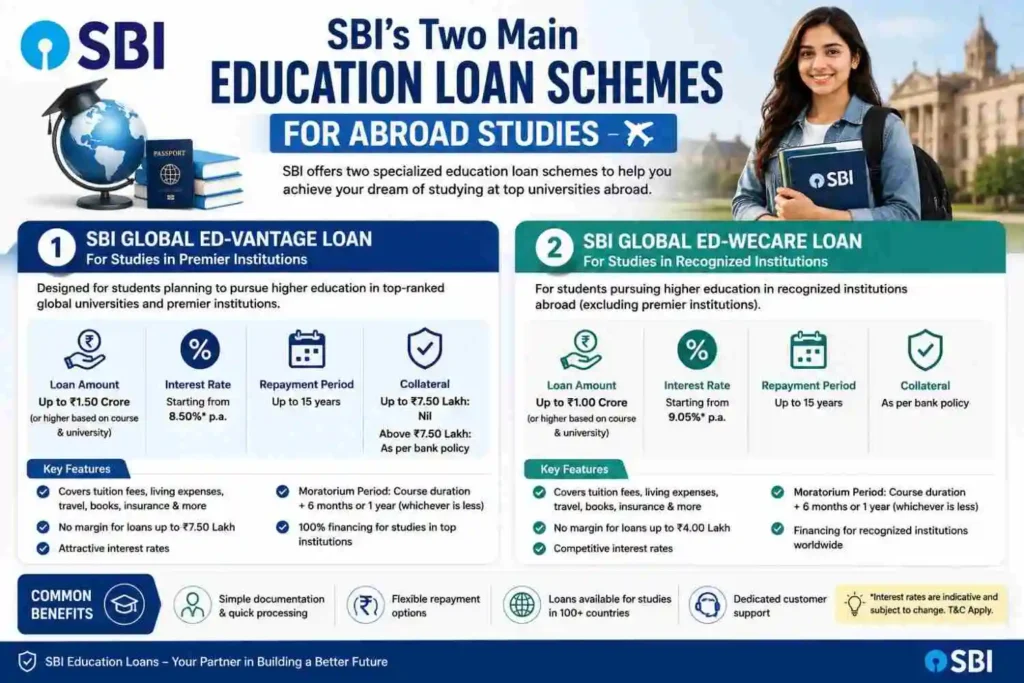
SBI’s Two Main Education Loan Schemes for Abroad Studies
Before getting into the SBI education loan abroad university list by country, you need to understand which scheme applies to your situation. SBI offers two main products for students going abroad, and the one you’re eligible for determines your loan limit, interest rate, and collateral requirement.
1. SBI Global Ed Vantage Scheme
This is SBI’s primary education loan product for students going abroad. It’s designed for Indian students taking up full-time degree or diploma courses at reputed foreign universities. Most students searching for the SBI education loan abroad university list are looking at this scheme.
| Feature | Details |
|---|---|
| Loan Amount | INR 7.5 lakh to INR 1.5 crore |
| Collateral Required | Yes tangible security required (property, FD, etc.) |
| Interest Rate (2026) | Approximately 10.65% to 11.65% per annum (floating, check SBI website for current rate) |
| Moratorium Period | Course duration + 6 months |
| Repayment Period | Up to 15 years after moratorium |
| Processing Fee | INR 10,000 + GST (refundable on disbursement) |
| Margin Money | 15% of total cost (student contributes this amount) |
| Expenses Covered | Tuition, living costs, travel, books, laptop, health insurance, examination fees |
The 15% margin money requirement is the part that catches students off guard. If your total course cost is INR 50 lakh, SBI will fund INR 42.5 lakh. The remaining INR 7.5 lakh needs to come from you or your family. This doesn’t mean you need to have it sitting in a bank account before applying, but it does need to be demonstrated during the loan process.
2. SBI Scholar Loan Scheme (For Premier Institutions)
The Scholar Loan scheme is for students getting into top-tier institutions globally. If your university is ranked in the QS Top 200 worldwide, this scheme often offers better terms including lower interest rates and sometimes no collateral requirement for smaller loan amounts.
| Feature | Details |
|---|---|
| Target Institutions | QS Top 200 global universities, premium institutions |
| Loan Amount | Up to INR 1.5 crore |
| Collateral | Waived for loans up to INR 40 lakh at select institutions |
| Interest Rate | Lower than Global Ed-Vantage — approximately 9.85% to 10.65% (verify with SBI) |
| Repayment | Up to 15 years |
If your target university falls in the QS Top 200, ask your SBI branch specifically about the Scholar Loan scheme rather than the standard Global Ed-Vantage product. The interest savings over 15 years can be significant.
SBI Education Loan Abroad University List by Country (2026)
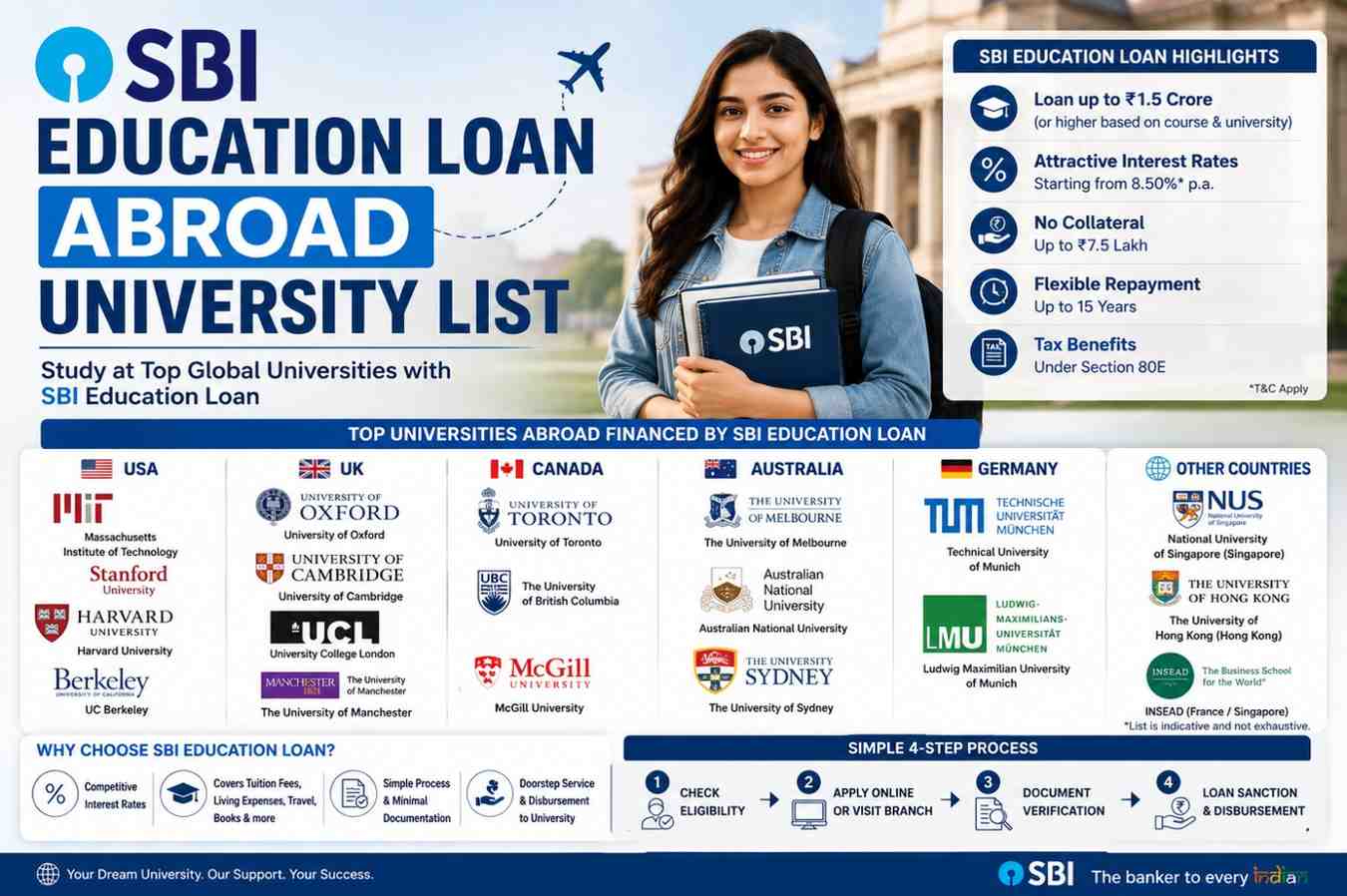
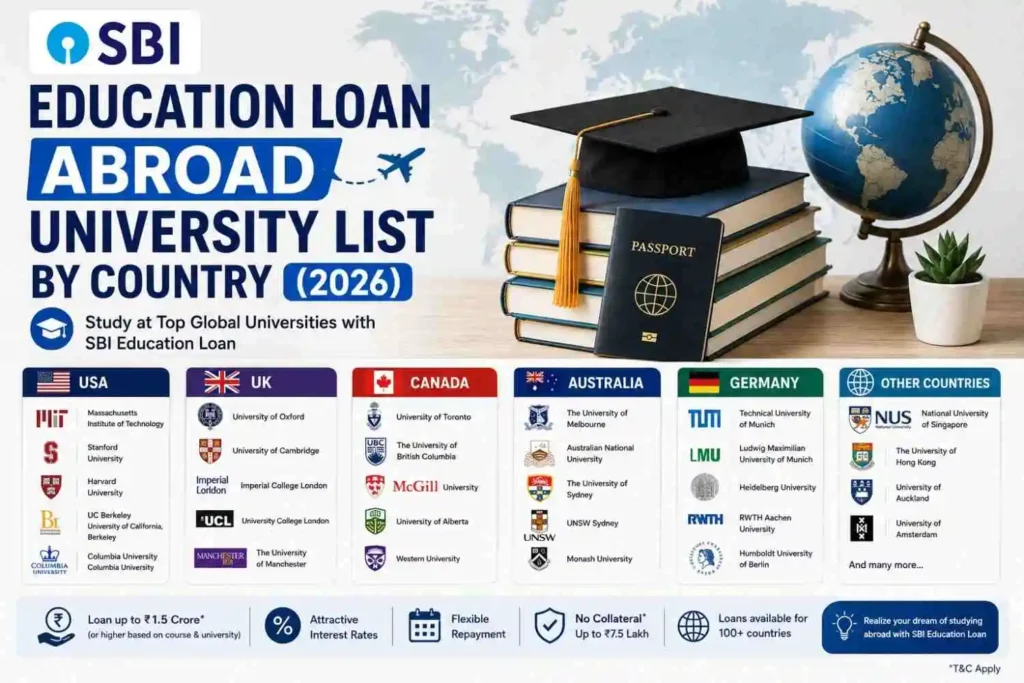
While there’s no single downloadable list, here’s a practical country-wise breakdown of what typically qualifies under the SBI education loan abroad university list framework. This is based on SBI’s general eligibility criteria applied to each destination.
United States of America
The USA has the highest number of Indian students abroad, and SBI funds education at accredited US universities regularly. Accreditation in the US comes from regional bodies — the most recognised being HLC (Higher Learning Commission), SACSCOC, WASC, and others. If your US university is regionally accredited, it qualifies.
Examples of consistently approved US institutions under the SBI education loan abroad university list criteria include universities like MIT, Stanford, Harvard, University of Texas, Purdue, Arizona State University, University of Illinois, Georgia Tech, and hundreds of other regionally accredited state and private universities. For business programmes, AACSB accreditation is an additional positive factor.
What typically doesn’t qualify: unaccredited online-only degree mills, institutions not recognised by the US Department of Education, and purely vocational certificate programmes without degree-level recognition.
United Kingdom
All UK universities listed on the UK government’s officially recognised institution register qualify for SBI education loans. In practice, this covers all Russell Group universities (Oxford, Cambridge, LSE, UCL, Imperial, Edinburgh, Manchester, King’s College, etc.) plus the hundreds of other registered universities across England, Scotland, Wales, and Northern Ireland.
UK universities are straightforward for SBI because they’re all government-regulated. If your UK university can issue a CAS (Confirmation of Acceptance for Studies) for a student visa, it’s a recognised institution and qualifies for SBI loans.
Canada
Canadian universities and colleges on the IRCC’s Designated Learning Institutions (DLI) list qualify under the SBI education loan abroad university list framework. This covers all major universities including University of Toronto, UBC, McGill, University of Waterloo, York University, and hundreds of other DLI-registered institutions.
One point to watch: some smaller private colleges in Canada that are DLI-registered for visa purposes may not meet SBI’s additional criteria around institutional reputation and graduate employability. University-level institutions and well-established public colleges are consistently approved. For lesser-known private colleges, it’s worth confirming with your SBI branch before paying any fees.
Australia
Australian universities registered on the CRICOS (Commonwealth Register of Institutions and Courses for Overseas Students) list qualify for SBI education loans. The Group of Eight universities — Australian National University, University of Melbourne, University of Sydney, University of Queensland, Monash University, UNSW Sydney, University of Adelaide, and University of Western Australia — are consistently approved with no issues.
TAFE and vocational education institutions (VET sector) are generally approved for diploma and certificate courses, but the loan amounts may differ from degree-level funding. Confirm the specific course type with your branch before applying.
Germany
German public universities are state-funded, free or near-free for tuition, and internationally respected. SBI approves loans for German public universities for living costs and other course-related expenses even when tuition is minimal. Technische Universität München (TUM), RWTH Aachen, Heidelberg University, and other well-ranked German institutions are consistently on the approved side of the SBI education loan abroad university list criteria.
For Germany, the loan is typically used to cover the blocked account requirement (currently €11,904 per year for a student visa), health insurance, and living expenses rather than tuition. SBI’s Global Ed-Vantage scheme covers these expenses.
Ireland, New Zealand, France, Singapore, and Other Destinations
SBI funds education at reputed institutions in Ireland (University College Dublin, Trinity College Dublin, University of Galway), New Zealand (University of Auckland, Victoria University), France (top Grandes Écoles, Sciences Po, INSEAD), Singapore (NUS, NTU), and several other countries where Indian students regularly study. The same framework applies: accredited, recognised, full-time, job-oriented.
How to Check If Your Specific University Is on the SBI Education Loan Approved List
Here’s the practical step-by-step for verifying whether your university qualifies, without wasting time waiting for a branch manager to check manually.
- Check your university’s accreditation status. Go to your university’s official website and look for their accreditation information. In the US, look for regional accreditation by HLC, SACSCOC, WASC, or similar bodies. In the UK, check if they’re on the UKRI or OfS register. In Canada, check the DLI list. In Australia, check CRICOS. If the institution is accredited or registered with the relevant national body, it’s very likely to qualify.
- Check QS or THE Rankings. Universities ranked in QS Top 1000 are almost always approved. Those in QS Top 200 may qualify for the Scholar Loan scheme with better terms.
- Call SBI’s education loan helpline. SBI has a dedicated education loan centre. Call 1800-11-2018 (toll-free) and ask specifically whether your university and course qualifies for the Global Ed-Vantage scheme. Have your university name, country, course name, and duration ready.
- Visit the nearest SBI branch with your offer letter. Bring your offer letter or admission letter to your nearest SBI branch and ask the loans officer to verify eligibility on the spot. This takes about 15 minutes and gives you a definitive answer without submitting a full application.
- Check the SBI official education loan page. The SBI Global Ed-Vantage scheme page on their official website lists the general eligibility criteria and covered expense categories. It confirms the framework even if it doesn’t list every university by name.
SBI Education Loan Abroad Eligibility Criteria
Knowing the SBI education loan abroad university list framework is only part of the picture. You also need to meet the personal eligibility criteria to qualify for the loan itself.
- Nationality: Indian national
- Age: No fixed upper age limit, but most applicants are between 18 and 35 years old
- Admission: Must have secured confirmed admission to a recognised foreign university for a full-time course
- Academic record: Should have a reasonably consistent academic record — no specific minimum percentage, but significant gaps or failures may require explanation
- Co-applicant: A parent, spouse, or other family member must be a co-applicant/guarantor. This is mandatory for the Global Ed-Vantage scheme.
- Collateral: For loans above INR 7.5 lakh under Global Ed-Vantage, tangible collateral is required — typically immovable property, government securities, fixed deposits, or NSC/KVP
⚠ About the Co-applicant: SBI requires a co-applicant for all education loans above a certain threshold. The co-applicant’s income, CIBIL score, and financial standing directly affect your loan approval chances and the interest rate offered. A co-applicant with a clean credit history and stable income makes the whole process significantly smoother. For more on how to structure your financial documents alongside the loan for a visa application, our guide on education loans without collateral or co-applicant for studying abroad covers alternative options if this is a constraint.
Documents Required for SBI Education Loan Abroad
Gathering these documents in advance saves significant time during the application process. SBI branch officers can be slow in their response if documents are submitted piecemeal rather than as a complete package.
Student Documents
- Completed SBI education loan application form
- Passport size photographs (2 to 4 copies)
- Passport (copy of all pages)
- Admission/offer letter from the foreign university confirming the course, duration, and annual fees
- Mark sheets and certificates of Class 10, Class 12, graduation (if applicable), and any entrance test scores
- GRE, GMAT, IELTS, TOEFL, or other test score cards (whichever required by the university)
- Proof of address (Aadhar card, voter ID, utility bills)
- Statement of expenses — total cost breakdown including tuition, accommodation, living costs, travel, and insurance
Co-applicant / Guarantor Documents
- PAN card
- Aadhar card / proof of address
- Last 6 months’ bank statements
- Latest salary slips (last 3 months) for salaried co-applicants
- Last 2 years’ ITR with computation for self-employed or business owner co-applicants
- Form 16 (for salaried co-applicants)
- Relationship proof with the student (birth certificate, marriage certificate as applicable)
Collateral Documents (For Loans Above INR 7.5 Lakh)
- Title deeds of property being offered as collateral
- Property valuation certificate from SBI-empanelled valuer
- For FD as collateral: FD receipt and a lien letter
- Encumbrance certificate (for property collateral)
- Latest tax receipts for the property
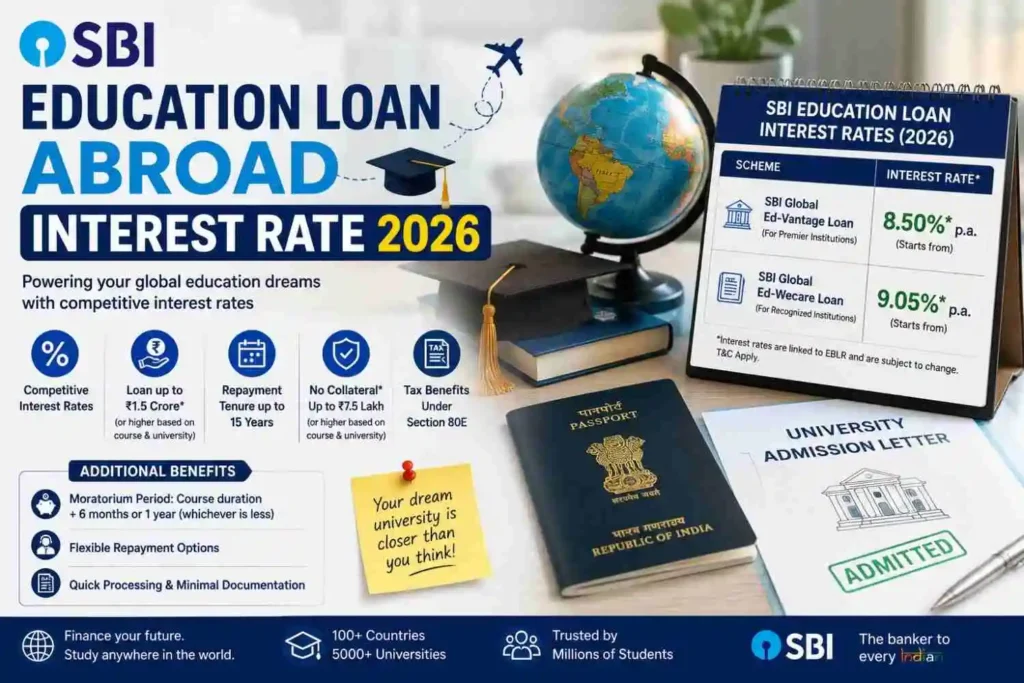
SBI Education Loan Abroad Interest Rate 2026
SBI’s education loan interest rates are floating rates linked to the repo rate. They change when RBI adjusts its policy rates, so the figures below are approximate benchmarks for 2026. Always verify the current applicable rate with your SBI branch or on the SBI official education loans page at the time of application.
| Scheme | Loan Amount | Approx. Interest Rate (2026) | Concession Available |
|---|---|---|---|
| SBI Global Ed-Vantage | INR 7.5 lakh to INR 1.5 crore | 10.65% to 11.15% p.a. | 0.50% for female students |
| SBI Scholar Loan (QS Top 200) | Up to INR 1.5 crore | 9.85% to 10.65% p.a. | 0.50% for female students |
| Simple Interest During Moratorium | All schemes | If paid monthly during course, reduces total outgo significantly | Concession on interest rate if SI paid during study period |
One thing many students miss: if you pay the simple interest that accrues during your course duration and moratorium period (rather than letting it compound into the principal), SBI typically offers an additional interest rate concession. Over a 15-year repayment period, this concession makes a meaningful difference to your total repayment amount. Ask your branch officer about this option when you apply.
What Expenses Does SBI Education Loan for Abroad Cover?
Students sometimes assume an SBI education loan only covers tuition. It covers significantly more than that, and knowing the full scope helps you calculate the right loan amount to request.
- Tuition fees payable to the institution (semester by semester as billed)
- Hostel or accommodation fees (on-campus or reasonable off-campus rent)
- Examination fees, library fees, and other mandatory institutional charges
- Travel expenses — one return economy class airfare to the country of study
- Purchase of books, equipment, instruments, and uniforms required for the course
- Purchase of a computer or laptop if required for the course (reasonable cost)
- Health insurance or overseas student health cover premium
- Study tours and project work expenses as required by the institution
- Caution deposit, building fund, or refundable deposits required by the institution
Living costs beyond institutional accommodation are covered up to a reasonable amount. SBI typically uses the institution’s own estimated cost of attendance figures as the basis for calculating the loan amount, which is why having a detailed cost breakdown from your university’s official fee schedule is helpful during the application.
Step-by-Step: How to Apply for SBI Education Loan for Abroad Studies
- Confirm your admission. You need a confirmed offer letter or admission letter before applying. Provisional offers without confirmed seats don’t work for loan applications.
- Calculate your total cost of study. Add up tuition for all years, accommodation, living expenses, travel, books, insurance, and any other mandatory costs. This is your loan requirement figure.
- Apply for pre-approval before paying fees to the university. Visit your nearest SBI branch with your offer letter, academic documents, and co-applicant’s financial documents and ask for an in-principle sanction. Getting pre-approval before paying the university’s acceptance deposit saves you from paying fees that you later can’t fund.
- Submit the complete document package. Use the checklist above. Submit everything in one go rather than piece by piece. Incomplete submissions are the most common reason for SBI loan processing delays.
- Collateral evaluation. If your loan amount requires collateral, SBI will arrange a valuation of the property or asset. This typically takes 7 to 15 working days.
- Loan sanction and agreement signing. Once approved, you’ll receive a sanction letter detailing the loan amount, interest rate, repayment schedule, and terms. Sign the loan agreement documents.
- Disbursement. SBI disburses directly to the university’s account for tuition fees. Living and other expenses are disbursed to your account in installments aligned with your academic year.
Using Your SBI Education Loan Letter for Your Visa Application
Your SBI loan sanction letter is an important document for your student visa application. For Australia, Canada, the UK, and Germany, visa officers want to see that you have genuine, documented financial support for your studies. An SBI sanction letter from a nationalised bank carries significant weight because it’s a verifiable, regulated financial commitment.
The loan sanction letter should clearly show the sanctioned amount, the purpose (course name and institution), and the terms of disbursement. For visa purposes, combine this with your family’s bank statements showing liquid funds covering the margin money (the 15% you contribute) and the first semester’s fees if not yet disbursed. Our guide on the proof of funds letter from bank explains exactly how to structure your financial evidence package for a visa application when part of your funding comes from an education loan.
Frequently Asked Questions About SBI Education Loan Abroad University List
Is there a fixed SBI education loan abroad university list I can download?
No. SBI does not publish a fixed downloadable list of approved foreign universities. Instead, they evaluate each institution against their eligibility criteria: accreditation status, course type, and institutional reputation. If your university is accredited by the relevant national authority and your course is full-time and job-oriented, it almost certainly qualifies. Confirm with your nearest SBI branch or call their education loan helpline at 1800-11-2018.
What is the maximum SBI education loan amount for abroad studies?
The maximum loan amount under the SBI Global Ed-Vantage scheme is INR 1.5 crore (approximately USD 180,000 at current exchange rates). This covers most full-cost programmes at US, UK, Australian, and Canadian universities. For programmes at exceptionally expensive institutions or for multiple years of study with high living costs, the INR 1.5 crore cap occasionally falls short. In such cases, SBI can sometimes be supplemented with a second loan from another lender, though this requires careful financial planning.
Can I get an SBI education loan without collateral for abroad studies?
For the standard SBI Global Ed-Vantage scheme, collateral is required for loans above INR 7.5 lakh. Since most abroad education costs well exceed this figure, most students need collateral. The Scholar Loan scheme for QS Top 200 institutions sometimes waives collateral for loans up to INR 40 lakh. For students who genuinely cannot arrange collateral, our guide on education loans without collateral for studying abroad covers alternative lenders including Prodigy Finance, MPOWER Financing, and Avanse, which offer collateral-free loans at competitive rates.
How long does SBI take to process an education loan for abroad?
A complete application with all documents submitted in one go typically takes 15 to 30 working days for sanction. Applications involving property collateral take longer because of the valuation and legal opinion steps. Applications at branches with high loan volumes can also take longer. Starting the application process at least 3 months before your university’s fee deadline gives you sufficient buffer. Do not wait until you receive your visa to start the loan process.
Does SBI education loan cover living expenses abroad or only tuition?
SBI’s education loan for abroad covers tuition fees, accommodation, travel, books, laptop, health insurance, and other mandatory course-related expenses. It’s not limited to tuition only. The total loan amount is calculated based on the full cost of study including living expenses, using the institution’s official cost of attendance estimate as the reference figure.
Can I get an SBI education loan if I’ve already paid my university fees?
Generally, SBI prefers to disburse directly to the institution rather than reimburse fees already paid. However, if you’ve paid from your own funds and need reimbursement, some branches do consider this case-by-case. You’d need to provide proof of payment and demonstrate that the loan is still needed for remaining course costs and living expenses. Speak directly with your SBI branch loans officer about your specific situation.
Start Early, Not When the Fee Deadline Is Three Weeks Away
The single most common mistake students make with the SBI education loan process is starting it too late. You receive your offer letter in January, your university wants a fee deposit by March, and you walk into the SBI branch in late February with no collateral documents, no co-applicant income proof, and no idea that the property valuation alone takes three weeks.
Start the moment you receive your offer letter. Verify your university’s eligibility under the SBI education loan abroad university list framework, assemble your complete document package, rope in your co-applicant, and get the collateral paperwork moving in parallel. A well-prepared application submitted in January can have a sanction in hand by mid-February, giving you clean documentation for both your university fee payment and your visa application.
For everything that comes after your loan sanction, from writing your Statement of Purpose to understanding what your visa officer looks for in your financial package, our complete study abroad resource library at StudyPathExp has you covered. The SOP guide with free templates and our country-specific visa guides for Australia and UK are good places to continue once your loan is sorted.
Disclaimer: Interest rates, loan amounts, eligibility criteria, and scheme details for SBI education loans are updated periodically by State Bank of India. All figures in this article are based on publicly available information as of August 2026 and are approximate. Always verify current rates, terms, and conditions with your nearest SBI branch or on the official SBI website before applying. This article is for general informational purposes and does not constitute financial or legal advice.