The Decision That Could Cost You Months of Preparation
The PTE vs IELTS debate hits almost every South Asian student’s desk at some point — usually late at night, a few weeks before applications close, with seven browser tabs open and a deepening sense of overwhelm. Both tests measure English proficiency. Both are accepted by thousands of universities and immigration departments worldwide. And both will cost you money, time, and real nerve. But they are not the same test — not even close — and choosing the wrong one for your profile can mean weeks of wasted preparation, a score that doesn’t reflect your actual ability, or a visa rejection that had nothing to do with your English.
The honest truth about PTE vs IELTS is that neither test is objectively better or universally easier. What actually matters is which test plays to your specific strengths — and that depends on how you speak, how you write, how well you perform under a machine-graded format versus a human-examined one, and which country you’re planning to study or migrate to. This guide covers all of it: the structural differences, the section-by-section difficulty breakdown, a complete score mapping table, country-specific guidance for the UK, Australia, Canada and the USA, an honest pros and cons comparison, and a self-assessment framework you can use right now to make the call.
By the time you finish reading, you’ll know exactly where you stand in the PTE vs IELTS decision — and you’ll have a clear preparation direction rather than another browser tab adding to the confusion.
PTE vs IELTS: What Is the Main Structural Difference?
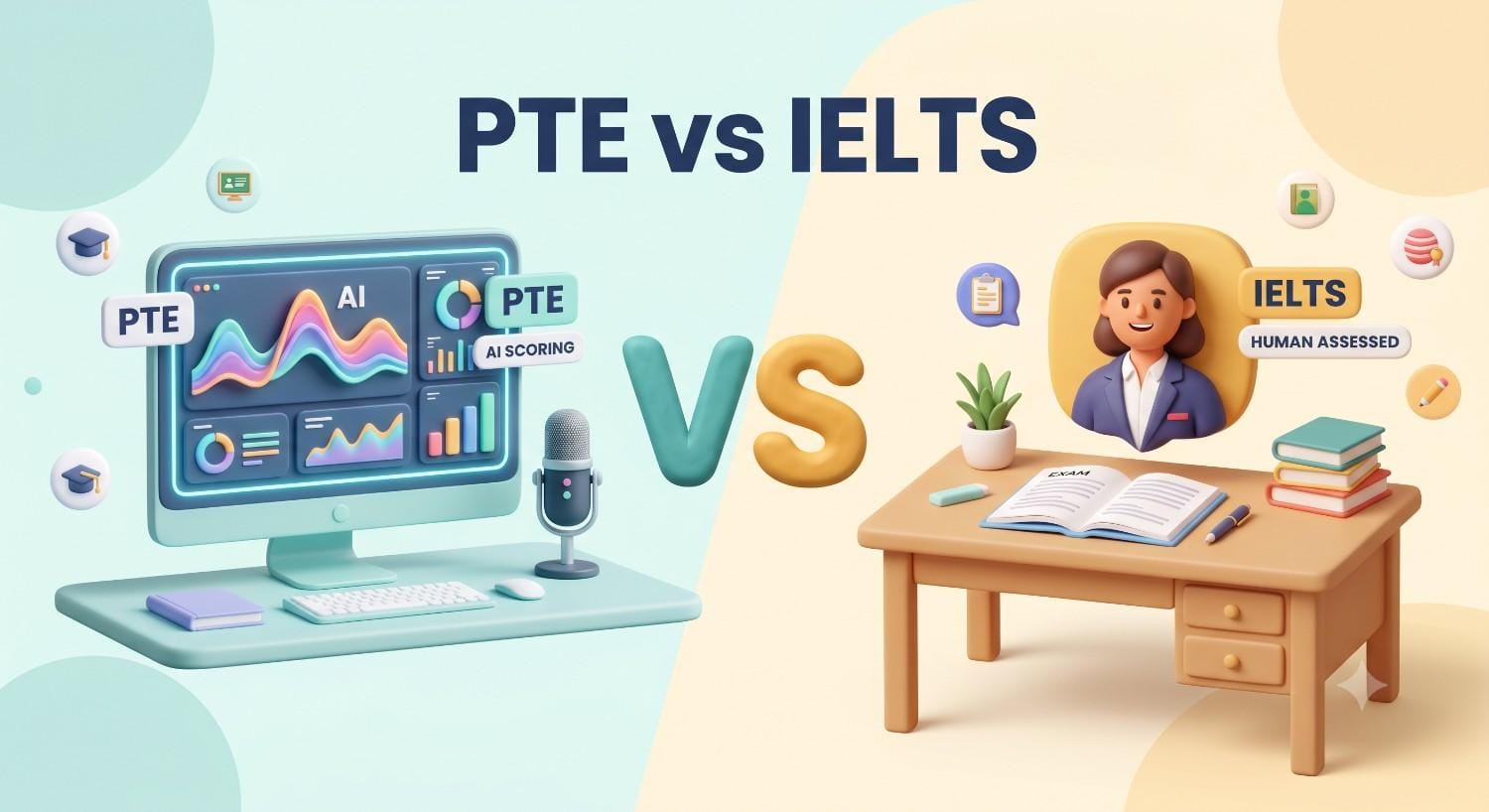
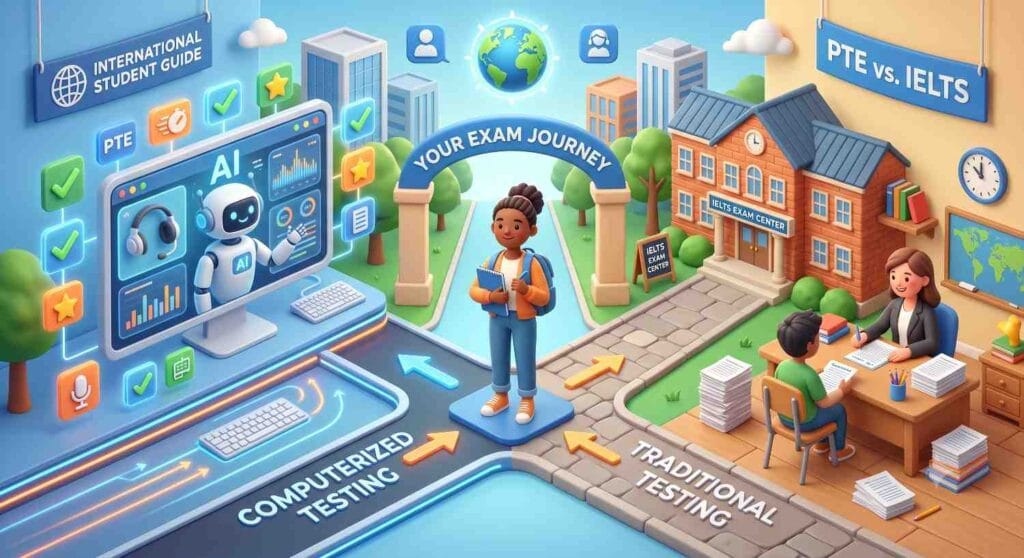
At the most fundamental level, the difference between PTE vs IELTS comes down to one question: who is marking your work? In PTE Academic, the answer is an AI algorithm. In IELTS Academic, the answer — at least for Speaking and Writing — is a trained human examiner. Everything else that matters about these two tests flows from that single distinction.
PTE (Pearson Test of English Academic) is entirely computer-based. You sit at a screen, speak into a microphone, type your responses, and a machine scores every single answer. No human ever looks at your work. This removes the risk of an inconsistent or tired marker, but it introduces a different set of variables — the quirks of speech-recognition software, the specific keyword patterns an algorithm is looking for in your essay, the precise timing windows you must speak within. If you understand how the machine thinks, you can prepare for it systematically. If you don’t, you can score lower than your actual English level deserves.
IELTS (International English Language Testing System), in contrast, has a live human examiner for the Speaking module and human markers for Writing. Reading and Listening are objectively scored. This means your IELTS result can vary slightly depending on which examiner you’re assigned — but it also means a real person hears your voice, understands your accent in full conversational context, and can follow the natural logic of your argument in an essay even if your grammar isn’t flawless. Whether that’s an advantage or a liability depends entirely on you.
| Feature | PTE Academic | IELTS Academic |
|---|---|---|
| Test Delivery | Fully computer-based | Computer or paper-based |
| Speaking Examiner | AI / Machine algorithm | Human examiner (face-to-face) |
| Writing Marker | AI / Machine algorithm | Human trained examiner |
| Test Duration | ~2 hours (no scheduled break) | 2 hours 45 minutes |
| Results Turnaround | 24–48 hours | 3–5 days (computer) / up to 13 days (paper) |
| Test Availability | 365 days/year at most centres | Fixed dates (~48 per year) |
| Score Scale | 10–90 (PTE overall score) | 0–9 (IELTS band, in 0.5 increments) |
| Approximate Fee | USD $170–$200 | USD $185–$230 (varies by country) |
The results timeline difference deserves specific attention. If you’re working with a tight visa deadline, a late university application, or you’re planning to rebook quickly if your first attempt doesn’t go well, PTE’s 24–48 hour result turnaround is a genuine, practical advantage. IELTS cannot match that speed — and for students in the middle of an urgent application cycle, that gap matters.
PTE vs IELTS Which Is Easy? A Brutally Honest Section-by-Section Breakdown
This is the section most students are actually here for — and it’s also the section where most comparison guides get it wrong by picking a winner. The reality of PTE vs IELTS difficulty is that the “easier” test is different for different people, and that difference is determined module by module. Let’s go through each one honestly.
Speaking: Microphone vs Human Examiner
This is where the PTE vs IELTS comparison gets deeply personal. In the IELTS Speaking test, you sit across from a human examiner for 11–14 minutes and have a real, structured conversation across three parts. The examiner can follow your natural speech patterns, understand your accent in full conversational context, and recognise genuine fluency even when your grammar occasionally slips. For students who speak confidently in English, who can hold their own in a real discussion, and who don’t freeze under social pressure — the IELTS Speaking format often feels more natural and more rewarding.
PTE Speaking works completely differently. You’re given a task — read this text aloud, describe this image, retell this lecture, answer this question — and then a beep sounds, and you have a fixed number of seconds to respond before the recording cuts off. Everything goes to a machine. No human context. No ability to recover with a charming follow-up sentence if your first attempt was rough. The algorithm scores you on pronunciation, oral fluency, and content against a database of expected responses.
If you have a strong regional accent — whether from Punjab, Gujarat, Karachi, or anywhere else in South Asia — PTE’s speech recognition can occasionally misprocess sounds it doesn’t recognise, which can pull your pronunciation score down even when your English is perfectly clear to any human listener. This is one of the genuine weaknesses of machine-scored speaking. On the other hand, if the idea of sitting one-on-one with a stranger in a formal examination room sends your spoken English to a completely different place than your actual ability — if anxiety is your biggest Speaking enemy — PTE’s impersonal format can genuinely set you free. Many students who struggled repeatedly with IELTS Speaking have crossed their target score in PTE simply because the pressure of the human examiner was removed from the equation.
Writing: What the Algorithm Wants vs What the Examiner Appreciates
IELTS Academic Writing asks you to complete two tasks: describe a data visualisation (graph, chart, diagram, or map) in Task 1 with at least 150 words, and write a discursive essay in Task 2 with at least 250 words. Both tasks are marked by a human examiner trained to evaluate four criteria — task achievement, coherence and cohesion, lexical resource, and grammatical range and accuracy. This means a skilled writer who constructs a sophisticated argument, uses vocabulary precisely, and builds a logically coherent response can score 7.5 or 8.0 even if they make a handful of grammatical errors, because the examiner can appreciate the overall quality of the writing beyond its technical surface.
PTE Writing consists of two tasks: Summarize Written Text (a single-sentence summary of a reading passage) and Write Essay (200–300 words). Machine scoring means the algorithm is looking for measurable markers — keyword density from the prompt, grammatical accuracy, word count compliance, vocabulary range measured against its database, discourse coherence signals. This is both the strength and the weakness of PTE Writing. If you are a structured, consistent academic writer who produces clean, clear, well-organised prose — the PTE algorithm will reward you reliably and consistently, without the unpredictability of a human marker’s judgment. If your writing is more creative, more argumentative, more willing to challenge the prompt or use unconventional structure — a human IELTS examiner might score that highly, while the PTE algorithm would simply miss it.
One practical note on typing: PTE Writing is timed and typed. If you’re a slow typist, you will run out of time before you run out of ideas — and that kills your score. Before sitting PTE, spend two to three weeks on basic typing speed. It sounds trivial. It is not.
Reading: Different Question Types, Different Skills
IELTS Academic Reading gives you 60 minutes and three increasingly complex academic passages, with 40 questions in total. The question types — True/False/Not Given, Matching Headings, Sentence Completion, Short Answer — are primarily testing your ability to locate and understand information that is explicitly stated in the text. The skill being tested is efficient reading: skimming for main ideas, scanning for specific information, and interpreting the meaning of words in context. Students who read quickly and can locate information efficiently under time pressure often find IELTS Reading manageable once they understand the question formats.
PTE Reading is integrated within the larger test structure and uses a different range of question types: Multiple Choice (single and multiple correct answers), Re-order Paragraphs, Reading Fill in the Blanks, and Reading and Writing Fill in the Blanks. The Re-order Paragraphs task is the one that trips up even strong readers — it requires you to understand the logical and discourse structure of a text, not just comprehend it, and reassemble jumbled paragraphs into the correct sequence. This is a fundamentally different cognitive skill from what IELTS Reading tests. Meanwhile, Reading and Writing Fill in the Blanks in PTE contributes to both your Reading and Writing scores simultaneously — meaning an error here costs you in two places at once.
The honest assessment of ielts vs pte difficulty for Reading: students with strong analytical reasoning and a grasp of how academic texts are logically structured often adapt to PTE Reading faster. Students who read extensively and can process large volumes of text efficiently often prefer IELTS Reading’s more straightforward comprehension focus.
Listening: Accents, Note-Taking, and Integrated Scoring
IELTS Listening presents four sections of increasing difficulty — two conversations and two monologues — featuring a range of native English accents from the UK, Australia, North America, and occasionally New Zealand. You hear each recording exactly once and answer as you listen or take notes to transfer later. In the paper-based version, you have 10 minutes at the end to transfer answers to your answer sheet — so note-taking speed and handwriting legibility become part of the equation. In the computer-based version, you type responses directly, which removes the transfer time pressure but introduces keyboard dependency.
PTE Listening is different in two important ways. First, the task types are more varied — Summarize Spoken Text, Multiple Choice, Highlight Correct Summary, Select Missing Word, Highlight Incorrect Words, and Write from Dictation. Write from Dictation in particular is a high-yield task where you hear a sentence once and type it verbatim — spelling errors count against you. Second, and critically, PTE Listening scores are integrated with Speaking scores in the overall scoring algorithm. This means your responses to listening tasks also contribute to your Communicative Skills sub-scores in ways that IELTS’s cleaner module separation does not. Strong performance across integrated tasks can boost you; weak performance can ripple in ways that feel disproportionate to a single bad answer.
PTE Score vs IELTS Score — The Complete 2026 Mapping Table
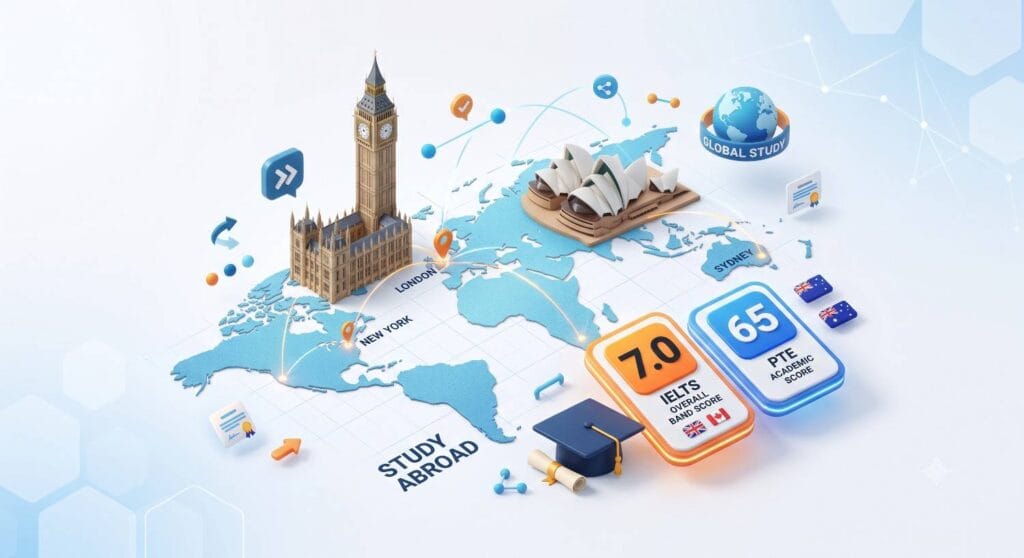
Understanding the PTE score vs IELTS equivalence is non-negotiable before you choose which test to sit. Universities, immigration departments, and visa authorities all use these scores against specific cut-offs, and the same proficiency level looks like a very different number depending on which test you took. Here is the current globally referenced mapping based on Pearson’s published concordance data and verified against major UK, Australian, and Canadian university admissions thresholds.
| IELTS Band Score | PTE Academic Score | Level Description | Typical University Requirement |
|---|---|---|---|
| 5.0 | 36–41 | Modest user | Foundation / pathway programmes |
| 5.5 | 42–49 | Limited competent user | Pre-sessional English courses |
| 6.0 | 50–57 | Competent user | Undergraduate entry (many UK / Australian universities) |
| 6.5 | 58–64 | Good user | Postgraduate entry (standard requirement) |
| 7.0 | 65–72 | Good user (upper) | Postgraduate / professional programmes |
| 7.5 | 73–78 | Very good user | Law, Medicine, Education (many institutions) |
| 8.0 | 79–84 | Expert user (lower) | Australia PR Superior English (20 extra points) |
| 8.5 | 85–88 | Expert user (upper) | Top-tier academic and immigration requirements |
| 9.0 | 89–90 | Native-level proficiency | Effectively perfect — rarely required |
Two things to pay close attention to when reading this table. First, many universities and visa authorities require minimum scores in each individual component — not just the overall band. You could score IELTS 6.5 overall but have a Speaking band of 5.5, which would fail you at institutions requiring 6.0 in all four skills. The same applies to PTE — an overall score of 65 with a Reading score of 42 may not satisfy requirements even if the total looks fine on paper. Always read the detailed language requirements of your specific university department, not just the headline university-wide figure.
Second, if you’re targeting Australian permanent residency, the score equivalence at the 8.0/79+ level carries a real financial implication — 20 additional points in the skilled migration points test. That’s significant. Many students find reaching PTE 79+ more achievable through preparation than IELTS 8.0+, specifically because machine-scored consistency in PTE removes the variability of human marking. But this is not a universal truth — your individual profile determines your achievable ceiling in each test.
Which Test Is Better for Your Target Country? Country-by-Country Analysis
The PTE vs IELTS question shifts significantly depending on where you’re planning to go. Different immigration authorities have different institutional relationships with these tests, and understanding the landscape in your specific target country should directly inform your choice — sometimes more than your individual test preference.
PTE vs IELTS for Studying in the United Kingdom
Both PTE Academic and IELTS Academic are accepted by the UK Home Office under the Secure English Language Test (SELT) framework for UK Student Visa applications. However — and this catches students out every single year — the standard test versions are not the SELT-approved versions for visa purposes. For UK visas, you specifically need PTE Academic UKVI or IELTS for UKVI (Academic). These are booked separately at the same test centres, at a slightly higher fee, and they produce results that the Home Office can verify directly in their system. Submitting a standard IELTS or standard PTE score for your UK Student Visa application will result in rejection — the test must carry the UKVI certification.
For university admissions specifically — separate from the visa requirement — virtually every UK university accepts both tests at standard scoring. The choice between PTE vs IELTS for UK study is therefore less about which test is accepted and more about which one you’re likely to perform better on. Check the specific language requirements for your programme, note any sub-score minimums, and then choose based on your individual profile. Our full guide to the UK student visa process for 2026 covers the complete documentation picture — your English test score is just one piece of a larger submission.
IELTS vs PTE for Australia Immigration and Study
Australia is the country where the ielts vs pte for australia immigration comparison has the most direct financial consequences, and it’s worth going into detail here. Both tests are fully accepted by the Department of Home Affairs for student visas and for Skilled Migration visa streams — but how you score on each test can translate into materially different outcomes in Australia’s points-based General Skilled Migration system.
The points allocation for English language in Australia’s skills assessment is tiered — and the difference between tiers is not trivial:
- Superior English (IELTS 8.0+ in all bands / PTE 79+ overall): 20 additional points toward your points total
- Proficient English (IELTS 7.0+ in all bands / PTE 65+ overall): 10 additional points
- Competent English (IELTS 6.0 / PTE 50 — the minimum threshold): 0 additional points
In Australia’s competitive migration environment, 10 additional points is often the difference between receiving an invitation to apply and sitting on a waiting list indefinitely. This is why so many students who are targeting Australian PR spend months specifically trying to crack the 65+ PTE or 7.0+ IELTS benchmark — and why the superior English tier at 79+/8.0+ is worth significant preparation investment if it’s achievable for your profile.
A pattern that admissions consultants frequently observe: students who struggle to break IELTS 7.0+ due to Speaking variability (inconsistent human examiner results across attempts) sometimes find they can more consistently score PTE 65+ because the machine scoring removes that variability. It’s not that their English is better in PTE — it’s that the scoring is more predictable, which benefits well-prepared candidates who understand what the algorithm is looking for. If you’re approaching Australia immigration from a Pakistani university background, also read our guide on education loans for abroad studies — understanding your funding options before you commit to Australian tuition is equally important.
Canada and USA — Which Test Do Universities and Immigration Authorities Prefer?
Canada has traditionally been an IELTS-dominant market for both student visas and permanent residency applications. However, PTE Academic is now accepted for Canada’s Student Direct Stream (SDS) — the fast-track visa pathway for students from Pakistan, India, the Philippines, and several other countries — with a minimum of 60 in each communicative skill. This is a relatively recent development. Many students preparing for Canadian university applications in 2025–2026 still aren’t aware that PTE is a valid SDS option, which means the field is currently less crowded with PTE applicants in Canada, and preparation materials tailored to Canadian university requirements are somewhat less readily available.
For the United States, IELTS has historically been the standard alongside TOEFL. PTE Academic acceptance at US universities has grown substantially — particularly at state universities, community colleges, and institutions with significant international student recruitment pipelines — but it is not yet universal across top-tier US research universities. If your US target institution is a top-50 university, verify PTE acceptance explicitly before choosing it over IELTS. For all other US institutions, check directly with your admissions office. Our student visa interview guide for the USA, UK, Canada and Germany covers what happens after your test score is submitted — knowing the full process from test to visa interview is useful preparation at every stage.
PTE vs IELTS — Pros, Cons, and the Honest Assessment Nobody Gives You
Let’s be direct. Both the official Pearson and British Council/IDP marketing materials present their respective tests in the most flattering light possible. The comparison below cuts through that and gives you what actually matters for a student deciding between PTE vs IELTS in 2026.
| ✅ Advantages | ❌ Disadvantages | |
|---|---|---|
| PTE Academic | Results in 24–48 hours; No human examiner bias; Test available 365 days/year; Strong for Australia PR points strategy; Consistent machine-scored results for well-prepared candidates; Retake flexibility due to frequent test dates | AI can misread strong regional accents; Robotic, high-pressure speaking environment; Integrated scoring means one weak area ripples across modules; Fewer preparation resources than IELTS; Re-order Paragraphs genuinely difficult for many students |
| IELTS Academic | 50+ years of global credibility; Human examiner rewards natural communication; Human marker appreciates writing nuance; Enormous official practice material bank; Preferred by most UK, Canadian, and top-tier US institutions; Clear module separation — weak area stays in one band | Results take 3–13 days; Speaking score depends partly on individual examiner; Fixed test dates limit rebooking flexibility; Paper-based requires fast, legible handwriting; Human marking can introduce occasional inconsistency |
One thing the table above doesn’t fully capture: the psychological dimension. Some students consistently underperform on IELTS Speaking not because their English is weak, but because the formal, face-to-face examiner format triggers a level of anxiety that genuinely degrades their performance. If that’s you — and you know who you are — the switch to PTE’s impersonal Speaking format is worth seriously considering, even if every other factor would point toward IELTS. Your best possible score on the right test beats a mediocre score on the “better” test every time.
How to Choose: A Practical Self-Assessment Framework
The most useful thing you can do right now — before buying a preparation course, before booking a test date, before reading another comparison article — is take a free diagnostic mock test for both PTE vs IELTS and see where your natural scores land. Pearson offers official free PTE practice tests on their website. The British Council and IDP both offer free IELTS practice materials including sample papers and online tests. An hour spent on each of these diagnostics will tell you more about which test suits you than any comparison guide can.
Beyond the diagnostic, work through these questions honestly:
Choose PTE Academic If You Identify With These Points
- You consistently underperform in face-to-face examinations — speaking anxiety is a real issue for you, not just pre-exam nerves
- You are a structured, consistent writer who produces clean academic prose rather than creative or argumentative writing
- You need results urgently — a visa deadline, a late application cycle, or you’re planning to rebook quickly if the first attempt doesn’t go as planned
- You are comfortable typing at reasonable speed and working in a fully digital, timed environment
- You are targeting Australia immigration and want to optimise your PR points at the 65+ or 79+ threshold
- You want more flexibility in test scheduling — particularly useful if your preparation isn’t fully ready and you need a little more time
Choose IELTS Academic If You Identify With These Points
- You are a confident, natural English speaker who performs better in real conversation than in timed microphone tasks
- You are a writer with range — someone who constructs original arguments, uses nuanced vocabulary, and wants a human marker to see the quality of your writing rather than having it measured against an algorithm
- You are applying primarily to UK universities (especially on the UKVI pathway), Canadian institutions, or top-tier US universities where IELTS is the established standard
- Your preparation timeline is sufficient that the slower results turnaround doesn’t create pressure
- You have access to strong IELTS preparation resources — tutors, coaching centres, mock test infrastructure — that you would need to build from scratch for PTE
One strategy worth knowing: there is nothing stopping you from sitting both. Many serious applicants — especially those applying to multiple countries or who have a tight deadline but aren’t confident about one specific test — book PTE one month and IELTS the following month, then submit whichever score is stronger for each specific application. This costs more upfront, but it removes the single-test-single-chance pressure that causes so many students to perform below their actual level. If your application timeline permits it and you can manage the preparation, the two-test strategy is a legitimate and increasingly common approach.
Whichever test you choose, your language score is only the beginning of what a strong application requires. Your Statement of Purpose and your proof of funds documentation are the two documents that typically require the most preparation time after your test score is confirmed. If you’re managing costs across the full application process, our guide on studying abroad on a low budget covers the financial planning piece in detail.
Frequently Asked Questions: PTE vs IELTS
Q1: Can I retake just one section of PTE or IELTS if I scored low in it?
No — both tests require you to sit all four modules if you want to improve your score. This is one of the most important practical differences between PTE, IELTS, and some other professional examinations. If you scored IELTS 6.5 overall but got 5.5 in Speaking and need 6.0 in all four bands, you’re registering and paying for the full test again — not just re-sitting Speaking. The same applies to PTE. There is no partial retake option in either test ecosystem. This makes the initial choice of test even more important — sitting the one that aligns with your profile across all four modules reduces the likelihood of needing multiple attempts.
Q2: How long are PTE and IELTS scores valid?
Both PTE Academic and IELTS Academic scores are valid for two years from the test date. This two-year validity applies universally — universities, visa authorities, and immigration departments all use the same window. This matters particularly for deferred intake students, students taking gap years, or students applying to programmes that start 12–18 months after application opens. If your score expires before your visa is processed or before your programme begins, you will need to resit. Plan your test date carefully relative to your full application timeline — not just your university application deadline, but your visa processing timeline as well.
Q3: Is PTE genuinely easier than IELTS for non-native English speakers from South Asia?
There is no universal answer — and anyone who tells you otherwise is oversimplifying. The pte vs ielts which is easy question for South Asian students depends entirely on your specific strength and weakness profile. If your speaking anxiety or your regional accent has cost you IELTS Speaking points repeatedly, PTE’s machine-scored format may be a genuine advantage. If you write creatively and fluently and your strength is constructing arguments in prose, IELTS Writing’s human marker may reward you better than PTE’s algorithm. If you are a fast, accurate typist with strong analytical reading skills, PTE’s question formats may feel more natural. If you read extensively and can process large volumes of text under time pressure, IELTS Reading may suit you better. Run the diagnostic tests and let your own results tell you the answer.
Q4: What happens technically if the computer crashes or freezes during my PTE test?
Pearson test centres have specific protocols for technical failures, and you are entitled to a free retest if a verified technical issue occurs. The moment you notice a problem — frozen screen, audio failure, microphone not responding — stop and raise your hand or alert the invigilator immediately. Do not attempt to fix the computer yourself. Document the issue with centre staff before you leave, and get written confirmation of the incident. Pearson’s customer support team can then process your case for a complimentary retest at the earliest available appointment. This situation is rare at established test centres, but knowing the protocol in advance means you won’t waste time trying to troubleshoot during a timed exam session.
Q5: Do Australian universities accept PTE for both admission and the student visa?
Yes — PTE Academic is fully accepted across Australian universities for both admission and Department of Home Affairs student visa requirements. PTE is also accepted for Australia’s Skilled Migration stream, including the points-tested Subclass 189, 190, and 491 pathways relevant to students who plan to apply for PR after graduating. However, individual faculties within Australian universities — particularly postgraduate programmes in nursing, education, social work, and some clinical medicine programmes — sometimes set minimum component scores that exceed the university’s general entry requirement. Always check your specific department’s page, not just the university’s main admissions page, and confirm both the overall score requirement and any minimum individual communicative skill scores before you book your test.
Q6: What keyboard layout should I expect in PTE test centres in Pakistan and India?
Test centres in Pakistan and India typically use standard QWERTY keyboards — the same layout used across the UK, US, and most global markets. However, specific configurations can vary between centres, and it is worth confirming with your booked test centre at registration. This matters more than it sounds: several PTE tasks — particularly Write Essay and Summarize Written Text — are timed and require sustained, fast typing. A student who types 35 words per minute under pressure will run short of time on these tasks regardless of how good their English is. If you are not a confident typist, allocate two to three weeks before your test to deliberate typing speed practice. Free tools like Keybr, TypingClub, or Monkeytype can meaningfully improve your words-per-minute rate in a short time — and that improvement directly translates into better PTE Writing scores.
The Bottom Line on PTE vs IELTS in 2026
After everything in this guide, here’s where we land: the PTE vs IELTS comparison has no universal winner, and any source that tells you it does is not being straight with you. Both tests are internationally credible. Both will get you into the same universities and past the same immigration counters when your scores meet the requirements. The right test for you is the one whose format aligns with how you naturally think, speak, and perform — and the only way to find that out definitively is to take a diagnostic mock test for both before you commit to either.
Make the PTE vs IELTS decision at the very start of your preparation cycle — not after you’ve spent six weeks on IELTS coaching materials and then panicked into switching. Run the diagnostic. Check your target country and institution requirements carefully. Be honest about whether speaking anxiety, accent, writing style, or time pressure is your biggest vulnerability. And then commit to one test and prepare for it with total focus rather than hedging across both simultaneously.
Your English test score is the first gate in a much longer application journey. For everything that comes after — the Statement of Purpose, the visa documents, the financial evidence, the first weeks in a new country — explore the full library of study abroad guides on StudyPathExp, built specifically for students from Pakistan and India navigating the complete path from English test to enrolment and beyond.
Disclaimer: Test formats, score mappings, and immigration authority acceptance policies are subject to change. Always verify current requirements directly with the official Pearson PTE and IELTS websites, and confirm acceptance at your specific target institution before registering. This article is for general guidance purposes only and does not constitute official admissions or immigration advice.