One Document Can Make or Break Your Entire Application
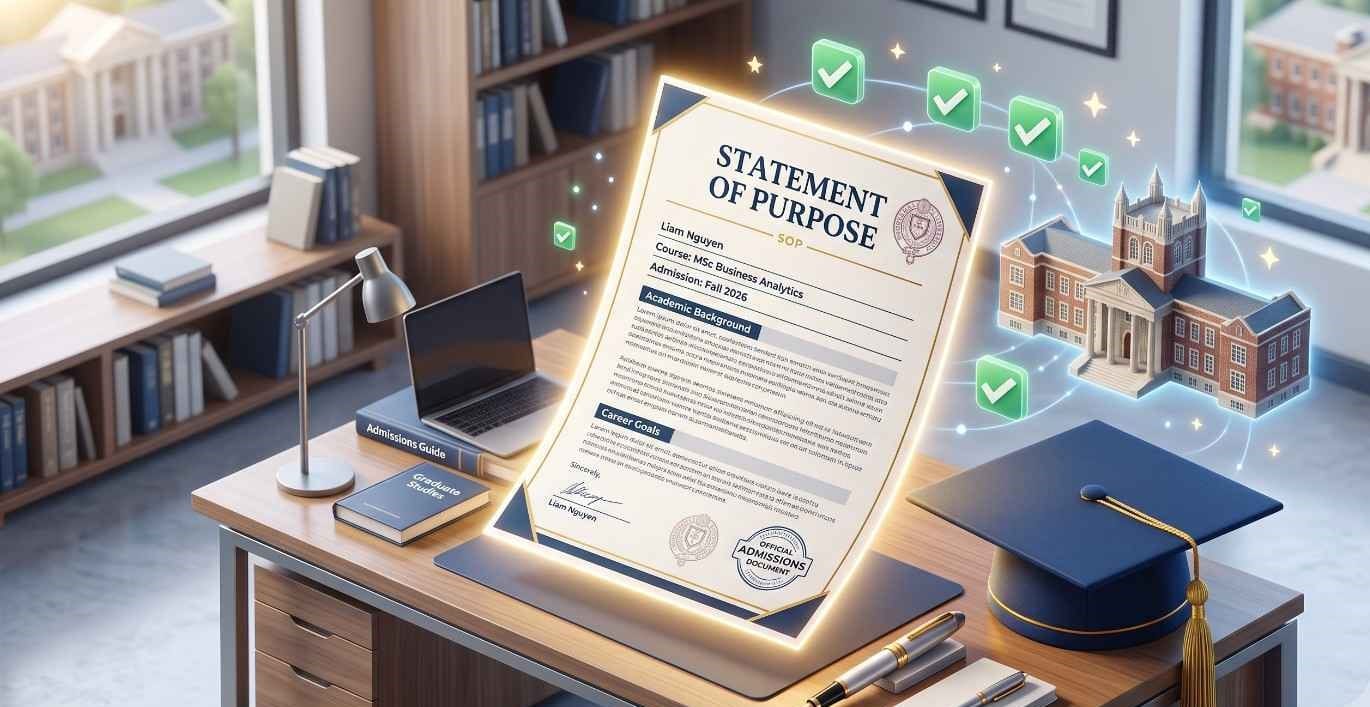
Your grades are strong. Your test scores are competitive. Your recommendation letters are solid. And yet thousands of qualified applicants get rejected from their dream universities every single year — not because they weren’t capable, but because their Statement of Purpose failed to convince the admissions committee that they were the right fit. Getting the statement of purpose sample format right isn’t a small detail buried in your application checklist. It is, in most cases, the single deciding document between an acceptance letter and a rejection email.
Admissions committees read hundreds, sometimes thousands, of applications per intake cycle. Your transcript and test scores get you past the initial academic screen — but the SOP is what tells the reader who you actually are, why you’ve chosen this exact programme, and whether you’re going to thrive in it. A poorly formatted, generic, or rambling SOP signals carelessness, even if your academic record is excellent. A well-structured one, following a proven statement of purpose sample format, signals clarity of thought, genuine motivation, and professional readiness — three things every admissions officer is actively screening for.
This guide gives you everything you need: the exact 5-paragraph structure that admissions consultants use with paying clients, two full copy-paste templates (one for Master’s applicants, one for Undergraduate applicants), the mistakes that get SOPs rejected outright, and the formatting standards universities expect. By the end, you’ll know precisely how to write a statement of purpose that gets read fully — not skimmed and discarded in the first paragraph. Every example, template, and tip in this guide is built directly around the same statement of purpose sample format that experienced admissions consultants charge hundreds of dollars to teach. Once your SOP is in shape, you’ll also need your proof of funds letter from bank ready — the two documents are usually requested around the same stage of the application process.
The Ideal Statement of Purpose Sample Format
Every effective SOP — regardless of country, university, or programme level — follows a recognisable underlying structure. Admissions officers read so many of these documents that they unconsciously expect a certain logical flow, and deviating wildly from it (no matter how creative you think you’re being) usually works against you, not for you. The proven statement of purpose sample format consists of five core sections, each doing a distinct job in building your case for admission.
- Introduction (Hook): A specific, personal opening that draws the reader in immediately — not a generic statement like “Since childhood, I have been passionate about…” Admissions readers see that exact sentence hundreds of times per cycle. Open instead with a specific moment, observation, or realisation that connects directly to your field of study.
- Academic Background: A concise summary of your relevant academic journey — not a repeat of your transcript, but an explanation of how your coursework, projects, and academic interests built toward this specific application. Highlight relevant courses, research, or academic achievements that connect logically to your intended programme.
- Professional/Practical Experience: Internships, jobs, research assistantships, volunteer work, or extracurricular projects that demonstrate applied skill and real-world engagement with your field. For Master’s applicants, this section typically carries significant weight. For Undergraduate applicants with limited work history, this can include school projects, competitions, or leadership roles.
- Why This Course and University: The section most applicants get badly wrong. Generic statements like “Your university has a great reputation” mean nothing. Name specific faculty members whose research interests you, specific modules or labs, specific opportunities the university offers that align directly with your stated goals.
- Conclusion (Future Goals): A forward-looking close that ties everything together — what you intend to do with this degree, how it fits into your career trajectory, and ideally, how it connects back to the opening hook from your introduction for a sense of narrative closure.
This structure isn’t a rigid cage — strong SOPs often blend sections 2 and 3 or adjust the order slightly depending on what story they’re telling. But every one of these five elements needs to appear somewhere in your document. Admissions officers at institutions like the Queen Mary University of London admissions office publish guidance confirming this exact structural expectation — academic background, motivation, and future goals are the three pillars every reviewer is trained to look for. Once you internalise this statement of purpose sample format, writing your first draft becomes a matter of filling in real details rather than staring at a blank page.
Master’s Degree SOP Template (Copy & Paste)
This template applies the exact statement of purpose sample format outlined above, built specifically for Master’s and MBA applicants who typically have some professional or research experience to draw on. The tone is analytical, specific, and forward-focused. Replace every bracketed section with your own details — but keep the underlying logical structure intact. This is not meant to be submitted word-for-word; it’s a scaffold to organise your own genuine story around. If you’re applying for a Master’s and also weighing how to fund it, our guide on education loans to study abroad is worth reading alongside this one.
PARAGRAPH 1 — INTRODUCTION / HOOK
During my final year working on [specific project/research/work task], I encountered [specific problem or realisation] that revealed a gap in my understanding of [specific subject area]. That moment crystallised what I now intend to pursue through a Master’s in [Programme Name] — not as an abstract academic exercise, but as the direct continuation of a question I have been trying to answer since [specific moment/year].
PARAGRAPH 2 — ACADEMIC BACKGROUND
My undergraduate degree in [Degree Name] at [University Name] gave me a strong foundation in [2-3 core relevant subjects]. I was particularly drawn to [specific module/course], where I [specific academic achievement, project, or grade]. My final-year project on [topic] required me to [specific skill demonstrated — research, analysis, technical work], which directly informs my interest in [aspect of the Master’s programme].
PARAGRAPH 3 — PROFESSIONAL / RESEARCH EXPERIENCE
Following graduation, I joined [Company/Organisation Name] as [Job Title], where I [core responsibility]. Over [X months/years], I [specific achievement with a measurable result — e.g., “led a team of 4 to deliver X, resulting in a 20% improvement in Y”]. This experience exposed me directly to [specific industry challenge], which I now want to address with deeper academic and theoretical grounding — precisely what your [Programme Name] offers.
PARAGRAPH 4 — WHY THIS COURSE & UNIVERSITY
[University Name]’s [Programme Name] stands out to me specifically because of [specific module, faculty member, or research centre — name them directly]. I am particularly interested in working with Professor [Name], whose research in [specific area] aligns closely with my own interest in [your specific interest]. The programme’s [specific feature — e.g., industry partnership, lab access, dual degree option] is something I have not found replicated at other institutions I researched, and it directly supports my goal of [specific outcome].
PARAGRAPH 5 — CONCLUSION / FUTURE GOALS
On completing this Master’s, I intend to [specific short-term career goal — role, industry, region]. In the longer term, I aim to [specific long-term goal — e.g., “lead sustainability initiatives within the renewable energy sector in South Asia”]. The rigorous foundation that [University Name]’s programme offers is, I believe, the most direct path between where I am now and where I intend to go — continuing the question I first encountered during [reference back to your opening hook].
Notice that every bracket asks for something specific — a name, a number, a real project. The strength of this statement of purpose sample format template comes entirely from how precisely you fill it in. A version of this template filled with vague generalities will read exactly like every other generic SOP an admissions officer has rejected. A version filled with real names, real numbers, and a real personal narrative will stand out immediately.
Undergraduate SOP Template (Copy & Paste)
Undergraduate applicants typically have less professional experience to draw on, and admissions committees know this — they are not expecting a 22-year-old’s career history from an 18-year-old applicant. The tone for this version of the statement of purpose sample format should be more enthusiasm-driven and forward-looking, focused on intellectual curiosity, school achievements, extracurricular involvement, and genuine passion for the subject rather than professional accomplishment.
PARAGRAPH 1 — INTRODUCTION / HOOK
I still remember the exact moment [specific experience — a class, a book, an event, a competition] first made me realise I wanted to study [Subject Area]. It wasn’t just curiosity — it was [specific reason this moment mattered to you]. That spark has only grown stronger through my time in school, and it’s what drives my application to study [Programme Name] at [University Name].
PARAGRAPH 2 — ACADEMIC BACKGROUND
Throughout secondary school, I consistently pursued [Subject Area] through [specific courses, advanced classes, or self-directed learning]. I achieved [specific grade/result] in [specific subject], and took on [extra academic challenge — e.g., an extended essay, an independent research project, an Olympiad] to deepen my understanding beyond the standard curriculum.
PARAGRAPH 3 — EXTRACURRICULAR / PRACTICAL EXPERIENCE
Outside the classroom, I [specific activity — club, competition, volunteer work, personal project] for [duration]. Through this, I [specific skill or insight gained]. For example, when I [specific situation], I learned [specific lesson] — an experience that directly shapes how I want to approach [Subject Area] at university level.
PARAGRAPH 4 — WHY THIS COURSE & UNIVERSITY
I chose [University Name]’s [Programme Name] because of [specific reason — a module, a teaching approach, a unique opportunity like a study-abroad year or industry placement]. Having researched the course structure in detail, I am especially excited about [specific year/module], because it directly connects to my interest in [specific topic].
PARAGRAPH 5 — CONCLUSION / FUTURE GOALS
Studying [Programme Name] at [University Name] represents the next step in a journey that began with [reference back to opening hook]. I am eager to bring my curiosity, my work ethic, and my genuine enthusiasm for [Subject Area] into your academic community — and to build the foundation for a future career in [general career direction, e.g., “engineering” or “international law”].
For both templates, the golden rule is the same: specificity beats eloquence every time. A simply written sentence with a real detail in it will always outperform a beautifully written sentence that says nothing concrete. Whichever version of the statement of purpose sample format you’re working from, admissions readers can tell the difference instantly — and so can plagiarism detection software, which brings us to the next section.
Common Mistakes That Will Get Your SOP Rejected
Even applicants with strong academic profiles routinely submit SOPs that actively damage their application — often because they deviated from a sound statement of purpose sample format at exactly the wrong moment. These mistakes are not subtle stylistic preferences — they are the specific red flags that cause admissions officers to mentally deprioritise an otherwise qualified candidate. Avoid every single one of these.
- Plagiarism or heavy reliance on online “sample” SOPs: Universities run every submitted SOP through plagiarism detection software like Turnitin. Copying structure or phrases directly from an online sample — even one you found through a search for “statement of purpose sample format” — is one of the fastest ways to get an application rejected outright, sometimes with a formal flag on your application record.
- Generic, copy-paste statements that could apply to any university: If you could swap out the university name in paragraph 4 and the sentence would still technically make sense, that sentence is too generic. Every “why this university” paragraph must contain details that prove genuine, specific research into that exact institution.
- Ignoring the word limit: Most universities specify a strict word count — typically 500 to 1,000 words depending on the institution and programme. Submitting an SOP that’s significantly over or under this limit signals an inability to follow basic instructions, which is a genuinely bad signal to send an admissions committee evaluating your readiness for academic work.
- Restating your CV instead of adding new context: Your SOP should not be a narrative version of your resume. If a fact is already visible on your transcript or CV, don’t waste SOP word count repeating it — use the space instead to explain the “why” and “so what” behind your experiences.
- Overly dramatic or fictionalised openings: Admissions readers have seen every version of “Ever since I was a child…” and overly poetic openings that don’t connect to anything substantive. A specific, grounded, slightly understated opening almost always outperforms a dramatic one.
- Negative framing of past failures without resolution: If you address a setback — a low grade, a gap year, an academic probation — always pair it with what you learned and how you’ve demonstrably grown since. Never leave a negative point unresolved in the reader’s mind.
- Spelling and grammar errors: This sounds obvious, but it remains one of the most common reasons strong applicants get filtered out. A single typo might be forgiven; multiple errors signal carelessness about a document the applicant had months to prepare. Always have at least two other people proofread your SOP before submission.
Pro-Tips for Formatting Your SOP Document
Content is what gets you admitted — but formatting is what determines whether your content gets read comfortably or skipped in frustration. A technically correct statement of purpose sample format still needs to look professional on the page. Admissions officers reviewing hundreds of documents respond better, even subconsciously, to clean, professional formatting. These are the technical standards that experienced consultants apply to every SOP before submission.
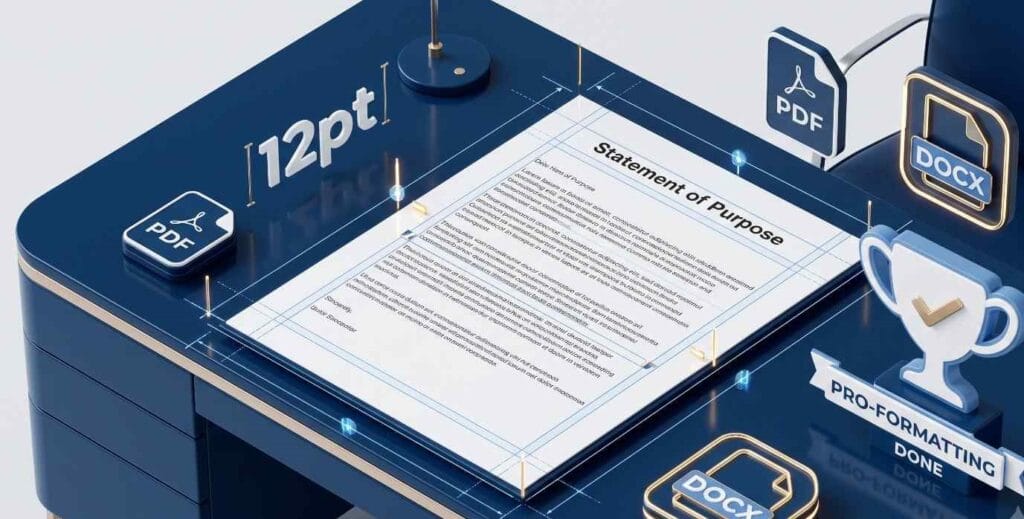
- Font: Use a standard, professional serif or sans-serif font — Times New Roman, Calibri, or Arial. Avoid decorative or unusual fonts entirely. Font size should be 11 or 12 points.
- Margins: Standard 1-inch (2.54cm) margins on all sides. Don’t shrink margins to squeeze in more content if you’re over the word limit — cut content instead.
- Spacing: 1.5 line spacing is the most common standard, making the document easier to read than single spacing while not wasting as much space as double spacing. Always check your target university’s specific formatting guidelines, as some institutions specify single or double spacing explicitly.
- Length: Stick precisely to the word or page limit specified by the university. If no limit is given, 800–1,000 words (roughly one to one-and-a-half pages) is the standard professional length for a Master’s SOP.
- File Type: Submit as a PDF unless the application portal explicitly requests a Word document (.docx). PDF preserves your formatting exactly as intended across any device or operating system the reviewer uses, while Word documents can shift formatting unpredictably. If you’re searching for an sop template pdf, always export your final draft to PDF as the very last step before submission — never submit directly from an editable Word file unless specifically required.
- File naming: Name your file clearly and professionally — “FirstName_LastName_SOP_UniversityName.pdf” rather than “Document1.pdf” or “SOP final FINAL v3.pdf.” Admissions offices handle thousands of files; a clearly named document reflects basic professionalism.
- No headers or titles within the document: Unlike this guide, your actual SOP should read as flowing prose without bolded section headers like “Introduction” or “Academic Background” visible in the submitted document. The five-part structure of a good statement of purpose sample format should be invisible to the reader — felt through the logical flow of the writing, not labelled explicitly.
Once your SOP and supporting documents are ready, the next major hurdle is usually the visa interview itself. Our guide to the UK student visa process for 2026 covers exactly what happens after your SOP is submitted and accepted.
Frequently Asked Questions About Statement of Purpose Sample Format
Q1: How long should my Statement of Purpose be?
Always check your specific university’s stated word or page limit first — it overrides any general rule. If no limit is specified, the standard professional length is 800 to 1,000 words for a Master’s SOP, and slightly shorter — around 500 to 650 words — for an Undergraduate personal statement. Every reputable statement of purpose sample format is built around these word count expectations, which is why the templates in this guide are sized accordingly. US universities applying through the Common App typically specify a 650-word limit for the main personal statement essay, as detailed on the Common App’s official essay prompts page. UK universities through UCAS specify a strict 4,000-character limit (roughly 600–650 words) for personal statements, per UCAS’s official personal statement guidance. Never assume — always verify the exact figure for your target institution before finalising your draft.
Q2: Should I include my IELTS or TOEFL score in my SOP?
Generally, no — your test scores are submitted separately as part of your application documents and don’t need to be restated in your SOP. Your SOP word count is precious and should be spent on narrative, motivation, and specific detail — not on data points already visible elsewhere in your application. The one exception is if your language proficiency score is directly relevant to a point you’re making — for example, if you’re discussing how you improved your academic English specifically to prepare for international study, briefly referencing your score in that context can work. But as a default rule, leave test scores out of your SOP entirely and let your application’s academic documents speak for that data on their own.
Q3: Can I use the same SOP for multiple universities?
You can reuse your core structure and most of your personal narrative, but the “Why This University” section must be rewritten for every single application. This is non-negotiable. Admissions officers can spot a generic SOP instantly — and submitting one signals that their specific institution wasn’t your genuine first choice. Build one strong master draft using the statement of purpose sample format covered in this guide — introduction, academic background, and professional experience — then customise paragraph four entirely for each university with specific faculty names, modules, and programme features. This approach saves significant time while still producing a genuinely tailored document for every application.
Q4: Is the SOP different from a Personal Statement or a Letter of Motivation?
The terms vary by country and institution, but the core purpose is nearly identical across all three. “Statement of Purpose” (SOP) is the most common term in the US and for graduate/Master’s applications globally. “Personal Statement” is the standard UK term, used heavily by UCAS for undergraduate applications. “Letter of Motivation” (or Motivationsschreiben) is the term most commonly used by European universities, particularly in Germany and the Netherlands. While emphasis can shift slightly — UK personal statements sometimes lean more academic and less narrative than US SOPs — the underlying statement of purpose sample format covered in this guide applies across all three naming conventions with only minor tonal adjustments needed.
Q5: Do I need a different SOP for my student visa application than the one I submitted for university admission?
In most cases, yes — your university admissions SOP and your visa-specific SOP serve different purposes and audiences. Your admissions SOP needs to convince a university that you’re academically prepared and genuinely motivated for their specific programme. A SOP sample for student visa applications — required by countries like Canada, Australia, and the UK in certain visa categories — needs to convince an immigration officer that you have genuine, non-immigrant intent to study and that you have a credible plan to return to your home country after your studies, alongside demonstrating sufficient financial support. These are different legal and persuasive goals, even though both typically borrow from the same core statement of purpose sample format taught in this guide. A visa SOP typically needs to address your financial situation, your ties to your home country, and your specific post-graduation plans far more explicitly than an admissions SOP would — our guide on the proof of funds letter covers the financial documentation piece in detail. Never submit your university admissions SOP unmodified as your visa application SOP — always adapt the content to address the specific immigration officer’s concerns.
Your SOP Is the One Document Where You Control the Narrative
Every other part of your application — your transcript, your test scores, your recommendation letters — is largely fixed by the time you sit down to apply. Your SOP is the one document where you have complete control over how your story is told, and that makes it both the most stressful part of the application and the most powerful opportunity within it. Follow the proven statement of purpose sample format in this guide, fill the templates with real, specific details from your own life, and avoid the mistakes that quietly sink otherwise strong applications.
Write your first draft without worrying about word count. Then cut it down ruthlessly, removing anything generic or repetitive of your CV. Have it proofread by at least two people who know you well and one who doesn’t. And always, always rewrite your “Why This University” section for every single application — it’s the single fastest way to separate yourself from the pile of generic submissions every admissions officer wades through each cycle. Bookmark this statement of purpose sample format guide and return to it for every application you submit this cycle. For more guidance on what comes next — visas, bank accounts, and settling in — explore the full library of study abroad guides on StudyPathExp.
Disclaimer: SOP requirements, word limits, and formatting standards vary by university, country, and programme level. Always verify the specific requirements directly on your target university’s official admissions page before finalising your document. This article is intended as general educational guidance and does not constitute official admissions advice.