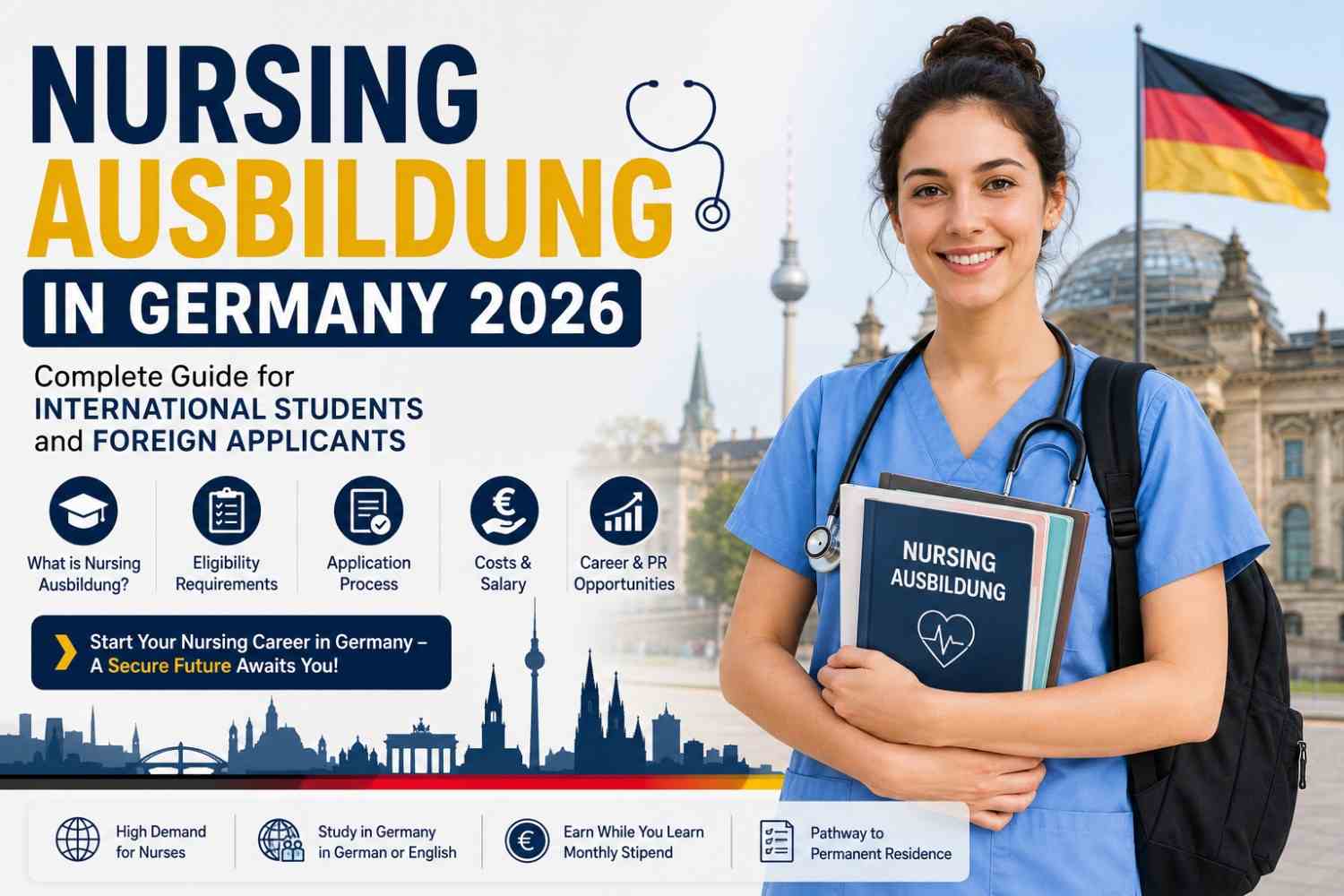
Germany has a nursing shortage that nobody is hiding. Over 150,000 nursing positions are currently unfilled across the country, and that number is growing every year as the population ages and experienced nurses retire. The German healthcare system needs people, and the government has responded by actively opening the door to international applicants who want to do their nursing Ausbildung in Germany and build a career there.
Here’s what makes this genuinely interesting. You don’t pay tuition for the Ausbildung. You get paid a training salary of around €1,000 to €1,300 per month while you train. After three years, you’re a fully recognised nursing professional in one of the most stable healthcare systems in Europe. And the path from completing your Ausbildung to German permanent residency is clearer than almost any other immigration route in the country.
This guide covers the full picture of nursing Ausbildung in Germany for foreign applicants — what the programme actually involves, the German language requirement (yes, it’s non-negotiable and here’s exactly what level you need), eligibility criteria, how to find a training contract, the visa process, salary details, and what your career looks like after you qualify.
What Is Nursing Ausbildung in Germany?
The word “Ausbildung” means vocational training or apprenticeship. A nursing Ausbildung in Germany is a state-approved, paid training programme that qualifies you as a licensed nurse (officially called Pflegefachfrau for women or Pflegefachmann for men) at the end of three years.
Since 2020, Germany reformed its nursing training into a single generalised programme that covers all three areas: general nursing care, elderly care, and paediatric nursing. This means you qualify in all three specialisations rather than just one. Graduates from the new programme are significantly more versatile in the job market than nurses trained under the old system.
The structure splits between practical training at your employer (a hospital, nursing home, or care facility) and theoretical lessons at a nursing school (Pflegeschule). Your employer pays your salary. The school trains you. And the state provides the curriculum oversight. It’s a dual-system programme, which is how most skilled vocational training in Germany works.
📌 Nursing Ausbildung in Germany at a Glance
- Duration: 3 years
- Training salary: €1,000 to €1,300/month (increases each year)
- Tuition fees: None — training is fully paid by employer
- Language required: German B2 level minimum
- Visa type: Ausbildung visa under §17 AufenthG
- Qualification awarded: Pflegefachfrau / Pflegefachmann (Generalised Nursing Professional)
- Path to PR: Work 2 years after qualifying, then apply for permanent residency
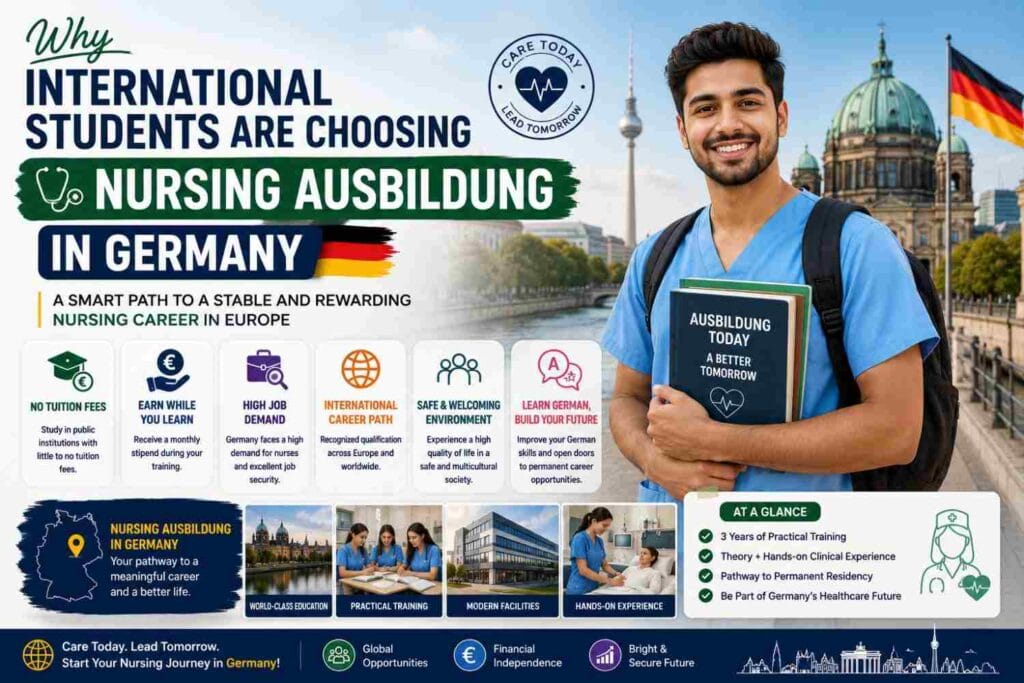
Why International Students Are Choosing Nursing Ausbildung in Germany
There are several good reasons why people from India, the Philippines, Pakistan, Morocco, Nepal, Egypt, Tunisia, and Nigeria are specifically targeting the nursing Ausbildung in Germany rather than nursing programmes in other European countries.
You Get Paid to Train
This is the biggest one. In most countries, nursing school costs money — sometimes a lot of money. In Germany, your employer pays you a training salary from day one. In your first year, you typically earn around €1,000 to €1,100 per month gross. By the third year, that rises to around €1,200 to €1,300. It’s not a lavish income, but it’s real money you can live on, especially in smaller German cities where rent is more manageable.
No Tuition Fees
Nursing Ausbildung has no tuition fees. Your employer covers training costs, and the nursing school is publicly funded. This is genuinely different from the model in the UK, Australia, or the US, where nursing degrees can cost tens of thousands in tuition alone. If funding is a concern, this matters enormously. Our guide on how to study abroad on a low budget puts Germany’s Ausbildung pathway in context alongside other low-cost international options.
A Clear Path to Permanent Residency
Germany’s immigration rules are set up to reward people who complete vocational training in Germany. After finishing your Ausbildung and working as a nurse for two years, you’re eligible to apply for a permanent residence permit under §9 AufenthG. This pathway is more reliable and more predictable than many skilled worker immigration routes because it’s tied to a qualification Germany actively needs.
Massive Demand, High Job Security
Germany’s healthcare sector is not going to stop needing nurses. The country’s demographic situation — an ageing population, a high number of retirees in the nursing workforce, and below-replacement birth rates — means nursing demand keeps growing. Completing a nursing Ausbildung in Germany means graduating into a job market where your skills are genuinely in shortage, not one where you’re competing with hundreds of applicants for every opening.
Eligibility Requirements for Nursing Ausbildung in Germany
Not everyone qualifies automatically. Here are the requirements that apply to international applicants looking to do a nursing Ausbildung in Germany.
1. Educational Qualification
You need at least a secondary school leaving certificate equivalent to the German “mittlerer Schulabschluss” (roughly equivalent to completing 10th grade or O-levels). In most cases, a full secondary school certificate (12th grade or A-levels equivalent) is preferred by employers and nursing schools. If you have a higher secondary certificate, you’re in a strong position.
If you have a prior nursing qualification from your home country — a diploma or degree — that can actually be recognised in Germany through an “Anerkennungsverfahren” (recognition process), potentially shortening your path to working as a fully qualified nurse. But for the Ausbildung specifically, a school leaving certificate is the minimum academic entry point.
2. Age Requirement
The nursing Ausbildung in Germany has no fixed upper age limit at the federal level. Most states allow adults of any age to apply. Some states require applicants to be at least 17 or 18 years old. There is no 35-year-old cutoff or similar restriction that exists in some other vocational programmes. If you’re in your 30s or 40s and considering a career change into nursing in Germany, the age factor is not the obstacle you might expect.
3. Health Certificate
You need a medical certificate confirming you’re physically fit to work in a nursing environment. This typically means demonstrating that you’re free from serious infectious diseases (particularly tuberculosis) and have no physical conditions that would prevent you from performing nursing duties. The health check is arranged either before you arrive or during the early stages of your application with your employer.
4. Clean Criminal Record
A clean police clearance certificate from your home country is required. This is standard for any healthcare-related visa or employment in Germany. The certificate should be no older than three to six months at the time of your application.
5. Training Contract (Ausbildungsvertrag)
This is the part that many guides gloss over. To start a nursing Ausbildung in Germany, you need a signed training contract with an approved employer — a hospital (Krankenhaus), a nursing home (Pflegeheim), or a care facility. You can’t just apply to a nursing school independently. The employer hires you as a trainee, pays your salary, and organises your practical training placements. Finding this contract is the first practical challenge international applicants face.
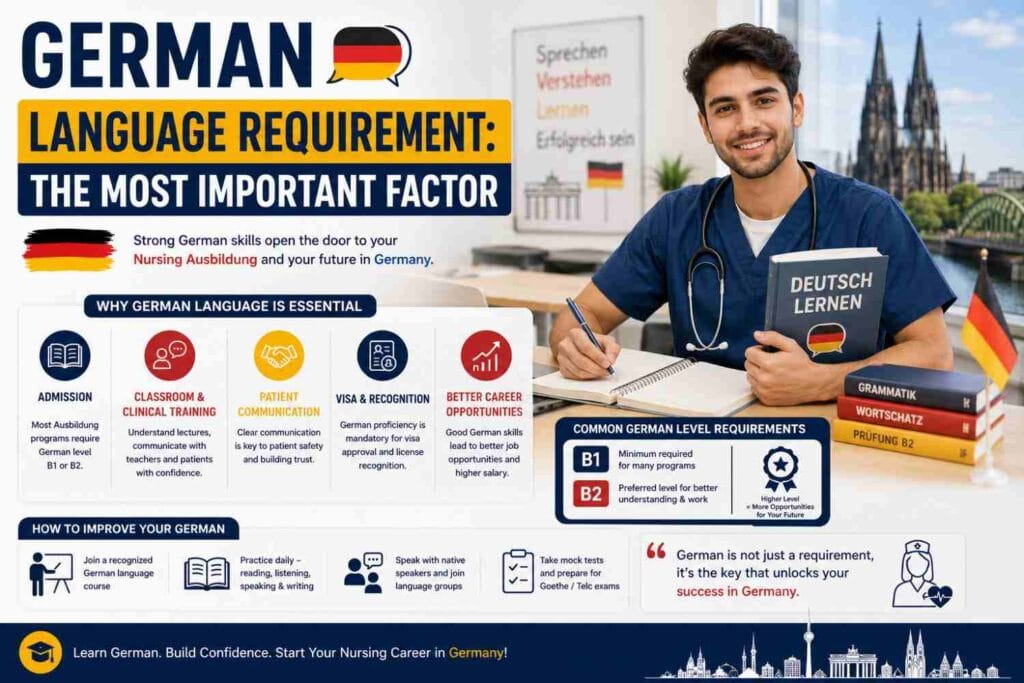
German Language Requirement: The Most Important Factor
Let’s be honest about this part because a lot of people underestimate it. The German language requirement for nursing Ausbildung in Germany is non-negotiable, and it’s more demanding than many people expect. You’re going to be communicating with patients, doctors, colleagues, and families — often in emotionally charged or medically complex situations. Your language skills need to be genuinely functional, not just classroom-level.
What Level Do You Actually Need?
The minimum language requirement for the Ausbildung visa application and for most employers is German B2 level, certified by a recognised examination such as the Goethe-Institut B2, TestDaF, or telc Deutsch B2 Pflege (which is specifically designed for healthcare workers).
The telc Deutsch B2 Pflege is worth knowing about specifically. It’s a language test designed for the healthcare context — it includes scenarios and vocabulary directly relevant to nursing. Many German hospitals and nursing homes specifically request this certificate rather than a general B2, because it proves language ability in the context where you’ll actually be using German.
Some employers and states require C1 level for the full nursing registration after completing your Ausbildung. It’s realistic to start your preparation at B1, work toward B2 for your visa and employer application, and continue improving to C1 during the three years of training itself. The Ausbildung environment is one of the fastest ways to improve your German because you’re using it eight to ten hours a day in a structured, professional setting.
| German Level | What It Means | When You Need It |
|---|---|---|
| B1 | Can understand everyday conversation, limited professional use | Minimum for some language course enrolments in Germany |
| B2 | Can follow professional discussions, write reports, communicate clearly in most work settings | Required for Ausbildung visa and most employer applications |
| B2 Pflege (telc) | B2 specifically for healthcare contexts | Required by many hospitals and nursing employers |
| C1 | Near-fluent professional usage, complex medical documentation | Required for full nursing registration in some states after Ausbildung |
⚠ Realistic Timeline: Going from zero German to B2 takes most people 18 to 24 months of consistent, structured study. If you’re starting from scratch, plan your language learning as a serious commitment before you arrive in Germany, not something you’ll “figure out” after you get there. B2 is not a short-term achievement for most learners.
Nursing Ausbildung in Germany Salary: What You Actually Earn
The training salary for nursing Ausbildung in Germany is set by collective bargaining agreements (Tarifverträge) and varies slightly depending on your employer — public hospitals, church-run facilities, and private care homes pay slightly different rates. Here are the approximate 2026 figures based on TVöD (the public service collective agreement used by most public hospitals):
| Training Year | Monthly Gross Salary (approx.) | Monthly Net (approx., single person) |
|---|---|---|
| Year 1 | €1,190 to €1,230 | €950 to €1,000 |
| Year 2 | €1,250 to €1,300 | €1,000 to €1,050 |
| Year 3 | €1,380 to €1,430 | €1,100 to €1,150 |
Church-affiliated employers (Caritas, Diakonie) often pay under their own agreements, sometimes slightly higher than TVöD. Private sector nursing homes sometimes pay below TVöD rates. When comparing employers, always ask specifically about the salary scale and whether they follow TVöD or their own agreement.
After completing your Ausbildung and working as a qualified nurse, starting salaries typically range from €2,800 to €3,500 gross per month depending on the employer and state, with the potential for higher earnings in intensive care, operating theatre specialisations, or with additional qualifications.
How to Find a Training Contract for Nursing Ausbildung in Germany
Finding an Ausbildungsvertrag (training contract) is the most practically challenging part of starting a nursing Ausbildung in Germany as an international applicant. Here’s how to approach it effectively.
Official Portals and Platforms
- Make it in Germany (www.make-it-in-germany.com): The German government’s official portal for international skilled workers. It has a dedicated section for nursing and care professions with job listings, employer contacts, and step-by-step guidance in multiple languages.
- Bundesagentur für Arbeit (Federal Employment Agency): The official German job agency. Their “JOBBÖRSE” lists Ausbildung positions across Germany. You can filter by profession (Pflegefachmann/Pflegefachfrau) and location.
- Ausbildung.de and Azubiyo.de: Two large private platforms specifically for Ausbildung positions. Many German hospitals and care facilities post openings here directly.
- Hospital and care facility websites directly: Most major hospital chains in Germany (Helios, Asklepios, Vivantes, Charité, university hospitals) have their own career pages where they list Ausbildung openings with application portals.
What a Good Application Includes
German employers expect a specific application format that’s different from what you might be used to. A standard German Ausbildung application includes a cover letter (Anschreiben) in German, a curriculum vitae (Lebenslauf) in the German format with a photo, certified copies of your school leaving certificate and transcripts with certified German translations, your German language certificate (B2 or B2 Pflege), your health certificate, your police clearance certificate, and two to three references if available.
The cover letter is important. German employers read it carefully and it needs to be specific — why this facility, why nursing, what you know about their work, and why you’re committed to staying in Germany after completing your training. A generic cover letter sent to 50 hospitals usually gets ignored. A letter that shows genuine knowledge of the specific institution gets responses. Our SOP and formal letter guide covers how to structure a compelling motivation letter that can be adapted for German employer applications.
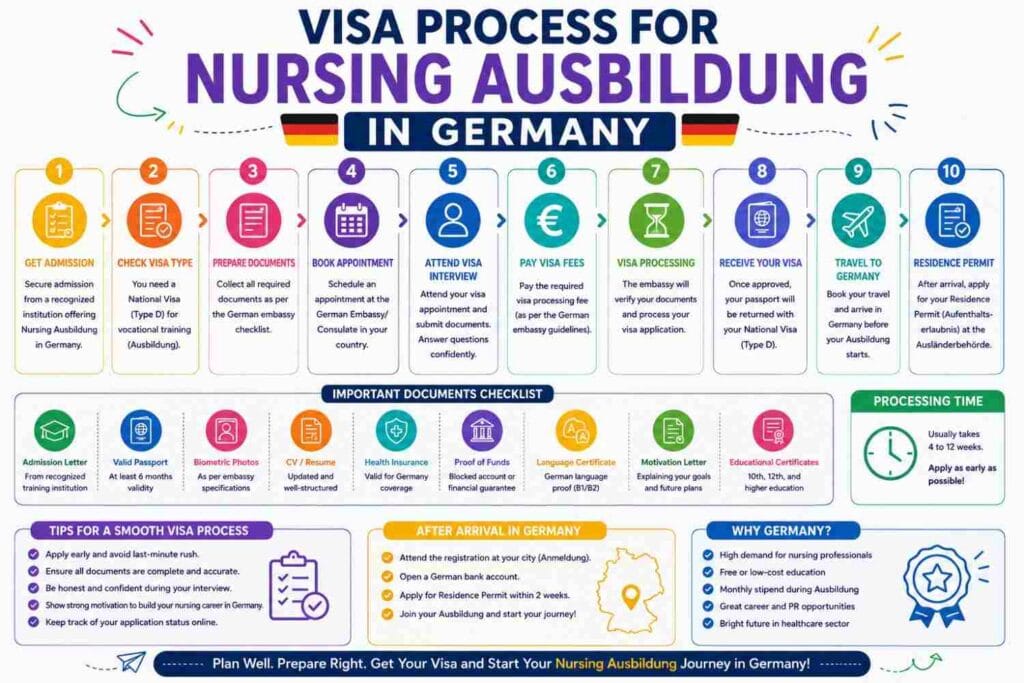
Visa Process for Nursing Ausbildung in Germany
Non-EU citizens need an Ausbildung visa to start a nursing Ausbildung in Germany. This visa is issued under §17 of the German Residence Act (Aufenthaltsgesetz). Here’s how the process works.
- Secure your training contract first. You cannot apply for an Ausbildung visa without a signed Ausbildungsvertrag from a German employer. The contract is the foundation of the entire visa application.
- Book an appointment at the German embassy or consulate in your country. Visa appointments for Germany can be booked several weeks in advance. Book as soon as you have your training contract in hand.
- Prepare your visa documents. You’ll need: completed visa application form, signed training contract, proof of accepted Ausbildung place at a nursing school, B2 German language certificate, school leaving certificate with certified German translation, passport valid for at least the duration of the Ausbildung, biometric passport photos, proof of health insurance (some employers arrange this, confirm with yours), and proof of sufficient funds for initial living costs until your first salary payment.
- Attend your visa appointment. German consulate visa appointments typically last 15 to 30 minutes. Be prepared to answer questions about your training programme and your plans in Germany.
- Visa processing time. An Ausbildung visa is typically processed within 4 to 12 weeks, depending on the consulate’s workload and your country of application. Apply well in advance of your intended start date — at least 3 months before is advisable.
What the Three Years Actually Look Like
One thing that’s hard to picture from abroad is what daily life during a nursing Ausbildung in Germany actually feels like. Here’s a realistic picture.
Your week is split between practical shifts at your training facility and theoretical classes at the Pflegeschule. During practical placements, you work alongside qualified nurses — taking vital signs, administering medications under supervision, caring for patients across different wards. In the classroom, you’re studying anatomy, pharmacology, ethics, care documentation, and nursing procedures in German.
The first six months are the steepest. Your German improves rapidly out of necessity, but the combination of learning a new profession in a second language while working in a physically and emotionally demanding environment is genuinely challenging. Most international trainees describe the first year as the hardest and the most rewarding period of their professional life.
By the second year, most trainees have developed strong professional German and are contributing meaningfully during shifts. The third year feels much more like being a junior nurse than a complete beginner. Your practical placements also rotate through different areas — general medicine, surgery, intensive care, paediatrics, psychiatry — which gives you a broad clinical foundation.
After Your Nursing Ausbildung: Career and Visa Options
Completing a nursing Ausbildung in Germany opens several clear paths forward.
Work Permit After Ausbildung
After completing your Ausbildung, you’re eligible for a regular skilled worker residence permit (Aufenthaltserlaubnis zur Beschäftigung) under §18a AufenthG. Most trainees are offered employment by the same facility where they trained, though you’re free to work for any employer in Germany.
Permanent Residency
After working as a qualified nurse for 24 months (and meeting other standard PR conditions including sufficient German language skills and contributions to the social insurance system), you become eligible to apply for a permanent residence permit under §9 AufenthG. This is one of the most accessible PR pathways available to non-EU citizens in Germany.
Further Specialisation
German nurses can pursue specialist qualifications (Fachweiterbildungen) in areas like intensive care, anaesthesia, oncology, or operating theatre nursing. These usually take one to two years, significantly increase your salary, and are often paid for by your employer. Some qualified nurses also go on to complete a nursing degree (Bachelor of Science in Nursing) at a German university of applied sciences, which opens up management and leadership pathways.
Common Challenges International Students Face in Nursing Ausbildung in Germany
No guide on this topic is honest if it doesn’t cover the real difficulties. Here are the challenges that come up most often and what you can realistically do about each one.
Language Barrier in Clinical Settings
Even with B2 German, medical terminology is its own dialect. Doctors use Latin-derived clinical terms. Patients from different regions speak strong dialects. Documentation has its own format and vocabulary. Plan to actively build your medical German vocabulary before and during your Ausbildung. Many trainees recommend the “Deutsch für Pflegeberufe” textbook series, which is specifically designed for this learning context.
Qualification Recognition Delays
If you have a prior nursing qualification from your home country, the recognition process (Anerkennungsverfahren) can take time. The Make it in Germany recognition portal and the Anabin database are the starting points for checking whether your qualification is recognised and what additional steps may be needed. Starting this process early — before you even arrive in Germany — is strongly recommended.
Homesickness and Cultural Adjustment
Germany is not a warm climate, German workplace culture values directness over hierarchy, and the first winter in a German city can feel genuinely isolating if you’re far from your support network. This is real, and most international nurses mention it as something they weren’t fully prepared for. Connecting with other international nurses through Facebook groups, local expat communities, and your hospital’s international staff network makes a meaningful difference, particularly in the first year.
Finding Accommodation
The German housing market, particularly in cities like Berlin, Munich, Frankfurt, and Hamburg, is tight. Many hospitals offer trainee accommodation or help with housing, which is worth asking about directly when you receive a contract offer. In smaller cities and towns, housing is much more accessible and affordable, which is one reason why smaller-city hospitals can sometimes be better starting points for international trainees than headline names in major metros.
Frequently Asked Questions About Nursing Ausbildung in Germany
Can I do nursing Ausbildung in Germany if I only speak English?
No. The nursing Ausbildung in Germany is conducted entirely in German — both the theoretical coursework at the Pflegeschule and the practical work with patients and medical teams. English is not a working language in most German healthcare settings outside of a few internationally oriented hospitals. B2 German is the minimum requirement, and C1 is needed for full professional registration in most states. If you’re starting from English-only right now, plan at least 18 to 24 months of intensive German learning before applying.
Is nursing Ausbildung in Germany free for international students?
Yes. There are no tuition fees for the Ausbildung itself. Your employer pays for your practical training, and the nursing school (Pflegeschule) is publicly funded. Not only do you pay nothing — you receive a training salary from your first day. The costs you do need to budget for are your living expenses (rent, food, transport) and the cost of your German language courses before you arrive, which can range from €1,000 to €5,000 depending on how much instruction you need and where you study.
How long does it take to become a qualified nurse through Ausbildung in Germany?
The Ausbildung itself takes three years. Before that, you need to achieve German B2 level, which typically takes 18 to 24 months from zero for most learners. So the realistic total timeline from deciding to pursue nursing Ausbildung in Germany to becoming a qualified Pflegefachkraft is roughly four to five years for most international applicants starting from scratch with no German.
Can I bring my family to Germany during the Ausbildung?
Family reunification during an Ausbildung is possible in principle but practically challenging. The Ausbildung salary is not considered sufficient income for family reunification in most cases, particularly for spouses and children. After completing the Ausbildung and working as a qualified nurse, your income level typically does meet family reunification requirements. This is a question worth discussing with the German consulate or an immigration advisor before making family plans around your training timeline.
Do I need a prior nursing qualification to start the Ausbildung?
No. The nursing Ausbildung in Germany is open to people with no prior nursing background. A school leaving certificate is the minimum academic requirement. If you do have a prior nursing qualification from another country, the recognition process may allow you to enter a shortened programme rather than the full three-year Ausbildung, but this depends on the equivalence assessment of your specific qualification.
Which German states are best for finding nursing Ausbildung positions as a foreigner?
Nursing shortages are present across all German states, but North Rhine-Westphalia, Bavaria, Baden-Württemberg, and Lower Saxony tend to have the largest number of available training positions simply because they have the largest populations and healthcare infrastructures. Berlin has many hospitals but a highly competitive housing market. Smaller states like Saxony, Thuringia, and Mecklenburg-Vorpommern often have easier housing situations with fewer applicants for available training positions, making them worth considering even if they’re less well-known internationally.
Is Nursing Ausbildung in Germany the Right Move for You?
The honest answer depends on where you are right now. If you’re willing to commit 18 to 24 months to learning German seriously before you apply, if you can handle the emotional and physical demands of care work in a second language, and if a stable long-term career in one of Europe’s most secure job markets appeals to you, then nursing Ausbildung in Germany is one of the most practical and well-supported pathways available to international applicants right now.
The German government knows it needs international nursing talent and has designed the system to make this pathway work — a paid salary, no tuition, a clear PR pathway, and active recruitment support through official channels. That combination is genuinely rare.
What it’s not is an easy shortcut. The language requirement is real, the cultural adjustment is significant, and the work itself is physically and emotionally demanding. Go in with clear eyes and solid German, and you’ll find a well-paying, stable, respected career with a genuine path to long-term life in Germany. Go in without adequate language preparation and realistic expectations, and you’ll struggle in ways that are difficult to recover from quickly.
For more on funding your study and work journey abroad without breaking the bank, our guide on studying abroad on a low budget puts Germany’s Ausbildung alongside other cost-effective international options. And if you need help structuring your motivation letter or formal application documents, the free templates in our SOP guide are a solid starting point for adapting into a German application format. The full resource library at StudyPathExp covers every step of the process from making the decision to actually landing in your new country.
Disclaimer: Salary figures, visa regulations, language requirements, and Ausbildung programme details referenced in this article are based on publicly available information as of August 2026. German immigration law and nursing training regulations are updated periodically. Always verify current requirements with the relevant German consulate, your prospective employer, and the Make it in Germany official portal before making any application or career decisions. This article is for general informational purposes and does not constitute immigration or legal advice.