The question every F-1 international student eventually asks is simple: can I work while I study, and can I start immediately? The answer is yes — but only if you choose the right institution. Day 1 CPT universities are schools that authorize Curricular Practical Training from your very first semester, meaning you can legally begin working in the United States before you have completed a single year of study. For international students who cannot afford to go twelve months without income, or who have job offers they cannot afford to delay, this is not a nice-to-have. It is a necessity. This guide covers everything you need to know about day 1 cpt universities in 2026 — who they are, how they work, what they cost, and where the risks actually lie.
We are going to be honest with you throughout this article in a way that most CPT guides are not. The space around day 1 cpt universities in usa is filled with marketing, half-truths, and agents who earn commissions for every enrollment they generate. Some of the schools in this space are genuinely strong institutions. Others have a troubling track record with SEVP compliance. And a few have already shut down, leaving their students scrambling for SEVIS transfers with deadlines closing in. Knowing the difference is not just about getting a good education — it is about protecting your immigration status, your career trajectory, and years of planning.
By the time you finish reading this, you will know exactly which cpt day 1 universities are worth your serious consideration in 2026, what the legal framework behind CPT actually says, and how to protect yourself from the most common mistakes F-1 students make when pursuing early work authorization. Let’s start with the foundation.
What Exactly Are Day 1 CPT Universities and How Does the Legal Framework Work?
Curricular Practical Training is a form of work authorization available to F-1 students under US immigration regulations — specifically under 8 CFR 214.2(f)(10), the federal regulation that governs F-1 student employment. CPT allows F-1 students to work off campus in a position that is directly related to their major field of study, provided that the work experience is an integral part of an established curriculum. The critical phrase there is “integral part of an established curriculum” — because that is the legal test every CPT authorization must satisfy, and it is the test that separates legitimate day 1 cpt universities from institutions that are gaming the system.
Standard CPT at most universities requires you to complete one full academic year of study before you become eligible. That is the default rule under F-1 regulations. However, the regulations include an exception: if your graduate program has a practicum, internship, or cooperative education component built into the curriculum from the first semester — as a required course rather than an optional elective — then CPT can be authorized immediately upon enrollment. Day 1 CPT universities are schools that have structured their graduate programs to include this kind of mandatory practical training component from semester one. When it is done correctly, it is entirely legal. When it is done sloppily — or as a transparent workaround with no real academic purpose — it creates serious risk for the student.
The Student and Exchange Visitor Program (SEVP), which sits under the Department of Homeland Security, is the federal body responsible for certifying schools to enroll F-1 students and monitoring their compliance. SEVP does not publish an official list of “approved CPT programs” — CPT authorization happens at the school level through your Designated School Official (DSO). What SEVP does monitor is whether schools are maintaining the academic integrity of CPT authorizations. Schools that authorize CPT without genuine curriculum requirements have faced decertification, and when a school loses its SEVP certification, every F-1 student enrolled there loses their status simultaneously.
This is why the accreditation and institutional history of any day 1 cpt university you consider matters enormously. Regional accreditation — from bodies like the Higher Learning Commission (HLC) or the Southern Association of Colleges and Schools (SACSCOC) — is a strong signal of institutional legitimacy. National accreditation is weaker and more commonly associated with vocational or for-profit schools. When you are evaluating day 1 cpt universities, regional accreditation is the floor, not a bonus feature. Below that floor, the risk to your immigration status increases significantly. Always verify a school’s accreditation status independently at the US Department of Education’s accreditation database before you apply anywhere.
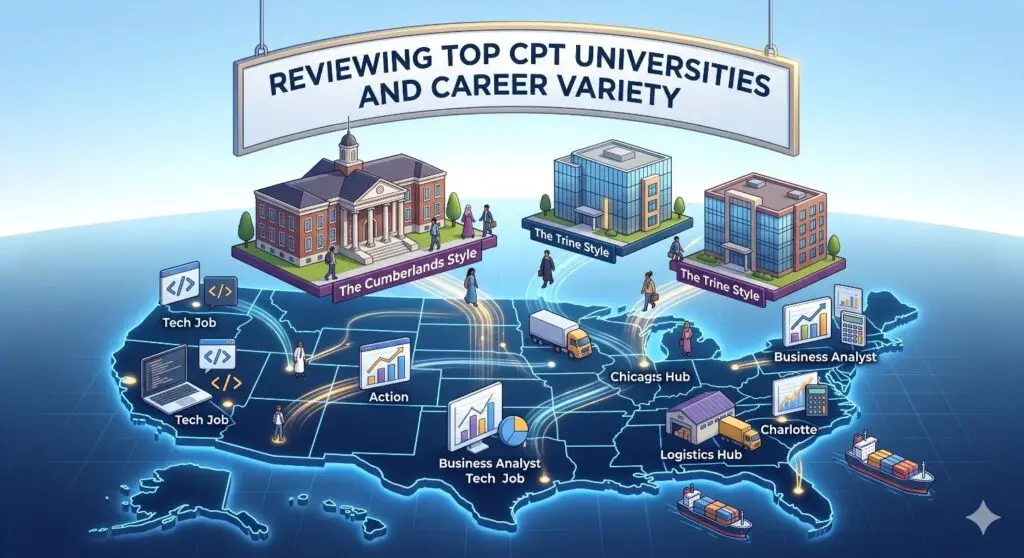
The Best Day 1 CPT Universities in USA: 2026 Honest Reviews
The following reviews cover four of the most frequently searched and most commonly enrolled day 1 cpt universities among F-1 students in 2026. Each review covers what the school offers, what makes it credible, what the costs look like, and where you need to be careful. We are not endorsing any of these institutions — we are giving you the information you need to make your own judgment.
University of the Cumberlands Day 1 CPT Programs
The University of the Cumberlands, based in Williamsburg, Kentucky, is one of the most widely known names among day 1 cpt universities in usa. It is a regionally accredited institution — accredited by the Southern Association of Colleges and Schools Commission on Colleges (SACSCOC) — which gives it a meaningful baseline of institutional credibility that many schools in this space cannot claim. UC has been actively enrolling international graduate students in CPT-eligible programs for several years, and its name recognition among F-1 students is high enough that it frequently appears in immigration attorney discussions alongside schools like Harrisburg and Westcliff.
The graduate programs most commonly associated with Day 1 CPT eligibility at University of the Cumberlands include the Master of Science in Information Technology, the Master of Business Administration (MBA), the Master of Science in Computer Science, and the Master of Science in Cybersecurity. These are high-employability STEM and business fields, which matters both for your job search and for the plausibility of the CPT connection — a CS or IT practicum requirement is far easier to justify to an employer’s legal team than a practicum in a less technically demanding field.
Tuition at UC for graduate international students runs approximately $450 to $600 per credit hour, depending on the program. Most graduate programs at UC are 36 credit hours, putting total tuition in the range of $16,200 to $21,600 for the full degree. UC does offer online-heavy delivery options, which is one of the reasons it has become popular among F-1 students who are working full-time remotely — but this is also a point of caution. Some employers, particularly those with strict onsite work requirements, have raised questions about CPT authorization from institutions where the student has minimal physical campus presence. Discuss your specific employment situation with your DSO before assuming fully remote study and full-time remote CPT will be straightforward.
One thing worth noting about University of the Cumberlands specifically: it has been scrutinized more than once by immigration attorneys and SEVP researchers for its CPT authorization practices at scale. That scrutiny does not mean the school is doing something illegal — it means the volume of CPT authorizations it issues draws attention, and students whose H-1B petitions are later filed citing UC CPT on their resume should be prepared for USCIS to look closely at the academic basis of that CPT. This is not unique to UC, but it is worth knowing before you enroll. Work with an immigration attorney, not just your DSO, if you are planning a long-term H-1B strategy.
For a related deep-dive on another institution in this space that combines regional accreditation with CPT flexibility, read our full review of Indiana Wesleyan University Day 1 CPT: 2026 Ultimate Guide & Fees.
Westcliff University Day 1 CPT
Westcliff University, headquartered in Irvine, California, occupies a different position in the day 1 cpt universities landscape compared to schools like UC or Harrisburg. It is a smaller, private institution that holds national accreditation through the Accrediting Council for Independent Colleges and Schools (ACICS) — not regional accreditation. This is a distinction that matters and one that is frequently glossed over in CPT comparison articles. National accreditation from ACICS carries less institutional weight than regional accreditation from HLC or SACSCOC, and certain employers — particularly large technology companies with rigorous background verification processes — may flag this during employment verification.
That said, Westcliff has built a genuine graduate program offering in California and operates with SEVP certification. Its most CPT-relevant programs include the MBA with concentrations in Healthcare Management, Technology Management, and Finance, as well as a Master of Science in Computer Science. Westcliff markets heavily to international students in the Southern California market, and its location in Irvine — in the heart of Orange County’s tech and business corridor — gives students legitimate access to the employment market that supports CPT’s “curricular” justification.
Tuition at Westcliff for graduate programs runs approximately $500 to $650 per credit hour. The school has physical campus facilities in Irvine, which addresses the onsite attendance concern that dogs more purely online institutions. However, Westcliff has also expanded aggressively into online program delivery, and if you are enrolling in a fully online track, the same employer skepticism questions apply as they do at any heavily online institution offering CPT. California’s proximity to major tech employers is a genuine advantage — but only if your job and your program have a defensible academic connection that your DSO has documented correctly on your I-20.
One thing Westcliff has going for it that some competitors lack is a relatively active career services and employer relations operation in California. Given that California remains one of the top states for F-1 CPT employment — particularly in tech, healthcare, and finance — this matters practically. Your CPT authorization needs to connect your coursework to your job role. The stronger the employer’s name and the clearer the role-to-program connection, the less likely you are to face issues during any future USCIS review. Westcliff’s California network gives you better access to that quality of employer than a school in a rural Kentucky or midwest location might.
The bottom line on Westcliff: it is a workable option for F-1 students in the Southern California job market with a clear career focus in business or technology. The national accreditation is a real limitation that you need to weigh honestly against your long-term career goals. If your target employers include FAANG companies or large financial institutions with strict educational screening processes, research how those employers treat ACICS-accredited degrees before you commit your enrollment deposit.
Harrisburg University Day 1 CPT
Harrisburg University of Science and Technology in Harrisburg, Pennsylvania is one of the most substantive names in the day 1 cpt universities space — and arguably the one with the strongest academic reputation among the schools that actively market CPT programs to F-1 students. HU holds regional accreditation from the Middle States Commission on Higher Education (MSCHE), which is one of the seven recognized regional accreditors in the United States. For F-1 students thinking about long-term immigration pathways — including H-1B sponsorship and eventually green card applications — the credibility of your academic institution is something that will come up in background checks for years after you graduate. Harrisburg’s MSCHE accreditation is a meaningful asset.
Harrisburg University focuses almost entirely on STEM fields, which aligns perfectly with the kinds of programs most likely to support legitimate CPT curriculum connections. Its graduate offerings include the Master of Science in Data Analytics, MS in Computer and Information Sciences, MS in Cybersecurity, MS in Project Management, and MS in Business Intelligence, among others. These are fields with genuine, defensible practical training requirements — data science students working on real enterprise datasets, cybersecurity students engaged in live network environments, project management students running actual projects. The CPT-to-curriculum connection at HU is more naturally defensible than at schools offering practicum components in more generalist business programs.
Tuition at Harrisburg University for graduate international students runs approximately $700 to $900 per credit hour, making it one of the pricier options among day 1 cpt universities in usa. A 30 to 36 credit hour program puts total tuition in the range of $21,000 to $32,400. That is not a small number — but Harrisburg’s STEM focus means that students who secure strong CPT employment in data, cloud infrastructure, or cybersecurity are often earning salaries that make the tuition calculation work reasonably well. The school also offers a hybrid delivery model with required onsite components at its Harrisburg campus, which addresses the “fully online” concern directly.
Harrisburg University has invested significantly in career services and employer partnerships, with a particular focus on East Coast technology and government contracting employers. For F-1 students interested in roles with government contractors — including defense and intelligence sector companies — Harrisburg’s Pennsylvania location, reputation, and government-adjacent focus can open doors that a California-focused school might not. That said, government contractor roles often come with additional background screening requirements for foreign nationals, so research your specific target employers’ foreign national hiring policies before making location and program decisions based on that pathway.
If you are looking for the strongest combination of institutional credibility and genuine STEM program depth among day 1 cpt universities, Harrisburg University consistently sits near the top of honest assessments. The higher tuition is the main friction point. Weigh it against your expected starting salary in your target field and do the math before you commit.
Trine University Day 1 CPT
Trine University, based in Angola, Indiana, is perhaps the least well-known of the four schools in this review among international students searching for day 1 cpt universities — but it deserves serious attention. Trine is a regionally accredited institution through the Higher Learning Commission (HLC), the same body that covers large Midwest state universities. It has been operating since 1884, giving it a century-long institutional track record that none of the newer, more aggressively marketed CPT schools can claim. Longevity is not everything, but it is a meaningful signal of stability in a space where schools have been known to shut down abruptly.
Trine’s graduate programs relevant for F-1 students seeking CPT include the Master of Business Administration, the Master of Science in Engineering Management, and select graduate programs in Criminal Justice and Leadership. The MBA and Engineering Management programs are the most commonly cited in CPT contexts, and Trine has built out practicum-based components in these programs specifically to support legitimate CPT authorization from semester one. The Engineering Management program in particular is notable — engineering management is a high-employability field that bridges technical and business roles, and the CPT connection for students in manufacturing, operations, or project management roles is genuinely straightforward to document.
Tuition at Trine for graduate international students runs approximately $550 to $700 per credit hour, positioning it in the mid-range of day 1 cpt universities in terms of cost. Angola, Indiana is a small town, which some students find limiting in terms of local employment access — but Trine’s CPT authorization does not require you to work locally. F-1 students at Trine have secured CPT employment across the country, working remotely or in major metro areas while maintaining enrollment at Trine. If remote work in your target field is viable, the school’s rural location is largely irrelevant to your employment outcome.
One aspect of Trine that distinguishes it from some competitors is its relatively smaller international student enrollment in CPT programs, which means the school has not drawn the same level of SEVP scrutiny or immigration attorney attention as higher-volume CPT institutions like University of the Cumberlands. Smaller enrollment in CPT programs can be a genuine advantage: your DSO has more bandwidth per student, CPT documentation tends to be more carefully handled, and the school has less reputational exposure if SEVP changes its enforcement posture. It is a quieter option in a noisy space — and that quietness is sometimes exactly what you want when your immigration status is on the line.
For F-1 students who want the credibility of HLC regional accreditation, a long institutional history, and a less crowded CPT processing environment, Trine University is worth adding to your shortlist. Contact their international admissions office directly to confirm current CPT-eligible programs and enrollment timelines for your intended start semester.
How to Choose the Right Day 1 CPT University for Your Specific Situation
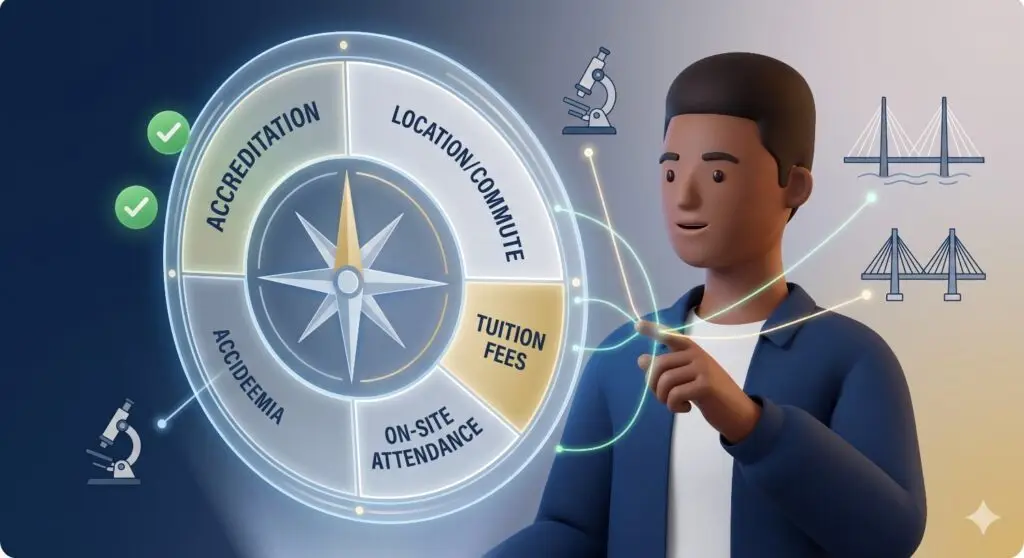
Choosing between day 1 cpt universities is not just about which school has the most students or the most aggressive marketing. The right school for you depends on a combination of factors that are specific to your profile: your target job field, your target employers, your geographic flexibility, your long-term immigration goals, and your risk tolerance. Here is how to think through each of these factors systematically before you commit an application or a deposit.
Accreditation type should be your first filter. Regional accreditation — from HLC, SACSCOC, MSCHE, or any of the other recognized regional bodies — is significantly stronger than national accreditation. Most serious employers conduct educational background verification through third-party services like The Work Number or HireRight, and those services flag the accreditation type of your institution. If you are targeting Fortune 500 employers, financial services firms, or technology companies with rigorous hiring processes, an ACICS-nationally-accredited degree may create friction during background screening. Start your evaluation with the accreditation filter and only move schools without regional accreditation to your list if you have a specific, well-researched reason to do so.
Program-to-job match is your second filter — and it is the legal heart of CPT. Your CPT authorization must be based on a genuine curricular requirement. That means your job role must be directly related to your field of study, and your DSO must be able to document that relationship clearly on your I-20. The more obvious and defensible that connection is, the less exposure you have if USCIS ever reviews your immigration history. A cybersecurity student working as a security analyst — clear connection. An MBA student working as a data entry clerk in an unrelated industry — problematic. Choose a program in a field where you already have a legitimate job offer or strong job market prospects, not just a program that happens to offer CPT.
Onsite attendance requirements matter more than most CPT guides admit. Several day 1 cpt universities offer programs that are substantially or entirely online. While fully online programs are not automatically illegitimate, they create a specific type of scrutiny: USCIS and employers may question whether a student who has never physically attended class at their enrolled institution has a genuine academic relationship with that school. Some attorneys recommend that F-1 CPT students have at least some documented physical campus presence — attending orientation, visiting campus for an event, or enrolling in at least one onsite course component — to strengthen the credibility of their enrollment. Ask each school specifically what their onsite requirements are and what documentation they provide to students about campus engagement.
Your long-term immigration pathway should shape your school selection from day one. If your goal is H-1B sponsorship and eventual green card, the quality and credibility of your US degree will be evaluated multiple times — at the H-1B petition stage, at any RFE response stage, and potentially during green card processing. Schools with strong regional accreditation and genuine academic programs create a more defensible immigration record than schools with weaker credentials. The short-term savings of a cheaper or easier-to-enroll program can become long-term immigration liabilities. Think ten years ahead, not just ten months ahead. For more on planning your study abroad strategy comprehensively, visit studypathexp.com for guides on program selection, visa planning, and financial preparation.
The Real Risks of Day 1 CPT: RFEs, Status Violations, and What No One Tells You
This is the section that most articles on day 1 cpt universities skip entirely — or bury in vague disclaimers. We are going to be direct, because the stakes for your immigration status are too high for vague disclaimers. Day 1 CPT is legal when done correctly. When done incorrectly — or when the institution’s CPT program later comes under SEVP review — the consequences for students can be severe and long-lasting.
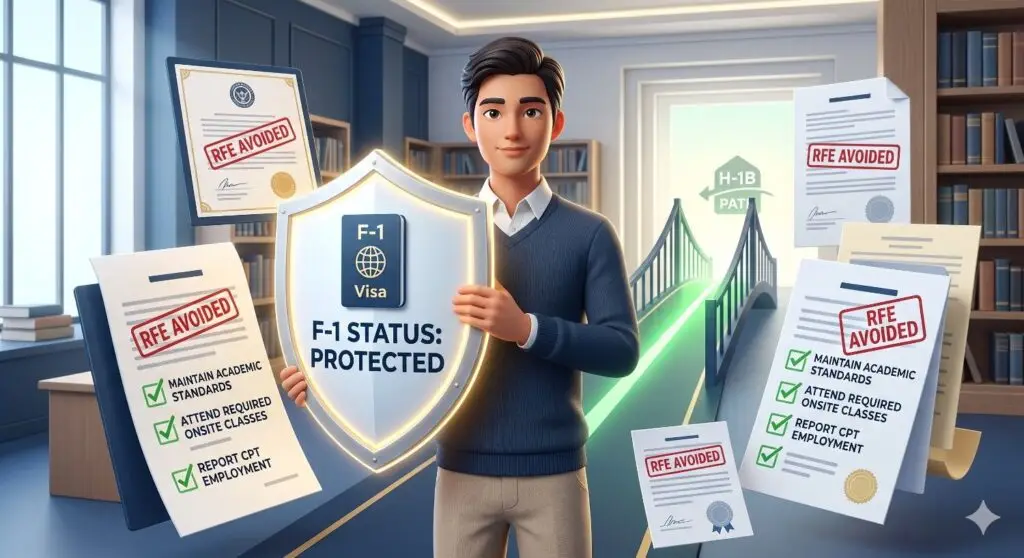
The RFE risk during H-1B is real and specific. When your employer files an H-1B petition on your behalf — typically within a few years of graduating — USCIS adjudicators review your immigration history, including your CPT usage. If USCIS determines that your CPT was not properly authorized, or that the academic institution’s CPT program lacked genuine curricular integrity, they can issue a Request for Evidence challenging your work authorization history. An RFE during H-1B processing is not an automatic denial, but it is expensive, time-consuming, and stressful. It delays your H-1B status, creates uncertainty for your employer, and requires you to build a retroactive case for the legitimacy of work authorization you received years earlier. The better your CPT documentation — and the stronger your institution’s accreditation — the lower your RFE risk.
Unauthorized employment is one of the most serious F-1 status violations. Under USCIS regulations governing F-1 student employment, working without valid authorization — including working before your CPT I-20 is updated, working at an employer not listed on your I-20, or working in a role that does not match your authorized CPT position — constitutes unauthorized employment. The consequences include termination of F-1 status, potential removal proceedings, and future visa bars. None of these are theoretical. F-1 students have faced these consequences, and the fact that “your agent said it was fine” or “other students at your school were doing it” is not a legal defense. Follow the authorization sequence exactly: course registration first, CPT request second, DSO approval third, I-20 update fourth, work start date after.
School closures and SEVP decertification are rare but catastrophic when they happen. In recent years, several schools that were marketing aggressive CPT programs to international students have faced SEVP investigations and, in some cases, decertification. When a school loses its SEVP certification, it immediately loses the ability to issue or maintain I-20s. F-1 students enrolled at a decertified school are in immediate status jeopardy and typically have a very short window — often 15 days — to transfer their SEVIS record to a new SEVP-certified institution. If you are working full-time on CPT when this happens, your work authorization is void from the moment of decertification. This is not a hypothetical scenario — it has happened to real students at real schools. Protecting against it means choosing institutions with strong accreditation, long operational histories, and no recent SEVP compliance concerns.
OPT elimination is the most commonly misunderstood risk. Using 12 months or more of full-time CPT makes you permanently ineligible for OPT. STEM OPT, which provides 36 months of post-graduation work authorization at qualifying employers, is one of the most valuable immigration assets an F-1 student can hold after graduation. Many F-1 students pursue Day 1 CPT without fully understanding that aggressive CPT usage — say, 18 months of full-time CPT across a two-year program — eliminates their ability to use OPT entirely. Plan your CPT usage carefully. Track every day of full-time CPT authorization. If your goal is to preserve OPT, structure your CPT so that total full-time usage stays under 12 months, even if that means taking some semesters at part-time CPT status while supplementing income through other means.
Final Thoughts on Day 1 CPT Universities and Frequently Asked Questions
Day 1 CPT universities in usa represent a genuine pathway for F-1 students to build their US career from the moment they arrive — without waiting a year, without burning OPT prematurely, and without the financial pressure of twelve months of tuition costs with no income. When the right institution is chosen, the program is genuinely educational, and the CPT employment is in a field that matches the curriculum, this pathway can work extraordinarily well. We have seen students go from international student visas to permanent residency using exactly this route, with strong employers, clean immigration records, and careers they built from semester one.
But we have also seen the other outcome — students who enrolled at the wrong school, worked at the wrong employer, skipped steps in the authorization process, or failed to track their OPT eligibility — and who are now dealing with immigration consequences that follow them for years. The difference between those outcomes is almost always information and preparation. You are doing the right thing by researching carefully before you commit.
Use the resources available to you: talk to multiple immigration attorneys (not just agents), speak directly with DSOs at your shortlisted schools, connect with students who have already been through the CPT process at those institutions, and read the actual federal regulations, not just summaries of them. For detailed guidance on specific schools, including our full review of Indiana Wesleyan University Day 1 CPT and its 2026 fee structure, visit our complete guide library at studypathexp.com.
Frequently Asked Questions About Day 1 CPT Universities
Below are the five questions we hear most consistently from F-1 students researching day 1 cpt universities. The answers are based on current regulations as of 2026 — always verify with a licensed immigration attorney and your DSO before making any enrollment or employment decisions.
Q1: Are Day 1 CPT universities legal, or is this a loophole that USCIS will crack down on?
Day 1 CPT is legal under existing F-1 regulations when it is properly structured. The regulation at 8 CFR 214.2(f)(10) permits CPT authorization from semester one for graduate programs that have a mandatory practical training component built into the curriculum. This is not a loophole — it is a specific, documented provision of F-1 regulations that has existed for decades. USCIS is aware of Day 1 CPT programs and has not moved to eliminate the provision. What USCIS does scrutinize is whether individual CPT authorizations meet the “integral part of an established curriculum” standard. Schools that authorize CPT without genuine academic requirements are the targets of enforcement action — not students at legitimately structured programs. The risk to you is in choosing the wrong school or the wrong program, not in CPT itself as a concept.
Q2: Can I use Day 1 CPT and then still apply for OPT after graduation?
Yes — as long as your total full-time CPT usage stays under 12 months. This is the most important number in Day 1 CPT planning. If you use 12 months or more of full-time CPT during your program, you become permanently ineligible for OPT — including STEM OPT. If you use 11 months and 29 days of full-time CPT, you remain fully eligible for both standard OPT (12 months) and STEM OPT extension (up to 24 additional months). Many students deliberately plan their CPT usage to preserve OPT: they take part-time CPT for certain semesters, take a semester without CPT, or structure their job to part-time status during a specific period. Track your CPT days precisely from the first authorization date, and ensure your DSO is tracking them too.
Q3: How do employers view degrees from Day 1 CPT universities — will it hurt my career?
This depends entirely on which school you attended and which employer you are targeting. Degrees from regionally accredited Day 1 CPT universities — Harrisburg, Trine, University of the Cumberlands, Indiana Wesleyan — are recognized by most US employers and are not flagged during standard background checks. The degree itself is what it is: a legitimate graduate credential from an accredited US institution. Where you may encounter friction is at employers with extremely rigorous educational screening processes, or at employers who have specifically developed internal policies around CPT-heavy institutions. This is relatively rare but not unheard of in financial services and certain government contracting environments. The solution is choosing the school with the strongest accreditation you can qualify for, not avoiding Day 1 CPT entirely.
Q4: Do I need to physically attend campus to maintain valid F-1 status on Day 1 CPT?
F-1 regulations require you to maintain a full course of study — defined as a minimum number of credit hours per semester that your school considers full time for graduate students, typically 9 credit hours per semester. They do not explicitly require physical campus presence if your program is delivered online. However, as discussed in the body of this guide, purely online enrollment with no physical campus presence creates questions that USCIS adjudicators sometimes raise, particularly when reviewing CPT authorization histories during H-1B processing. The practical recommendation from most experienced immigration attorneys is to have some documented physical connection to your enrolled institution — attend orientation in person, visit campus at least once per academic year, and ensure your school has physical infrastructure, not just a mailing address. All four schools reviewed in this guide have physical campuses.
Q5: What documents should I keep to protect myself if USCIS ever questions my CPT history?
Keep permanent, organized copies of the following: every version of your I-20 that authorized CPT, including the specific dates and employer listed on each; your official course registration records for every semester you used CPT, showing the practicum or internship course you were enrolled in; your employment offer letters from every CPT employer, including the job description and start/end dates; any DSO correspondence authorizing your CPT; your transcripts showing completion of the practicum courses; and pay stubs or W-2s from CPT employment. Store these documents both digitally and physically, in a location you control independently of your school. If your school closes, you still need access to these records. Students who have faced H-1B RFEs related to CPT are enormously grateful they kept this documentation — students who did not keep it face a much harder road.