By Mohsin Khan | Updated: May 2026 | 15 min read | Study in UK
Let me ask you something blunt. You’ve probably already Googled “best countries to study abroad” at least three times. You’ve seen the same recycled lists — Canada, Australia, Germany, USA. So why does the UK keep showing up at the top of serious students’ shortlists?
Because when you actually dig into the numbers, the timelines, and the real post-graduation outcomes — the answer becomes clear. Nearly 700,000 international students chose the UK last year alone. That’s not marketing. That’s people voting with their futures.
If you’ve been asking yourself why study in UK — or what the real benefits of studying in UK are beyond the headline university rankings — this guide gives you the honest, unfiltered breakdown. Every major advantage, every practical detail, what it actually costs Pakistani students, and how to answer the visa interview question that trips most applicants up.
In This Guide
- Universities That the World Actually Respects
- The 1-Year Master’s: The Reason Postgrads Keep Choosing the UK
- The Graduate Route Visa — Your Two-Year Head Start
- NHS Healthcare — The Benefit Nobody Talks About Enough
- Cultural Diversity — You Won’t Feel Like an Outsider
- Total English Immersion
- Scholarships and Funding
- Graduate Careers and Alumni Networks
- Safety, Infrastructure, and Quality of Life
- Real Costs for Pakistani Students in 2026
- Answering the Visa Interview Question: “Why Do You Want to Study in the UK?”
1. Universities That the World Actually Respects
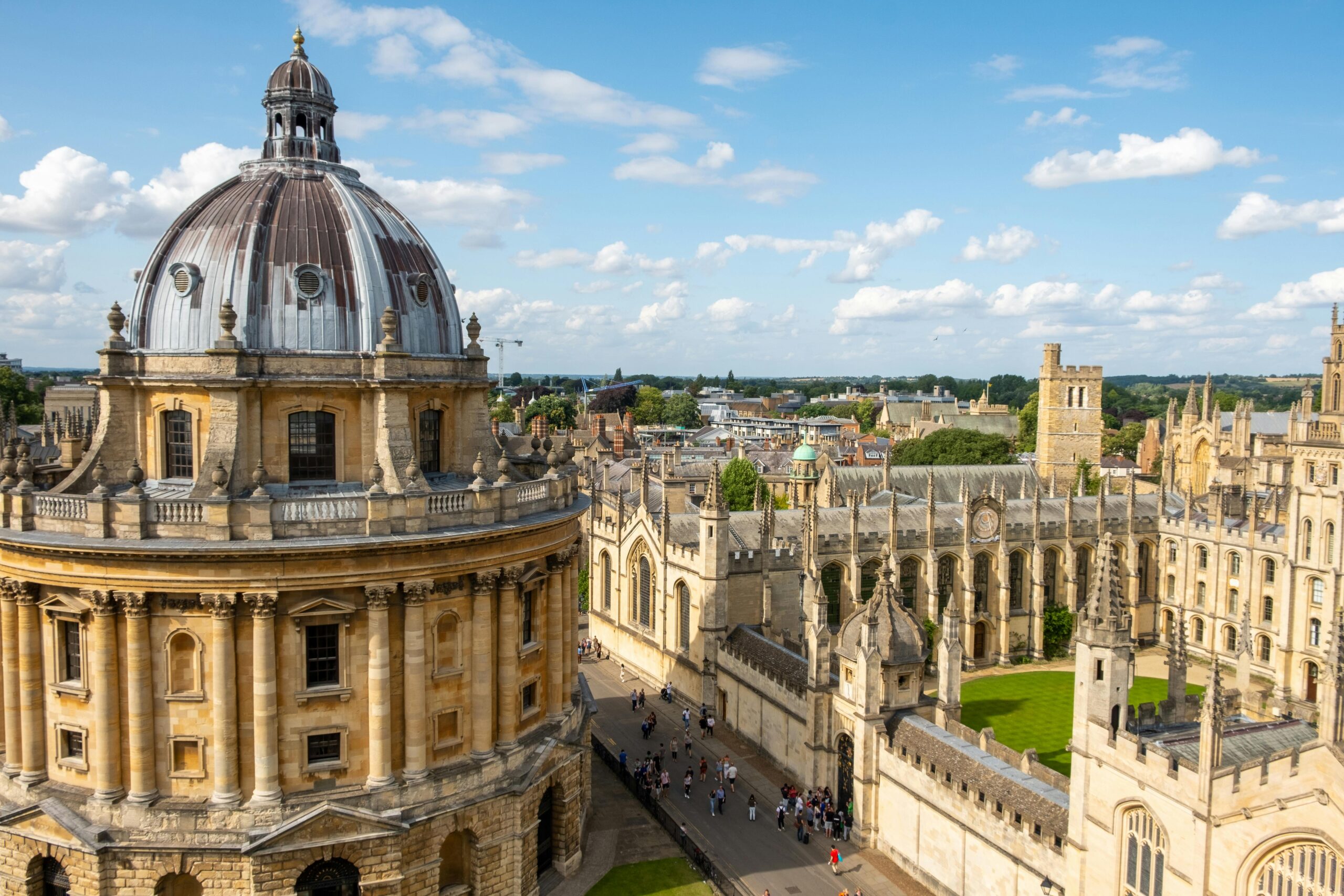
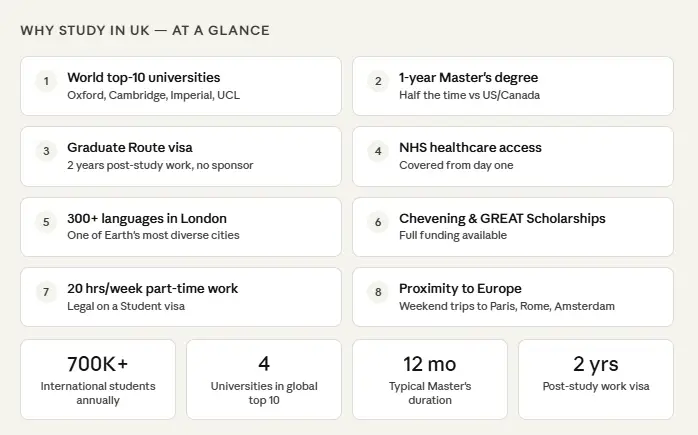
Four of the world’s top ten universities are British. Oxford. Cambridge. Imperial College London. UCL. That’s not a coincidence — it’s the result of centuries of investment in research infrastructure, academic freedom, and faculty who are genuinely at the frontier of their fields.
But here’s what the rankings don’t tell you. It’s not just Oxbridge that matters. The University of Edinburgh produces graduates recruited by global consultancies. Manchester’s engineering programmes feed directly into aerospace and manufacturing firms. King’s College London places students in policy roles across governments and international organisations. One of the strongest advantages of studying in UK is precisely this depth — the academic ecosystem runs well beyond the famous names, and employers worldwide know it.
What makes UK teaching genuinely different
- Heavy emphasis on independent research and critical analysis — you’re not just absorbing content, you’re challenged to question it
- Most undergraduate programmes run 3 years in England, trimming a full year of fees and living costs compared to American or Canadian equivalents
- Lecturers frequently combine active research with teaching — so your seminar discussion connects to cutting-edge work published last month, not a textbook from 2015
- Small-group tutorials (especially at Oxbridge) mean you can’t hide — and that pushes your thinking faster
For Pakistani students specifically: a UK degree from a recognised institution carries real weight in Pakistan’s corporate sector, in the Gulf, and across international organisations operating in South Asia. Employers in Karachi, Lahore, Dubai, and London itself treat UK-educated candidates differently. That’s a concrete, career-shaping reason why study in UK makes strategic sense.
2. The 1-Year Master’s: The Reason Postgrads Keep Choosing the UK
If you’re considering postgraduate study, this single fact changes the entire calculation. A UK Master’s degree — MSc, MA, MBA, LLM, whatever the discipline — is typically done in 12 months. The equivalent qualification takes 18 to 24 months in the United States or Canada. That’s not a minor difference. That’s one entire year of your life, your career, and your earning potential.
Think about the person who chooses Canada for their Master’s. By the time they’re halfway through their second semester of coursework, you could already have your UK degree in hand and be applying for jobs. This is one of the most underrated benefits of studying in UK for Pakistani and Indian students — you spend less time out of the workforce, and less money on living costs.
Who benefits most from the accelerated timeline
- Professionals on a career break — every extra month out of the workforce is expensive, professionally and financially
- Sponsored students — if your employer, government, or scholarship has a fixed funding window, 12 months fits. 24 months often doesn’t.
- Career changers — the faster you can credential into a new field, the less runway you burn
- Recent graduates — get specialised, get qualified, get moving — without spending two years in academic limbo
Yes, the pace is intense. UK Master’s programmes expect you to hit the ground sprinting. But if you’re the kind of person reading a detailed guide about why study in UK is worth it, you can handle it.
3. The Graduate Route Visa — Your Two-Year Head Start
In 2021, the UK government relaunched one of the most genuinely student-friendly immigration policies in the English-speaking world: the Graduate Route visa. Here’s what it actually gives you — no spin:
- Two full years to live and work freely in the UK after graduating (three years for PhD graduates)
- Zero employer sponsorship required during this entire period
- The legal right to work in any role, at any salary level, switch jobs whenever you want, or explore self-employment
This directly answers the question that haunts most international students: “What happens the day after graduation?” With the Graduate Route, the answer is: you stay, you work, you build experience, and you figure out your next step from inside the UK — not from back home filling out applications and hoping a sponsored role comes through.
For students from Pakistan especially, where UK work experience dramatically accelerates career trajectories back home and in the Gulf, this visa is a genuine life accelerator. It’s not just a perk. It’s a strategic advantage that appears on no other destination’s list in quite the same way. This is arguably the single most compelling reason why you want to study in UK in 2026 specifically — because the Graduate Route is still intact and currently under policy review, meaning it may change in future years.
If your visa application is refused before you even get here, none of this matters. Read our full UK Student Visa Refusal 2026 guide — including the 609% rise in refusals and which universities are still admitting Pakistani students — before you submit anything.
4. NHS Healthcare — The Benefit Nobody Talks About Enough
Everybody mentions the universities. Hardly anyone explains the healthcare situation properly. So let’s fix that. When you apply for a UK Student visa, you pay an Immigration Health Surcharge (IHS) — currently £776 per year of study. In return, you get full access to the National Health Service (NHS), the same universal healthcare system that British citizens use.
What this covers in practice
- GP (doctor) appointments — free at the point of use
- Hospital treatment, including emergency care — covered
- Mental health services — accessible via NHS referral, increasingly important for international students navigating academic pressure far from home
- Prescriptions — a fixed charge per item (currently £9.90 in England as of 2026, free in Scotland and Wales), regardless of the medication’s actual cost
For students coming from Pakistan, where private medical bills can be catastrophic without insurance, this is a fundamentally different reality. You are not one unexpected illness away from a financial crisis. That peace of mind has real value that doesn’t show up in any university brochure — and it’s one of the most tangible benefits of studying in UK that students only fully appreciate after they arrive.
5. Cultural Diversity — You Won’t Feel Like an Outsider
Walk through Birmingham, Manchester, Leeds, or London on any given morning and pay attention. Listen to the conversations around you. Look at the restaurant signs, the shop names, the faces on the bus. The UK — and especially its major cities — is one of the most genuinely multicultural places on earth.
- Your community is already there. Almost every UK university has cultural societies, Pakistani and South Asian student associations, and active faith groups. You won’t be starting from zero.
- Food familiarity is real. Halal restaurants, South Asian grocery stores, Pakistani supermarkets — they exist in abundance in Birmingham, Bradford, Manchester, Leeds, and London.
- Faith infrastructure is in place. Mosques are accessible and active in every major UK student city. Friday prayers, Ramadan facilities, and Eid celebrations are part of student life, not exceptions.
- Culture shock is genuinely reduced. Students who feel settled and comfortable perform better academically. It’s that simple.
London alone is home to speakers of over 300 languages. There are an estimated 1.6 million people of Pakistani heritage living in the UK — meaning you will have community, familiarity, and a support network from day one in a way that Germany, South Korea, or Japan simply cannot offer.
6. Total English Immersion — A Career Advantage That Compounds
This one is underrated. Not just because English proficiency is career-valuable — obviously it is — but because living in an English-speaking environment is categorically different from studying English in a classroom.
When you’re in the UK, English isn’t a subject. It’s the language you use to negotiate your lease. Argue a point in a seminar. Network at a careers fair. Complain about a delayed train. Write a dissertation that a professor will tear apart if the argument is weak. The immersion is total. Unavoidable. And it accelerates fluency faster than any language programme ever could.
This is one of the most underappreciated advantages of studying in UK — especially for students from Pakistan, where English is already used professionally but full immersion takes communication skills to a completely different level. Pakistani students who return home after a UK degree consistently report that the shift in their professional confidence — presentations, negotiations, writing — is one of the most lasting changes from their time abroad.
Why UK English proficiency specifically matters for Pakistani students
- International businesses in Pakistan, the Gulf, and Southeast Asia frequently treat British-educated candidates as a mark of high professional polish — right or wrong, that perception affects hiring decisions
- The academic writing skills developed in UK programmes transfer directly to professional report writing, client communication, and policy work
- Students consistently report that their confidence in professional communication — presentations, negotiations, difficult conversations — transforms within a few months of arriving
Before you arrive, make sure your IELTS score is solid. Read our Complete IELTS Guide for Pakistani Students 2026 for score requirements and preparation strategies that actually work.
7. Scholarships and Funding: More Options Than You Think
Let’s be honest about cost. UK tuition for international students typically runs between £10,000 and £38,000 per year, depending on the programme and institution. London is expensive to live in. This is not a cheap option. But the funding landscape is genuinely rich — and most Pakistani students don’t fully explore it.
Major scholarships worth your attention
Chevening Scholarships — Funded by the UK government, these cover full tuition, living costs, flights, and a visa fee contribution. They’re competitive and targeted at future leaders. Applications open annually and the selection process looks for people with a credible plan for what they’ll do after returning home. Pakistani students have historically been among the top recipients globally.
Commonwealth Scholarships — Available to students from Commonwealth nations including Pakistan. Cover full costs for Master’s and PhD programmes. Highly competitive, but genuinely full-ride.
GREAT Scholarships — A British Council programme offered in partnership with specific countries, including Pakistan. Check current availability on the British Council Pakistan website.
University-specific awards — Most UK universities offer merit-based fee reductions ranging from £2,000 to full tuition waivers. These often aren’t prominently advertised — you have to apply directly or email the international office and ask specifically.
HEC Overseas Scholarships — Pakistan’s Higher Education Commission funds study abroad programmes specifically for Pakistani students pursuing postgraduate degrees at top-ranked universities. Check hec.gov.pk for current open windows.
And remember: the 1-year Master’s means you’re paying both tuition and living costs for 12 months instead of 24. That’s a built-in financial advantage before any scholarship is applied. For a complete list of fully funded options, read our Fully Funded Scholarships 2026 for Pakistani Students guide.
8. Graduate Careers and Alumni Networks That Open Real Doors
A degree is only as valuable as what it connects you to afterward. UK universities — particularly the Russell Group — invest heavily in graduate outcomes.
- Dedicated careers services that actively connect international students with employers recruiting globally
- On-campus recruitment events where firms like Goldman Sachs, McKinsey, Deloitte, the UN, and tech multinationals show up looking for talent
- Alumni networks that span governments, NGOs, startups, and corporations in virtually every country — including very active Pakistani alumni communities at institutions like LSE, Manchester, and Edinburgh
- Published graduate employment statistics — UK universities are legally required to report these, meaning you can research real post-graduation outcomes before you even apply
For Pakistani students returning home, a UK alumni network is not a formality — it’s a genuine professional asset. The number of senior positions in Pakistan’s banking, legal, NGO, and government sectors held by UK graduates is disproportionately high relative to the country’s total graduate population.
9. Safety, Infrastructure, and Quality of Life
The practical stuff matters too. The UK is consistently ranked among the safer countries in the world for international students, with strong legal protections and well-resourced university welfare systems. Beyond safety, the infrastructure makes daily life manageable in a way that directly affects your academic focus:
- Excellent public transport — trains, buses, the Underground — with student railcards offering up to one-third off rail travel nationwide
- Part-time work rights of up to 20 hours per week during term time on a Student visa — enough to meaningfully supplement your living costs
- A well-regulated rental market with legal protections for student tenants
- Easy weekend access to Europe — budget flights to Paris, Amsterdam, Barcelona, Rome, or Istanbul are common and often surprisingly cheap when booked ahead
Once you arrive, opening a UK bank account should be your first practical step. Read our UK Student Bank Account guide for which banks are easiest for Pakistani students and exactly what documents you need.
10. Real Costs for Pakistani Students in 2026 — In PKR
One thing most “why study in UK” articles never do is translate costs into what Pakistani families actually deal with. Here it is, honestly.
| Cost Item | Amount (GBP) | Approx. PKR (May 2026) |
|---|---|---|
| Tuition (Master’s, 1 year — mid-range university) | £14,000–£22,000 | PKR 5.0M–7.9M |
| Tuition (Master’s, London / Russell Group) | £22,000–£38,000 | PKR 7.9M–13.7M |
| Living costs — outside London (9 months) | £9,000–£12,000 | PKR 3.2M–4.3M |
| Living costs — London (9 months) | £13,500–£18,000 | PKR 4.9M–6.5M |
| Immigration Health Surcharge (1 year) | £776 | PKR ~280,000 |
| Student visa application fee | £490 | PKR ~176,000 |
| Total 1-year Master’s (outside London) | ~£25,000–£35,000 | PKR ~9M–12.6M |
| Total 1-year Master’s (London) | ~£37,000–£58,000 | PKR ~13.3M–20.9M |
Key point: These are 1-year totals. Canada or USA would cost you 2–2.5x this amount for the equivalent Master’s degree when you factor in the extra year. The 12-month structure is not just convenient — for many Pakistani families, it’s what makes the UK financially possible at all compared to North America.
Sheffield, Leeds, Nottingham, Liverpool, Newcastle, and Glasgow consistently deliver excellent academic quality at 30–50% lower living costs than London. These cities have strong Pakistani communities, good transport, and universities that genuinely support international students. Don’t let the London bias push you toward a more expensive experience than you need.
Compare the UK against other destinations in full detail: Top 10 Countries to Study Abroad for Pakistani Students 2026.
11. Answering the Visa Interview Question: “Why Do You Want to Study in the UK?”
This section might be the most practically useful thing in this entire guide. Because this question — asked in UK student visa credibility interviews, personal statements, and university applications — trips up more Pakistani applicants than any paperwork issue.
Visa officers and admissions teams are not impressed by generic enthusiasm. They’ve heard “the UK has excellent universities” approximately ten thousand times. What they’re actually assessing is whether you’ve thought seriously about your choice — and whether your plan makes coherent sense.
The difference between a weak and a strong answer
Weak: “The UK is famous for quality education and I want to improve my English and gain international experience.”
This tells them nothing. It could describe any country and any programme. Every visa officer reading a Pakistani application has seen this phrasing hundreds of times this month alone.
Strong: “I’ve chosen the University of Manchester because the MSc in Data Science is the only UK course that combines quantitative modelling with business application in the way my current role at [company] requires. The 12-month structure fits within my employer’s study leave window. The Graduate Route visa gives me two years of UK work experience before I return to Lahore, where I intend to join [specific sector]. That career plan is why I want to study in UK specifically — not just abroad generally.”
That answer shows research, specificity, and a credible plan. It answers the question the officer is actually asking: do you know what you’re doing, and will you come back?
The five pillars of a strong answer
- Specific university and department — name the faculty, the course, the reason this institution over others
- Programme fit — explain what this specific degree offers that others don’t
- Career alignment — connect the degree to a clear professional trajectory back in Pakistan
- Timeline logic — show why the UK’s 12-month structure fits your specific situation
- Post-study intent — be honest and coherent about what happens after graduation
Prepare this before your interview. Practice it out loud. Know your why in specific, articulable terms — not just as a feeling. Our Student Visa Interview Guide 2026 has the full list of UK credibility interview questions with sample answers.
Frequently Asked Questions
Is a UK degree worth the cost for Pakistani students?
For most serious students — yes, and the maths is clearer than people expect. The 1-year Master’s means you pay tuition for 12 months instead of 24, saving roughly a full year of fees and living costs compared to the US or Canada. Add scholarship opportunities, part-time work rights during study, and the post-graduation earning premium that UK-educated professionals see in Pakistan’s corporate sector and the Gulf job market, and the ROI calculation shifts significantly. That said, it genuinely depends on your field, your target job market, and what funding you can access.
Can I bring my family to the UK while studying?
If you’re enrolled in a full-time degree-level course at a UK university, you may be eligible to bring a spouse or partner (and in some cases children) on a Dependant visa. Your dependants can typically work full-time in the UK. Eligibility conditions apply and have been subject to policy changes — always verify current rules on the official UK government website or through your university’s international student support team before making plans.
Is the UK safe for Pakistani students?
Generally, yes. The UK has strong legal protections, a well-established Pakistani community, and university campuses that take student safety seriously. Most Pakistani students report feeling comfortable and welcomed — especially in diverse cities like London, Birmingham, Leicester, Bradford, and Manchester where the Pakistani community is large, well-established, and culturally present in daily life.
How hard is it to find part-time work as a Pakistani student in the UK?
Harder than some students expect, easier than others fear. The job market varies by city — London has the most opportunities but also the highest competition. Retail, hospitality, tutoring, and campus jobs are the most common entry points. Budget conservatively and treat any part-time income as a supplement to your main funding rather than a primary source.
What happens after the 2-year Graduate Route visa expires?
The most common path for students who want to stay longer is transitioning to a Skilled Worker visa, which requires a job offer from a UK employer with a sponsorship licence at or above the required salary threshold. Others use the two years to gain experience and build a UK professional network, then return to Pakistan with credentials and work history that significantly boost their career. Go in with a plan — the Graduate Route is not a permanent solution, but it’s a serious head start.
Do I need IELTS to study in the UK?
Most UK universities require proof of English proficiency, and IELTS Academic (UKVI-approved) is the most widely accepted test. Typical requirements range from 6.0 to 7.5 overall depending on the course level and institution. Read our Complete IELTS Guide for Pakistani Students 2026 for a full breakdown of requirements by country and university type.
Which UK cities are the most affordable for Pakistani students?
London is the most expensive by a significant margin — expect monthly living costs of £1,500–£2,000+. Considerably more affordable alternatives include Sheffield, Nottingham, Leeds, Liverpool, Newcastle, and Glasgow, where excellent universities sit alongside living costs roughly 30–50% lower. These cities also have strong Pakistani communities, halal food, and mosques — making the transition much smoother than arriving in a city with no existing community.
How is the UK different from Germany or Canada for Pakistani students?
Germany offers zero tuition but requires 18 months of planning (APS certificate wait), full German language acquisition for most undergraduate courses, and a much smaller Pakistani community. Canada has a stronger PR pathway but costs twice as much over a 2-year Master’s, and 2026 visa conditions for Pakistani students have tightened significantly. The UK sits between the two — internationally recognised degree, English language, established Pakistani community, manageable visa timeline, and the Graduate Route for post-study work. See our full country comparison: Top 10 Countries to Study Abroad 2026.
The Bottom Line
The question of why study in UK has a genuinely strong answer in 2026 — and it’s built on practical realities, not just prestige. A shorter degree that saves time and money. A Graduate Route visa that gives you real career runway. Universal healthcare that protects you while you’re there. A Pakistani community large enough that you will never feel completely alone. And a degree that carries weight in every serious job market your career might take you into.
The benefits of studying in UK and the advantages of studying in UK are real — but so are the costs and the current visa challenges. Go in with your eyes open, your finances organised, and your SOP written for a specific programme at a specific university. That combination is what separates the students who thrive in the UK from the ones who struggle before they even arrive.
Related Guides: UK Student Visa Refusal 2026 — What Changed and What to Do | Education Loan to Study Abroad 2026 | Fully Funded Scholarships 2026 | Visa Interview Guide 2026 | Documents Required for Student Visa | Top 10 Countries to Study Abroad 2026