📋 Quick Navigation
- What Is the Duolingo English Test?
- Why Students Choose the DET
- Complete Duolingo English Test Format
- How the Adaptive Test Works
- Every Question Type Explained
- Scoring System & Score Interpretation
- IELTS vs Duolingo vs TOEFL
- Registration, Fee & Tech Requirements
- Test Rules & Common Mistakes
- Preparation Strategy & Free Resources
- Universities & Countries Accepting DET
- Advantages & Disadvantages
- 15 Frequently Asked Questions
Introduction: The Smarter English Test Nobody Told You About
Understanding the Duolingo English Test Format is the first step for any international student considering this test as an alternative to IELTS or TOEFL. The DET has grown from a niche option to a globally accepted English proficiency test used by thousands of universities across the USA, UK, Canada, Australia, and Europe — and the format is fundamentally different from anything you may have experienced before.
Unlike IELTS, which takes up an entire Saturday and requires you to travel to a test centre, the Duolingo English Test is taken from home in about an hour. Unlike TOEFL, it costs a fraction of the price. And unlike both, it uses an adaptive algorithm that adjusts the difficulty of every question based on how well you’re doing in real time.
If you’re a Pakistani student planning to study abroad, this test might be the most accessible, affordable, and fast English proficiency option available to you right now. But only if you understand exactly how it works. This guide covers everything — from the format and question types to the scoring system, preparation strategy, and universities that accept it.
Why Students Are Choosing the Duolingo English Test in 2027
The DET has earned its reputation for three specific reasons: cost, convenience, and speed. Here’s why more and more students — particularly from South Asia and Africa — are switching to it.
- 💸 Cost: The DET fee is approximately USD $65, compared to USD $215–$250 for IELTS and USD $220 for TOEFL. That’s a massive saving — especially if you plan to retake.
- 🏠 At-home convenience: No test centre. No travel. No need to book weeks in advance. You take it from your own laptop.
- ⚡ Fast results: Scores are typically available within 2 days, compared to 13 days for paper-based IELTS.
- 📤 Free unlimited score sharing: You can send your scores to as many universities as you want — for free. IELTS charges per additional score report.
- 🔁 Retake flexibility: You can retake the DET every 14 days. There’s no need to wait months to retest.
⚠️ Important: Always verify the current exam fee and retake policies on the official Duolingo English Test website as pricing and rules are updated periodically.
Complete Duolingo English Test Format (2027)
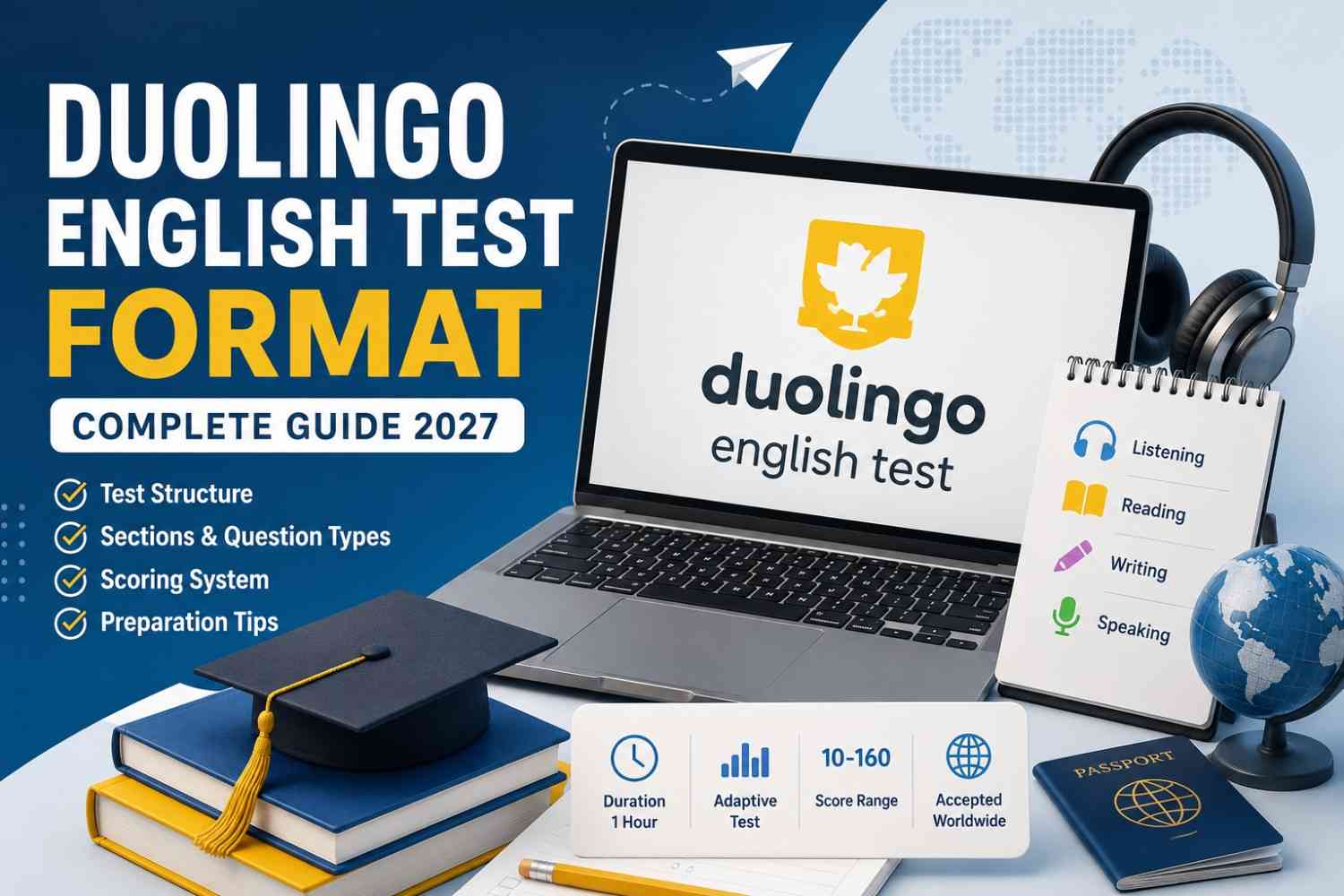
The Duolingo English Test Format consists of two main parts completed in a single session lasting approximately 60 minutes. Understanding both parts — and what happens in each — removes most of the anxiety students feel before their first attempt.
| Component | Duration | Scored? | Purpose |
|---|---|---|---|
| Adaptive Test | ~45 minutes | ✅ Yes | Tests Reading, Listening, Writing & Speaking skills |
| Video Interview | ~10 minutes | ❌ Not scored numerically | Shared with institutions to assess communication & personality |
| Writing Sample | ~5 minutes | ❌ Not scored numerically | Open-ended written response shared with institutions |
The adaptive test produces your official DET score between 10–160. The video interview and writing sample are unscored but are included in your result report — universities use them to get a fuller picture of your communication ability.
How the Adaptive Test Works — Explained Simply
The adaptive test is the heart of the Duolingo English Test Format. Here’s what “adaptive” actually means in practice.
As you answer questions, the algorithm tracks your performance in real time. If you answer correctly, the next question gets harder. If you answer incorrectly, the next question becomes slightly easier. This continues for the entire test. The final score reflects not just how many you got right, but the overall difficulty level you were able to sustain.
📌 Real-World Example: Two students both answer 30 questions. Student A answered easier questions correctly. Student B answered harder questions correctly. Student B will score higher — even if both answered the same number correctly. This is adaptive scoring in action.
This means there’s no “easy” or “hard” version of the test — every student gets a personalised sequence that accurately measures where their English ability actually sits.
Every Question Type in the Duolingo English Test Format
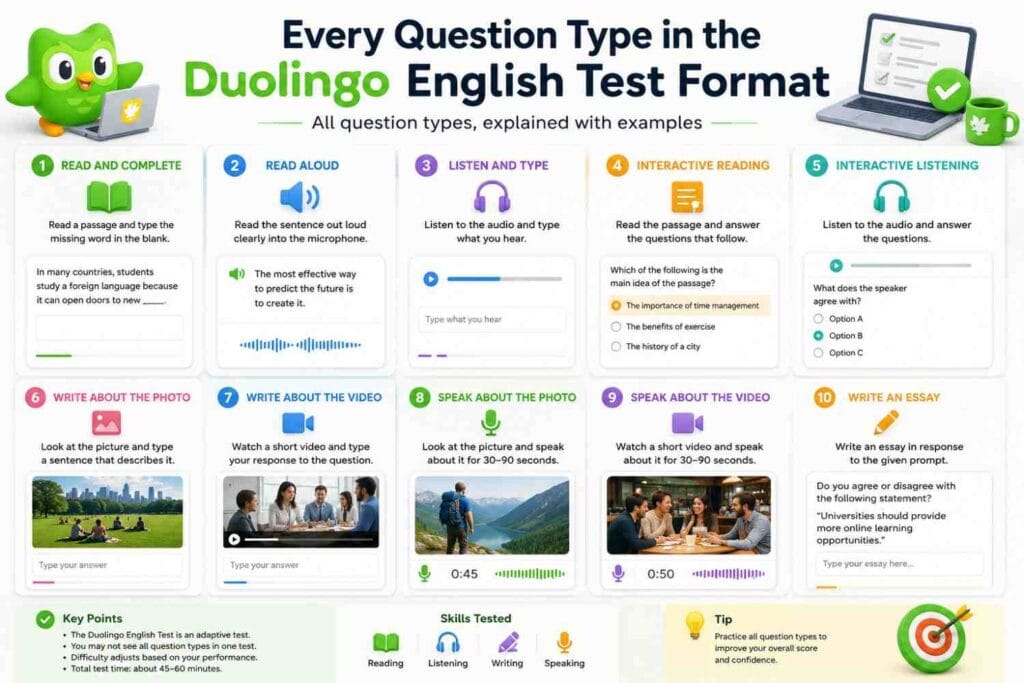
The DET uses a variety of task types that test reading, listening, writing, and speaking — often within the same question. This integrated approach is different from IELTS and TOEFL, which test each skill in a separate, clearly labelled section. Below is every task type you’ll encounter.
Reading Question Types
- Read and Complete: A passage with missing letters in words. You type in the missing letters. Tests vocabulary and spelling accuracy. Example: “She studied eng___ring at university.” You complete the word “engineering.”
- Read and Select: You see a list of words and must click only the real English words — not invented or nonsense words. Tests vocabulary breadth and recognition speed. No pressure to read full sentences; just quickly identify real words.
- Fill in the Blanks: A reading passage with gaps. You select the correct word or phrase from a dropdown to fill each blank. Tests grammar and reading comprehension simultaneously.
Listening Question Types
- Listen and Type: You hear a short sentence or phrase — sometimes just a few words — and type exactly what you hear. Tests listening accuracy and spelling. Punctuation is typically not required. Audio plays once only.
- Listen and Select: You hear a word or phrase and select whether it was a real English word. Combines listening with vocabulary recognition.
Writing Question Types
- Read Aloud then Write: You read a sentence displayed on screen (for about 30 seconds), then it disappears, and you must type it from memory. Tests reading comprehension, short-term memory, and writing accuracy.
- Write About the Photo: You see an image and write a short description (at least 50 words) about what you observe. Tests descriptive writing, vocabulary, and sentence construction.
- Read, Then Write: You read a short passage and then write a paragraph responding to a question about it. Tests analytical reading and written English.
- Writing Sample (Unscored): A 3–5 minute open-ended written response to a prompt. This is included in your report for institutions but does not contribute to your numerical DET score.
Speaking Question Types
- Read Aloud: A sentence or passage appears on screen and you have a few seconds to read it silently, then you speak it into the microphone. Tests pronunciation, fluency, and oral reading ability.
- Repeat the Sentence: You hear a sentence once and immediately repeat it as accurately as possible. Tests listening retention, pronunciation, and oral fluency.
- Answer the Question: You hear a short question and must speak your answer within 30 seconds. Tests spontaneous spoken production.
- Speak About the Photo: You see an image and speak for 60–90 seconds describing what you see. Tests descriptive speaking, vocabulary range, and fluency.
- Read, Then Speak: You read a short passage and then verbally respond to a question about it. Tests spoken comprehension and communication.
- Video Interview (Unscored): You answer 4 open-ended questions by recording 30–90 second video responses. This is unscored but shared with universities. Think of it as a mini recorded interview.
💡 Expert Tip: The “Read and Select” and “Listen and Select” tasks move fast. Don’t second-guess yourself. Trust your instinct — your first reaction to whether a word sounds real is usually correct. Spending too long on these causes time pressure later.
Duolingo English Test Scoring System (2027)
The DET uses a scale of 10 to 160. Scores are reported in a single overall score rather than broken into four separate band scores like IELTS. Your official score report also includes four sub-scores — Literacy, Comprehension, Conversation, and Production — which give universities a more detailed picture of your abilities.
DET Score Interpretation Chart
| DET Score | CEFR Level | Approximate Proficiency | Typical IELTS Equivalent |
|---|---|---|---|
| 10–55 | Below A2 | Basic / Elementary | Below 4.0 |
| 60–85 | A2–B1 | Pre-intermediate / Intermediate | 4.0–5.5 |
| 90–105 | B2 | Upper-Intermediate | 6.0–6.5 |
| 110–120 | C1 | Advanced | 7.0–7.5 |
| 125–160 | C1–C2 | Highly Proficient / Expert | 8.0–9.0 |
Most universities require a minimum DET score between 95 and 120 for undergraduate and postgraduate entry. Always check the specific DET requirement on your target university’s admissions page, as requirements vary by department and programme level. IELTS-DET equivalencies are approximate — universities set their own thresholds independently.
IELTS vs Duolingo vs TOEFL — Which Should You Take?
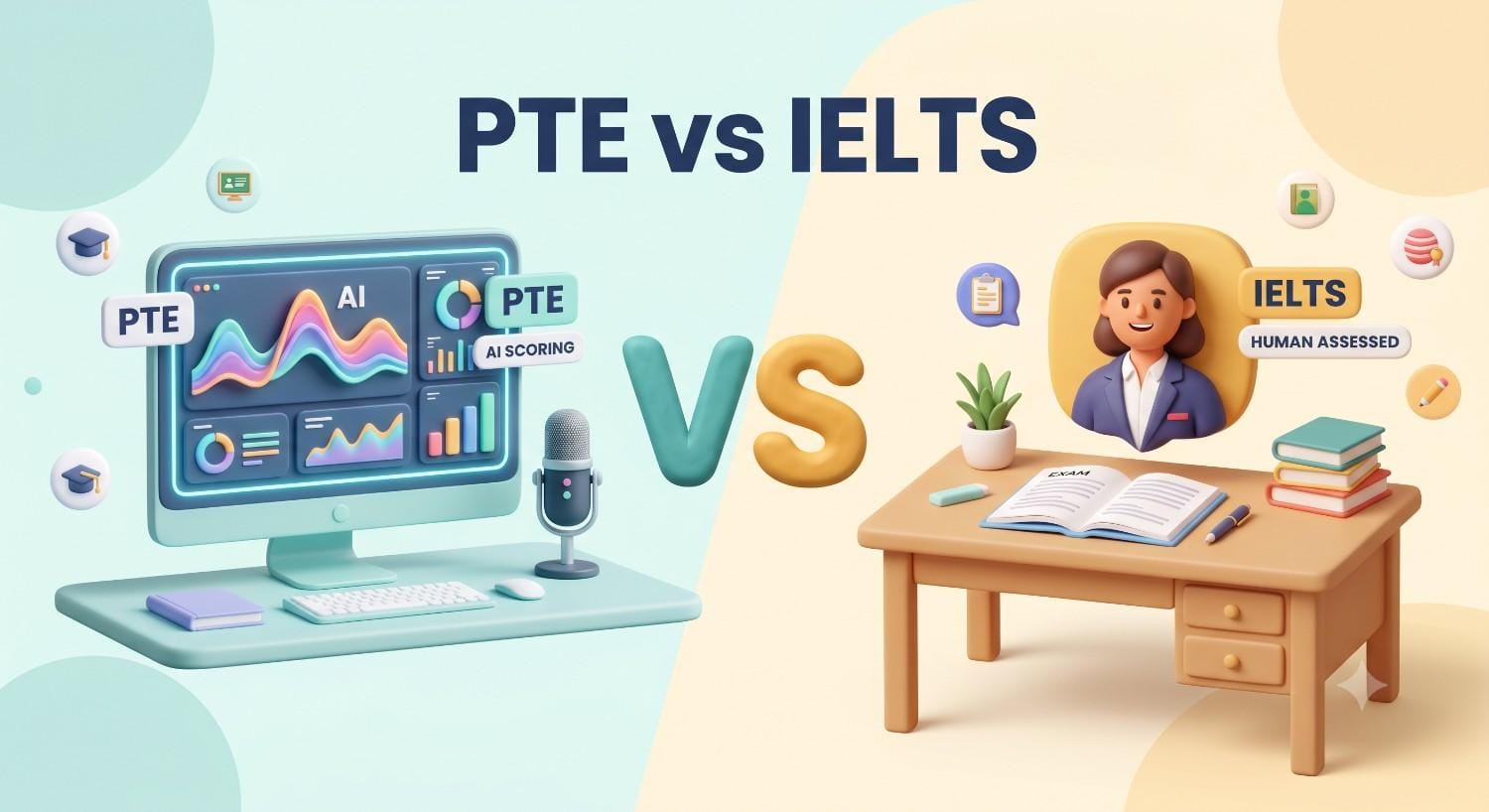
This is the most searched comparison by students considering the DET. Here’s an honest, side-by-side breakdown. Before reading this, check out our in-depth PTE vs IELTS comparison guide which covers similar trade-offs for PTE and IELTS specifically.
| Feature | Duolingo (DET) | IELTS Academic | TOEFL iBT |
|---|---|---|---|
| Test Duration | ~60 minutes | ~2 hrs 45 mins | ~3 hours |
| Test Location | At home (laptop) | Test centre | Test centre or home |
| Approximate Fee | ~USD $65 | ~USD $215–$250 | ~USD $220 |
| Score Delivery | Within 2 days | 3–5 days (computer), 13 days (paper) | 4–8 days |
| Score Validity | 2 years | 2 years | 2 years |
| Retake Policy | Every 14 days | Unlimited (with fee each time) | Every 12 days |
| Score Sending | Free, unlimited | Paid (per report) | Free (4 reports), paid extra |
| Format | Fully adaptive, integrated | Fixed, separate skill sections | Fixed, separate skill sections |
| Human Examiner | No (AI-graded) | Yes (Speaking & Writing) | No (AI + human hybrid) |
| Global Acceptance | Growing — 5,000+ institutions | Very high — near universal | Very high — near universal |
📌 Key Recommendation: If your target universities explicitly accept DET, it is the most cost-effective and flexible choice. If you’re applying to a mix of universities — some of which may not accept DET — IELTS remains the safest universal option. Always verify DET acceptance at each individual institution before deciding.
Registration Process, Fee & Technical Requirements
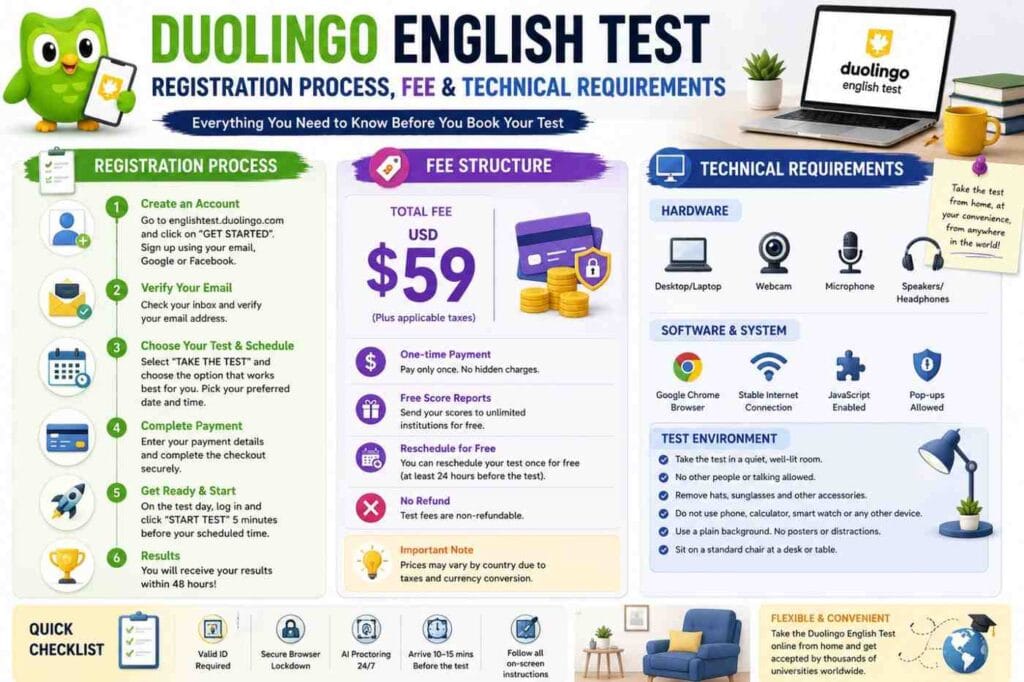
How to Register for the Duolingo English Test
- Visit the official Duolingo English Test website
- Create or log in to your Duolingo account
- Click “Take the Test” and complete identity verification
- Pay the test fee (approximately USD $65 — verify current pricing on the official site)
- Choose your test time — the test is available 24/7
- Complete the test in one sitting; do not close the window
- Receive your results via email within approximately 2 days
- Share your score report with universities directly from your DET dashboard — free, unlimited times
Technical Requirements
Because the DET is taken at home, your device and environment must meet specific technical standards. Failing any of these can result in your test being flagged or cancelled.
- ✅ A Windows or Mac laptop or desktop — tablets and phones are not accepted
- ✅ A working webcam and microphone (built-in or external)
- ✅ A stable internet connection — minimum 1 Mbps upload and download recommended
- ✅ Google Chrome browser — latest version
- ✅ A quiet, private room — no other people visible on webcam during the test
- ✅ Valid government-issued photo ID — passport or national identity card
- ❌ No secondary displays or screens connected during the test
- ❌ No headphones or earphones — the test uses your device’s speakers
Test Rules, AI Proctoring & Common Mistakes to Avoid
Test Rules
- You must be alone in the room throughout the test — the webcam monitors this continuously
- Do not look away from the screen frequently — eye-tracking is part of the AI proctoring system
- Do not use any other applications, tabs, or devices during the test
- Do not have notes, books, or any written materials near you
- Your face must be fully visible and well-lit at all times
- Results may be withheld if the AI flags suspicious behaviour — human reviewers then review the recording
8 Common Mistakes Students Make in the DET
- Not testing their microphone before starting. A microphone that is not working properly can ruin speaking scores. Test it at least 30 minutes before your test.
- Spending too long on Read and Select tasks. These need to be completed quickly. Trust your first instinct rather than overthinking.
- Mumbling during Read Aloud. Speak clearly and at a natural pace. AI grading is sensitive to clarity, not speed.
- Writing too little in the Write About the Photo task. The minimum is 50 words. Aim for 80–100 words with descriptive vocabulary.
- Looking away from the screen repeatedly. This triggers the AI proctoring flag system. Stay focused on the screen throughout.
- Taking the test in a noisy environment. Background noise affects listening task accuracy and speaking task grading. Use a genuinely quiet room.
- Not leaving enough time for the Video Interview. Many students rush or skip preparation for the Video Interview section because it’s unscored. But universities do review it — treat it seriously.
- Using a slow or unstable internet connection. Test your connection well before your scheduled session. A disconnection mid-test can cause significant issues.
Preparation Strategy for the Duolingo English Test Format
Because the Duolingo English Test Format is different from IELTS or TOEFL, using IELTS preparation books is only partially helpful. You need to specifically practise the DET’s unique task types. Here is a structured four-week preparation strategy.
4-Week DET Preparation Plan
| Week | Focus Area | Daily Activities |
|---|---|---|
| Week 1 | Vocabulary & Word Recognition | 30 mins Duolingo app (vocabulary), 20 mins reading English news, practice Read and Select tasks daily |
| Week 2 | Listening & Dictation | Listen and transcribe short English audio clips, BBC Learning English podcasts, practice Listen and Type tasks |
| Week 3 | Speaking & Fluency | Read aloud practice (10 mins daily), record yourself speaking about photos, repeat-the-sentence drills |
| Week 4 | Full Practice Tests & Timed Sessions | Take 2–3 full official practice tests, time yourself strictly, review errors, practise Video Interview responses |
Best Free Practice Resources
- 🎯 Official DET Practice Test: Available free on the Duolingo English Test practice portal — the only authentic simulation of the real test
- 📻 BBC Learning English: Excellent for listening practice and vocabulary building
- 📝 Grammarly: Use the free version to check and improve your writing responses before they become a habit
- 🎙️ Voice recording app: Record yourself reading aloud and compare your pronunciation against native speaker models
- 📱 Duolingo app: Daily vocabulary and sentence exercises on the app genuinely help for the Read and Select and vocabulary-based tasks
Universities and Countries Accepting the Duolingo English Test
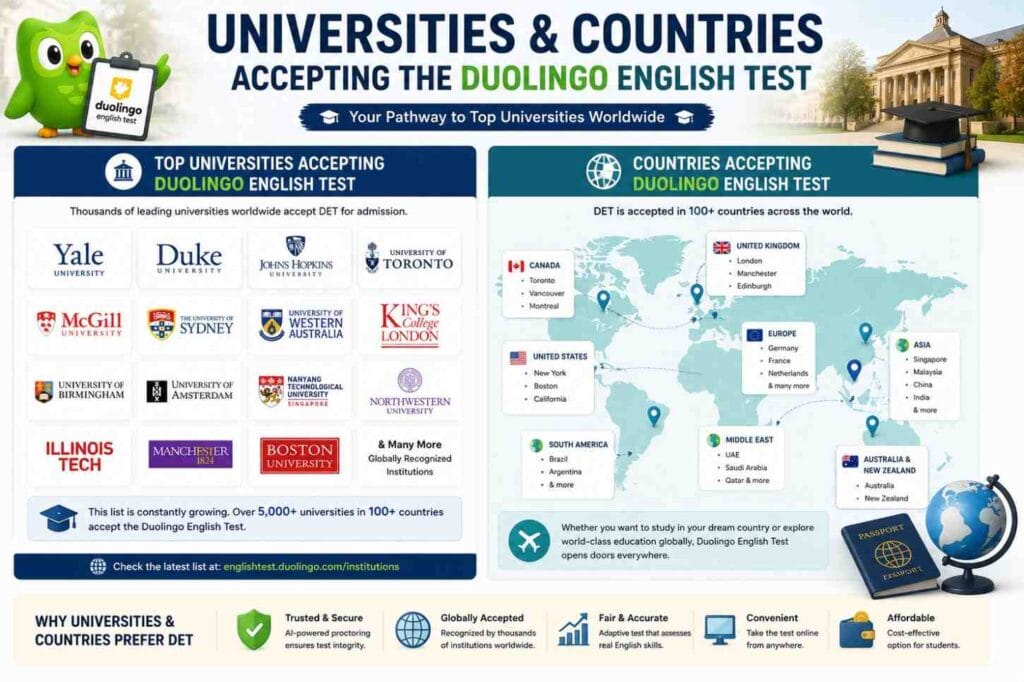
DET acceptance has expanded rapidly. As of 2027, over 5,000 universities and institutions globally accept DET scores. This includes universities across the USA, UK, Canada, Australia, Germany, and many other countries.
Countries Where DET Is Widely Accepted
- 🇺🇸 United States: Very broad acceptance — including Ivy League and major state universities. Some programmes still require TOEFL or IELTS alongside DET or as an alternative.
- 🇬🇧 United Kingdom: Growing acceptance — UK universities now widely include DET as an approved test for Student Visa language requirements at many institutions. Always verify UKVI acceptance for visa purposes specifically.
- 🇨🇦 Canada: Accepted at many Canadian universities. Also accepted under Canada’s Student Direct Stream (SDS) at certain institutions.
- 🇦🇺 Australia: Accepted by a large number of Australian universities for admission purposes.
- 🇩🇪 Germany: Accepted at German universities and technical institutions offering English-taught programmes.
- 🇳🇱 Netherlands, Ireland, New Zealand, and many EU countries: Growing acceptance at English-medium institutions.
⚠️ Critical Reminder: DET acceptance changes regularly. Before choosing DET over IELTS or TOEFL for a specific university application, always check that university’s current admissions page to confirm they accept DET — and note the minimum score required. The DET website’s institution search tool is the most up-to-date resource for this.
Advantages and Disadvantages of the Duolingo English Test
| ✅ Advantages | ❌ Disadvantages |
|---|---|
| Very affordable (~USD $65) compared to IELTS/TOEFL | Not yet accepted by all universities worldwide |
| Taken at home — no travel required | Requires a reliable laptop, webcam, and stable internet |
| Results in approximately 2 days | Some universities consider IELTS or TOEFL more credible |
| Free unlimited score sharing | AI proctoring can be strict — minor issues may flag your session |
| Retake every 14 days | No human examiner — doesn’t test natural conversation flow |
| Short total duration (~60 minutes) | Test environment must be perfectly quiet and private |
| Adaptive format accurately reflects real ability | Preparation resources less abundant than IELTS or TOEFL |
15 Frequently Asked Questions About the Duolingo English Test
Q1: What is the Duolingo English Test Format exactly?
The Duolingo English Test Format consists of a ~45-minute adaptive test section (which generates your score of 10–160), followed by a ~10-minute unscored video interview and a ~5-minute unscored writing sample. The total session is approximately 60 minutes. The adaptive test covers reading, listening, speaking, and writing through integrated question types that change in difficulty based on your real-time performance.
Q2: Is a DET score of 100 good?
A score of 100 on the DET is roughly equivalent to IELTS 6.0–6.5 and corresponds to B2 (Upper-Intermediate) on the CEFR scale. It meets the minimum requirements of many universities for undergraduate entry and some postgraduate programmes. However, many competitive or research-focused programmes require 115–125 or higher. Always check the specific minimum for your target programme.
Q3: How long is the Duolingo English Test?
The total session is approximately 60 minutes. The scored adaptive test takes about 45 minutes. The unscored video interview adds around 10 minutes, and the writing sample takes approximately 5 minutes. You must complete the entire session in one sitting without breaks or closing the browser window.
Q4: How much does the Duolingo English Test cost?
The test fee is approximately USD $65 as of the latest available information. This is significantly less than IELTS (~USD $215–$250) or TOEFL (~USD $220). However, fees are subject to change — always verify the current price on the official Duolingo English Test website before payment.
Q5: How quickly do Duolingo English Test results come?
Results are typically delivered within 2 days of completing the test. In some cases it may take slightly longer if the AI proctoring system flags the session for human review. You’ll receive an email notification when your results are ready, and you can then view and share your score report from your DET dashboard.
Q6: Can I take the Duolingo English Test in Pakistan?
Yes — the DET can be taken from anywhere in the world with a laptop, webcam, microphone, and stable internet connection. There are no physical test centres. Pakistani students have taken and submitted DET scores successfully to universities in the UK, USA, Canada, and Australia. The main requirements are a reliable internet connection, a working webcam, and a quiet private room.
Q7: Is the Duolingo English Test accepted in the UK for visa purposes?
Some UK universities accept DET for admission purposes, but the UK Home Office has a separate SELT (Secure English Language Test) framework for visa requirements. IELTS for UKVI, PTE Academic UKVI, and a small number of other tests are approved for visa purposes. DET acceptance for UK Student Visa requirements specifically should be verified directly on the UK Home Office SELT guidance page.
Q8: What is the minimum DET score required by most universities?
Most universities accepting DET set their minimum between 95 and 120, though this varies considerably by institution and programme level. Some universities accept as low as 85 for undergraduate pathway programmes. Top research universities often require 115–130+. There is no single universal minimum — always check your specific university’s official admissions requirements page.
Q9: How many times can I retake the DET?
You can retake the Duolingo English Test once every 14 days. There is no lifetime cap on retakes. This is significantly more flexible than IELTS, which has no mandatory waiting period but carries a full fee for each attempt. Each retake requires a new payment of the test fee.
Q10: How is the Duolingo English Test different from IELTS?
The key differences are format, cost, location, and duration. IELTS tests each skill (reading, listening, writing, speaking) in a separate section with a human examiner for speaking. DET uses an adaptive, integrated format where all skills are tested together, entirely by AI. DET costs about one-third of IELTS, takes one hour instead of nearly three, and is taken at home. IELTS has broader global acceptance but DET is catching up fast.
Q11: What devices are supported for the Duolingo English Test?
Only laptops and desktop computers running Windows or macOS are supported. Tablets, Chromebooks, and smartphones cannot be used. The test runs in the Google Chrome browser only. You must have a working built-in or external webcam and microphone, and your browser must have permission to access both before the test begins.
Q12: Is the Video Interview section important?
The Video Interview is not numerically scored and does not affect your DET score of 10–160. However, it is included in your official score report and shared with every university you apply to. Universities use it to assess your spoken communication style, personality, and confidence — particularly for programmes where oral English is important. Treat it seriously. Prepare short answers to common questions like “Tell me about yourself” and “Why do you want to study abroad?”
Q13: What is the validity period of a DET score?
DET scores are valid for 2 years from the date of the test. This matches the validity period of IELTS and TOEFL scores. Plan your test date so that your score remains valid throughout your entire application cycle — from first submission through to visa processing if applicable.
Q14: How do I send my DET score to universities?
From your DET dashboard, you can send your score report directly to any participating institution — completely free and unlimited times. This is one of the DET’s strongest advantages. You search for the institution by name, select it, and share your report digitally. Most universities receive it within 24 hours. There is no per-recipient fee unlike IELTS or TOEFL additional score reports.
Q15: Is the Duolingo English Test right for me?
The DET is right for you if your target universities explicitly accept it, you prefer taking a test at home, you need results fast, and you want to minimise cost especially for multiple attempts. It may not be the right choice if your target institutions still require IELTS or TOEFL, or if you perform better in a structured, separated skill format. For most Pakistani students applying to universities in the USA, Canada, and increasingly the UK and Australia, DET is worth seriously considering alongside IELTS.
Conclusion: Is the Duolingo English Test Format Right for You?
The Duolingo English Test Format is genuinely different from anything that came before it — shorter, cheaper, more flexible, and built for the digital generation of students. If your universities accept it, it removes almost every practical barrier that makes IELTS and TOEFL difficult: the cost, the travel, the wait, the rigid test day. That’s a significant advantage that’s worth taking seriously.
What it is not is a shortcut to a high English score. The adaptive format ensures that your final result genuinely reflects your ability. Preparation still matters — especially for the speaking tasks, the Read and Select speed requirement, and the integrated written tasks that require both comprehension and production simultaneously.
Start by checking whether each of your target universities accepts DET. If they do, register for the free official practice test on the Duolingo website before your real test. Use the four-week preparation framework above. And make sure your technical setup is working at least a day before your scheduled session. Your visa and admissions journey has many moving parts beyond the English test — from your Statement of Purpose to your proof of funds documentation. The more of these you get right early, the smoother your path to your chosen university will be. Explore the full library of study abroad guides at StudyPathExp to stay ahead at every stage.
Disclaimer: Test fees, accepted universities, minimum score requirements, and visa-related policies for the Duolingo English Test change regularly. All information in this article is based on publicly available data and should be verified on the official Duolingo English Test website and your specific target institution’s admissions page before making any decisions. StudyPathExp is not affiliated with Duolingo, IELTS, or ETS.