Every year, thousands of international students apply for an Australian student visa — and a significant number get refused at the financial assessment stage. Not because they lacked the grades. Not because their institution was unrecognised. But because their bank statements were too thin, their sponsor documents were incomplete, or their living cost calculations did not add up to what the Department of Home Affairs expected to see. Meeting the Australia student visa financial requirements correctly is the single most controllable factor in your visa outcome.
The Australia student visa financial requirements 2026 are more than just a number on a page. They are the foundation of your visa application. Case officers are specifically trained to assess whether you have genuine, accessible financial capacity to fund your education and stay in Australia — and they apply that assessment strictly.
This guide covers everything: the exact figures, the documents you need, the sponsor rules, the common mistakes that result in refusals, and a dedicated section for Pakistani students navigating the specific challenges of currency conversion, bank statements, and affidavit requirements. Before you read on, it is worth knowing that financial documents are only one part of a complete visa application — see our full documents checklist for student visa and university admission for the complete picture. All financial figures referenced here are sourced from the Australian Department of Home Affairs — but requirements can and do change. Always verify current figures at the official Australian Government website before you submit your application.
What Are Australia’s Student Visa Financial Requirements?
The Australia student visa (Subclass 500) requires every applicant to demonstrate “financial capacity” — meaning you must prove that you, or your sponsor, can genuinely cover all costs associated with studying and living in Australia. Understanding the Australia student visa financial requirements fully before you apply is what separates well-prepared applications from ones that generate costly delays or refusals.
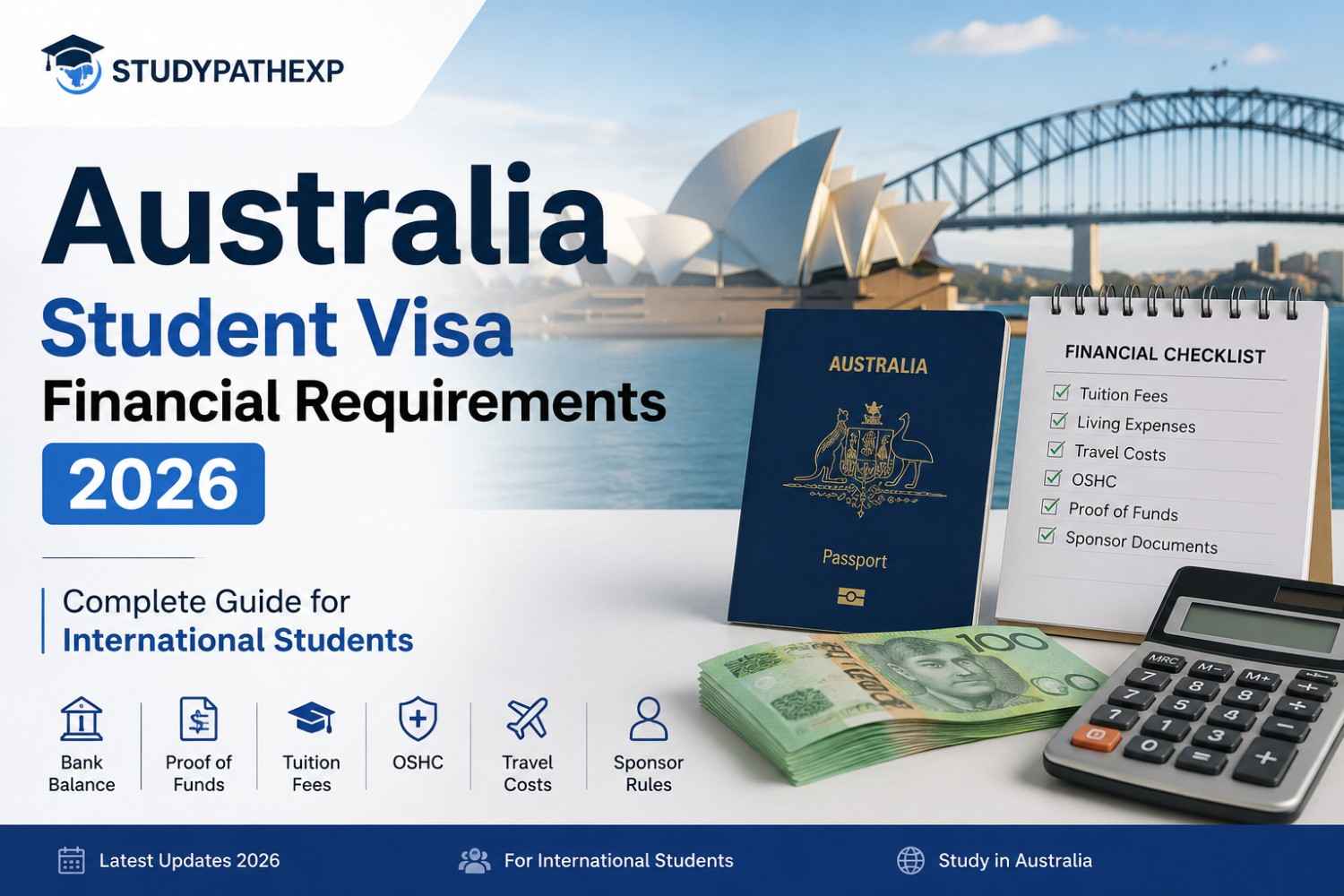
The financial requirement has four main components that you must account for:
- Tuition fees for your first year of study (or the full course if it is under one year)
- Living costs for yourself and any accompanying family members
- Return travel costs from Australia back to your home country
- Overseas Student Health Cover (OSHC) for the duration of your visa
You do not need to show all of this as cash sitting in a single bank account. What matters is that you can demonstrate credible, accessible, and sufficient funding from legitimate sources. The case officer makes a judgment based on the totality of your financial evidence — not just one document.
| Requirement | Who Needs It | Mandatory? | 2026 Requirement |
|---|---|---|---|
| Living Costs | All applicants | ✅ Yes | AUD 24,505 per year (student) |
| Living Costs (Spouse) | Applicants with partner | ✅ If applicable | AUD 8,574 per year |
| Living Costs (Child) | Applicants with children | ✅ If applicable | AUD 3,670 per child per year |
| Tuition Fees | All applicants | ✅ Yes | Full first-year tuition (varies) |
| Return Travel | All applicants | ✅ Yes | Approx. AUD 2,000–4,000 |
| OSHC | All student visa holders | ✅ Yes | Approx. AUD 600–700/year (single) |
Why Australia Requires Financial Proof
The Australia student visa financial requirements exist for a specific reason: the government needs assurance that you will not become a financial burden on the Australian state, that you will be able to focus on your studies rather than working illegally to survive, and that you have genuine intentions to complete your course and return home after graduation.
The Department of Home Affairs has seen a pattern over the years — students who arrive underfunded struggle academically, take excessive paid work (often in breach of visa conditions), and sometimes abandon their studies entirely. The financial capacity requirement is designed to filter out those scenarios before they happen.
Minimum Bank Balance Required in 2026
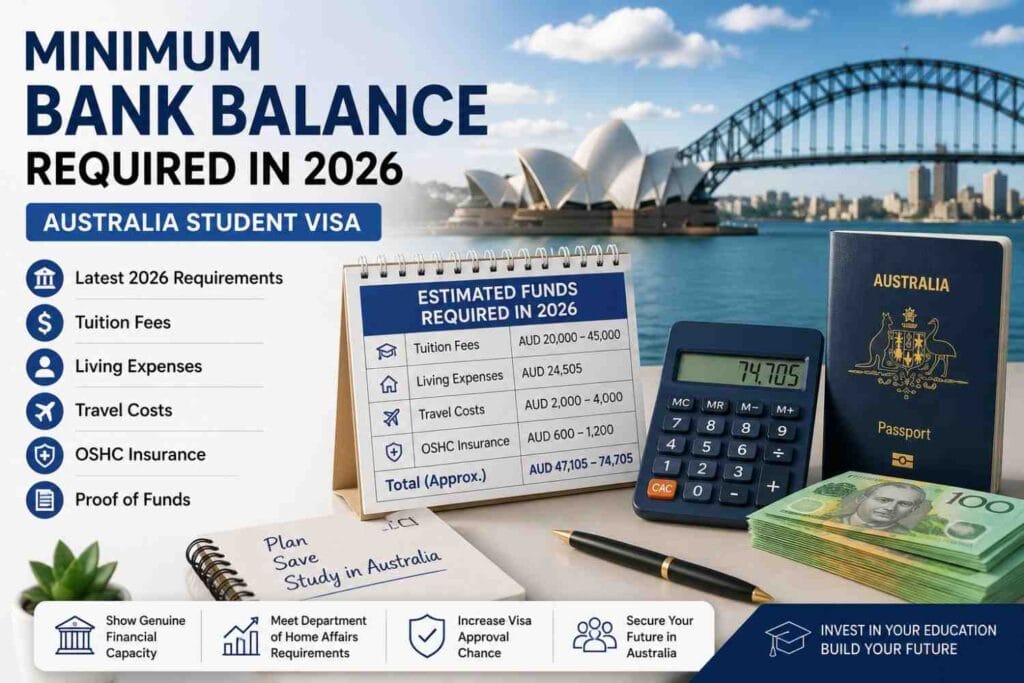
Australia does not publish a single “minimum bank balance” figure the way some countries do. Instead, the Australia student visa financial requirements 2026 require you to demonstrate sufficient funds to cover all four cost components combined. That means your total required financial evidence depends on your specific situation.
Here is how the calculation works in practice for a single student coming to study a one-year Master’s programme in Australia:
Tuition fees (typical Master’s): AUD 28,000–40,000
Return airfare: AUD 2,500
OSHC (1 year, single): AUD 650
Estimated Total: AUD 55,655 – 67,655
Equivalent to approximately PKR 2.3 crore – 2.8 crore at current exchange rates. Verify with your bank for the latest conversion.
For a two-year programme, the living costs component doubles — you must show AUD 49,010 for living costs alone, plus two years of tuition fees. The Department of Home Affairs publishes the current living cost thresholds on their official website, and these figures are updated periodically.
Tuition Fees
Tuition fees in Australia vary significantly depending on the institution, the course level, and the subject area. As a general guide for the Australia student visa financial requirements, here is what you should expect to account for:
| Course Level | Typical Annual Tuition (AUD) |
|---|---|
| Undergraduate Degree | AUD 20,000 – 45,000 |
| Postgraduate (Master’s) | AUD 22,000 – 50,000 |
| Doctoral (PhD) | AUD 18,000 – 42,000 |
| Vocational Education (VET/TAFE) | AUD 4,000 – 22,000 |
| English Language Programs | AUD 300 – 400 per week |
Your Confirmation of Enrolment (CoE) from your Australian institution will state your exact tuition fee. This document is central to your visa application — it confirms what you owe and when. The financial requirement expects you to show evidence of funds covering at minimum the first year of tuition as stated in your CoE.
If your tuition has already been paid — through a scholarship, a deposit, or upfront payment — this reduces the funds you need to show. Keep payment receipts and scholarship award letters as part of your financial evidence package. If you are looking to reduce the overall cost burden of studying abroad, our guide on how to study abroad on a low budget covers practical cost-reduction strategies including scholarships and grants worth pursuing.
Living Expenses in Australia 2026
The Department of Home Affairs sets a standard annual living cost threshold that all applicants meeting the Australia student visa financial requirements must demonstrate they can cover. For 2026, the figures are as follows:
| Person | Annual Living Cost (AUD) |
|---|---|
| Student (primary applicant) | AUD 24,505 |
| Partner / Spouse | AUD 8,574 |
| Each dependent child | AUD 3,670 |
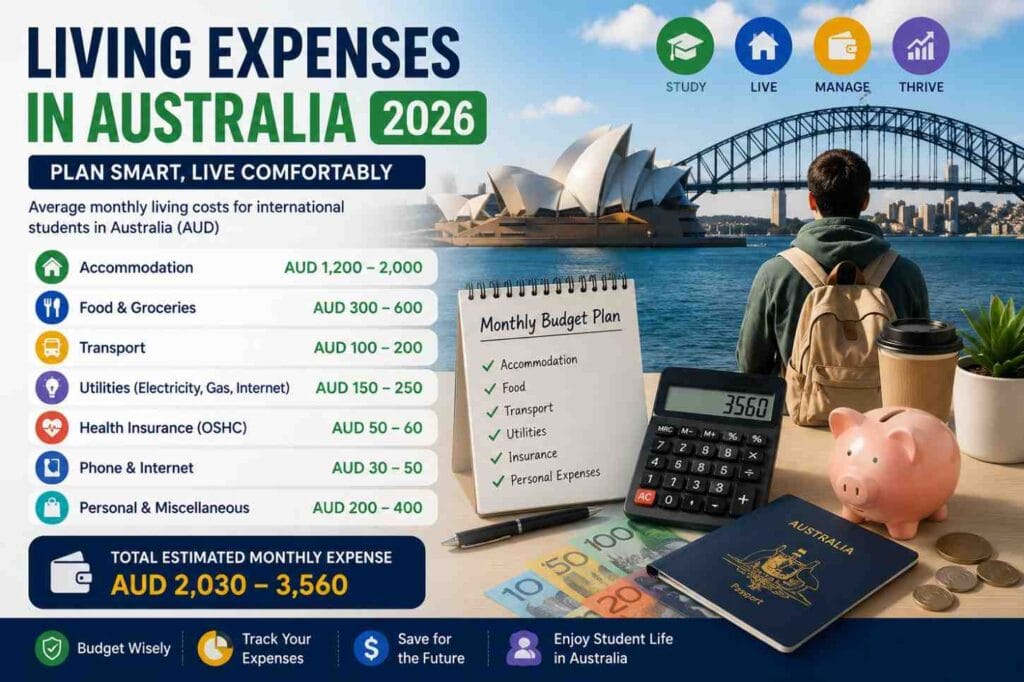
These are the government’s minimum thresholds. In reality, living in major Australian cities like Sydney, Melbourne, or Brisbane costs considerably more. The Study Australia official guide to living costs suggests international students budget AUD 1,500–2,500 per month in major cities when accommodation, food, transport, utilities, and personal expenses are factored in.
Groceries & food: AUD 300–500
Public transport: AUD 100–180
Utilities (share of household): AUD 60–100
Phone plan: AUD 25–50
Personal expenses: AUD 150–300
Estimated Monthly Total: AUD 1,335 – 2,330
These are estimates only. Regional cities and towns are typically 20–30% cheaper than Sydney or Melbourne. Students at universities in Adelaide, Canberra, or Hobart often report significantly lower living costs while accessing equivalent quality education.
Travel Costs
The Australia student visa financial requirements include return travel — meaning the cost of flying from your home country to Australia, and eventually flying back home at the end of your studies. The Department of Home Affairs does not specify an exact amount, but AUD 2,000–4,000 is the standard planning figure used by most immigration advisors and education consultants.
For Pakistani students, a return economy flight between Lahore or Karachi and Sydney or Melbourne typically costs between PKR 350,000 and PKR 600,000 depending on the airline, season, and booking window. Budget airlines and indirect routing (via Doha, Dubai, or Kuala Lumpur) can reduce this cost significantly.
OSHC — Overseas Student Health Cover
All international students studying in Australia on a Subclass 500 visa are legally required to maintain Overseas Student Health Cover (OSHC) for the entire duration of their visa. This is not optional. OSHC covers basic medical and hospital costs during your stay in Australia.
Most Australian universities arrange OSHC on your behalf as part of the enrolment process. The cost is typically included in your first tuition invoice. Current OSHC costs for 2026 are approximately:
- Single student: Approx. AUD 600–750 per year
- Student + partner: Approx. AUD 1,400–1,800 per year
- Family (student + partner + children): Approx. AUD 2,000–2,800 per year
These figures vary between OSHC providers — Medibank, Bupa, Allianz, nib, and AHM are the main approved providers in Australia. Your university may have a preferred provider, but you are generally free to choose any approved provider. Visit the Australian Government’s OSHC comparison page to compare current premiums.
Proof of Funds — What Documents Are Accepted?
This is where most students run into trouble. Knowing the Australia student visa financial requirements amount is one thing — proving it convincingly is another. Multiple forms of financial evidence are accepted, and combining them thoughtfully is often more convincing than relying on a single document alone. For a detailed breakdown of how to write and format a bank proof letter, see our free proof of funds letter from bank guide — it includes copy-paste templates accepted by universities and embassies.
Acceptable Financial Documents
| Document | What It Shows | Notes |
|---|---|---|
| Bank statements (personal) | Liquid funds available to the student | Last 3–6 months preferred; consistent balance required |
| Bank statements (sponsor) | Financial capacity of parent or sponsor | Must include sponsor’s name, account history |
| Term deposits / Fixed deposits | Saved funds accessible for education | Include certificate confirming maturity date & accessibility |
| Property ownership documents | Assets backing financial capacity | Valuation certificate from registered valuator required |
| Scholarship award letter | Funding from institution or government | Must clearly state amount, duration, and what it covers |
| Education loan letter | Approved credit from a bank or NBFC | Must show sanctioned amount, disbursement schedule |
| Salary slips / Employment letter | Ongoing income of student or sponsor | Recent months, with employer letterhead |
| Income tax returns | Financial history and income pattern | Last 2–3 years; both student’s and sponsor’s if applicable |
Who Can Sponsor Your Australia Student Visa?
Not every student can self-fund their Australian education — and that is completely normal. The Department of Home Affairs accepts sponsored financial evidence as part of the Australia student visa financial requirements, provided the sponsorship is genuine and well-documented.
| Sponsor Type | Accepted? | Required Documents |
|---|---|---|
| Parent / Guardian | ✅ Yes — most common | Bank statements, income proof, relationship proof, affidavit |
| Sibling | ✅ Yes | Bank statements, income proof, relationship proof, affidavit |
| Spouse / Partner | ✅ Yes | Bank statements, marriage certificate, income proof |
| Employer sponsor | ✅ Yes (scholarship/sponsorship letter) | Official sponsorship letter, company registration, commitment letter |
| Government scholarship body | ✅ Yes (strongest) | Award letter with full funding details |
| Friend (non-relative) | ⚠ Accepted with caution | Very strong documentary evidence + genuine relationship proof required |
A sponsorship letter — sometimes called an Affidavit of Support — must be more than a generic statement. It should clearly state:
- The sponsor’s full name, relationship to the applicant, and contact details
- The exact amount the sponsor commits to providing
- How the funds will be transferred (bank transfer, direct payment to institution, etc.)
- The duration of financial support
- The sponsor’s signature and date
Australia Student Visa Financial Requirements for Pakistani Students
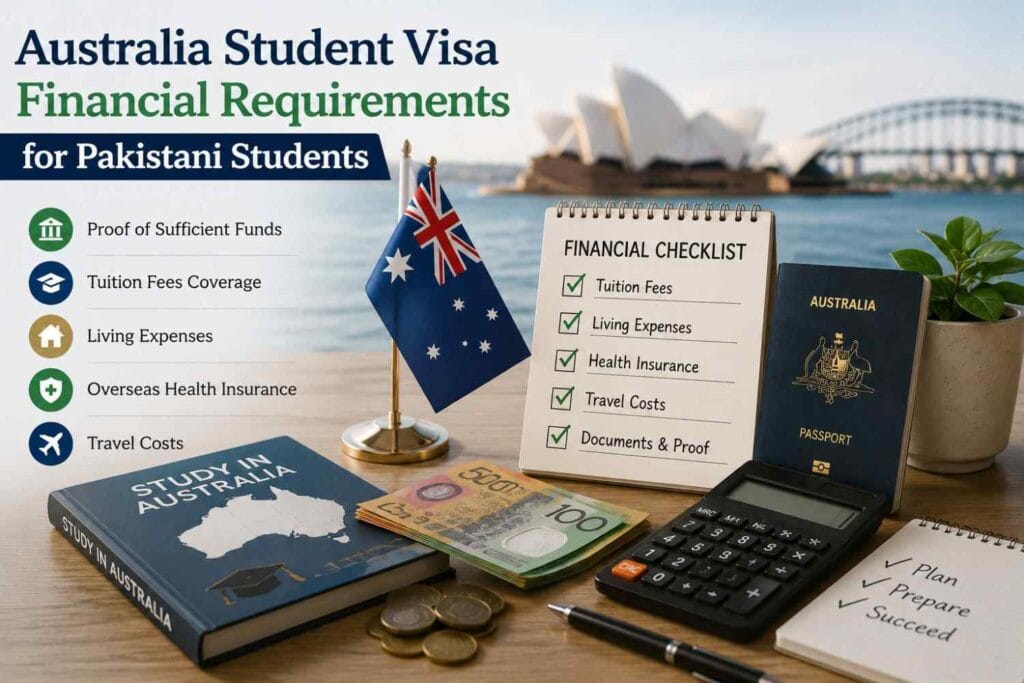
Pakistani students face a specific set of challenges when it comes to demonstrating Australia student visa financial requirements — challenges that are practical, not reflective of personal financial position. Understanding these in advance saves enormous stress during the application process.
Bank Statements
Pakistani bank statements submitted for Australian visa applications should cover a minimum of six months. Three months is often considered insufficient for Pakistani applicants given the scrutiny applied to high-risk nationality applications. The statements should be:
- Printed on official bank letterhead or downloaded through the bank’s official online portal
- Stamped and signed by a branch officer if submitted in hard copy
- Showing consistent credit history — salary, business income, rental income — not just periodic deposits
- Accompanied by a bank balance certificate or official bank letter confirming current balance
Currency Conversion
All financial evidence must clearly demonstrate sufficient funds in Australian Dollar equivalent. You do not need to convert your PKR to AUD before applying — you simply need to show that the PKR equivalent of the required AUD amount is genuinely available in your or your sponsor’s account.
At current rates (July 2026), AUD 1 is approximately PKR 195–205. This means the living cost requirement alone — AUD 24,505 — represents approximately PKR 47–50 lakh. Add tuition fees and travel costs and the total financial evidence requirement for most Pakistani students ranges from PKR 1.2 crore to PKR 2.5 crore depending on the course and institution. Always use the exchange rate prevailing at the time of your application.
Education Loans
An approved education loan from a Pakistani bank or financial institution is accepted as financial evidence for the Australia student visa financial requirements. The loan approval letter must clearly state the sanctioned amount, the institution it is being taken for, and the disbursement terms. Loans from HBL, UBL, MCB, and other scheduled banks in Pakistan are generally accepted, provided the approval documentation is thorough.
For a complete guide on structuring loan documentation for overseas study — including which lenders accept collateral-free applications — read our in-depth guide on education loans without collateral for studying abroad.
Affidavit of Support
If a parent or relative is sponsoring your education, a notarised Affidavit of Support is strongly recommended — and in many cases, effectively required by case officers reviewing Pakistani applications. The affidavit should be:
- Drafted in English or accompanied by a certified English translation
- Notarised by a registered notary public in Pakistan
- Accompanied by the sponsor’s CNIC copy, relationship proof, and supporting financial documents
- Specific about amounts, duration, and method of financial support
Financial History
Case officers reviewing Pakistani applications pay close attention to the history of the funds, not just the balance on the statement date. A long-standing account with a stable balance that has grown gradually over time is significantly more convincing than a newly opened account or one that shows erratic, unexplained activity. If your sponsor’s account has a large current balance, be prepared to explain the source of those funds — business income, salary, property sale, agricultural income — with supporting documentation.
Common Reasons Applications Get Refused on Financial Grounds
Knowing why applications fail is as important as knowing what to submit. These are the most frequent financial refusal reasons for the Australia student visa Subclass 500 — and most of them are directly tied to misunderstanding or mishandling the Australia student visa financial requirements. For a broader look at all the top reasons student visas are refused globally, our guide on top student visa rejection reasons in 2026 covers every common failure point with actionable fixes.
- Insufficient total funds — the bank balance shown does not cover all four cost components for the full course duration
- Sudden large deposits — funds parked in an account days before the application are treated as borrowed or fabricated
- Inconsistent bank history — a balance that fluctuates wildly, with no clear income source, raises credibility questions
- Weak sponsor documentation — a sponsor letter without supporting bank statements, income proof, or relationship documentation is rarely sufficient on its own
- Unclear source of funds — the origin of the money is not explained, particularly for large cash deposits or business income
- No explanation for gaps — if the account shows periods of very low balance followed by recovery, this needs to be explained in a cover letter
- Documents not translated — financial documents in Urdu, Arabic, or any non-English language must be accompanied by certified English translations
- Outdated documents — bank statements more than 3 months old at the time of lodgement are generally not accepted
Tips to Strengthen Your Financial Evidence
2. Combine evidence sources. A combination of personal savings + sponsor bank statements + a scholarship letter is a stronger package than any single document alone.
3. Write a financial cover letter. Briefly explain your funding plan — who is sponsoring you, how funds will be accessed, and how you have planned for the full course duration. This is not required but significantly helps case officers understand your Australia student visa financial requirements coverage at a glance.
4. Get documents certified. All foreign-language documents must have certified English translations. All bank statements should be stamped and signed by a bank officer.
5. Calculate conservatively. Always aim to show 10–15% more than the minimum required. This small buffer signals to the case officer that you have planned carefully rather than scraped together the bare minimum.
Latest 2026 Updates to Financial Requirements
The Department of Home Affairs reviews the living cost thresholds for the Australia student visa financial requirements periodically — typically once per year. The most significant recent updates include:
- The annual living cost threshold for the primary student applicant increased to AUD 24,505 — a rise from the previous AUD 21,041, reflecting Australia’s increased cost of living
- Dependent partner costs increased to AUD 8,574 per year
- Per-child costs increased to AUD 3,670 per child per year
- The GTE (Genuine Temporary Entrant) assessment was strengthened — financial capacity is now assessed more holistically alongside your genuine intention to return home
- Digital bank statements are now widely accepted — printed online statements are accepted provided they are clearly from an official banking app or portal
These figures are accurate as of the date this article was published. Financial requirements can change without extended notice. Always verify the current thresholds at the official Department of Home Affairs website before lodging your application.
Financial Document Checklist
| Document | Required? | Notes |
|---|---|---|
| Personal bank statements (6 months) | ✅ Yes | Stamped & signed by bank officer |
| Sponsor bank statements (6 months) | ✅ If sponsored | Same requirements as personal statements |
| Affidavit of Support / Sponsor letter | ✅ If sponsored | Notarised, English, specific amounts |
| Salary slips (sponsor/student) | ✅ Recommended | Last 3–6 months |
| Income tax returns | ✅ Recommended | Last 2–3 years |
| Business registration (if business income) | ✅ If applicable | Shows legitimate income source |
| Education loan approval letter | ✅ If applicable | Sanctioned amount, disbursement terms |
| Scholarship award letter | ✅ If applicable | Amount, duration, what it covers |
| Tuition payment receipt | ✅ If paid | Reduces funds required in bank |
| OSHC policy certificate | ✅ If already arranged | Provider, coverage period, amount paid |
| Confirmation of Enrolment (CoE) | ✅ Yes | Issued by Australian institution |
Frequently Asked Questions
1. What is the minimum bank balance for an Australia student visa in 2026?
There is no single fixed minimum — the required amount depends on your course duration, tuition fees, and family situation. The Australia student visa financial requirements 2026 for a single student on a one-year Master’s programme typically need total evidence of AUD 55,000–68,000, combining living costs (AUD 24,505), tuition, travel, and OSHC. Always verify the current living cost thresholds at the Department of Home Affairs website.
2. Can my parents sponsor my Australia student visa?
Yes. Parental sponsorship is the most common form of financial support for international students applying under the Australia student visa financial requirements. You will need your parents’ bank statements (minimum 6 months), salary slips or income proof, tax returns, and a notarised affidavit committing to fund your education. A clear relationship proof — such as your birth certificate — should also be included.
3. Are education loans accepted as proof of funds for Australia student visa?
Yes. An approved education loan from a recognised financial institution is accepted as part of the Australia student visa financial requirements evidence package. The loan letter must clearly state the sanctioned amount, the purpose (tuition and living costs for Australian study), and the disbursement schedule. The loan should be from a scheduled bank or regulated financial institution — informal loan agreements are not accepted.
4. How recent do my bank statements need to be?
Bank statements should be no older than 3 months at the time you lodge your visa application. Statements that are 4–6 months old at the time of lodgement are generally not accepted. If your application is delayed after you have collected your financial documents, you may need to obtain fresh statements before submitting.
5. Does a scholarship reduce my financial requirements?
Yes, significantly. A scholarship that covers tuition reduces the tuition component of your Australia student visa financial requirements. A scholarship that covers both tuition and living allowance may cover most or all of the financial requirement. Always include the scholarship award letter in your application and ensure it clearly states the amount, duration, and what expenses it covers.
6. Can I show funds in a fixed deposit or term deposit?
Yes, fixed deposits are accepted as financial evidence, provided you also include the deposit certificate showing the maturity date and confirming that the funds are accessible. A fixed deposit that matures after your intended visa start date may be questioned — the funds need to be demonstrably available when needed.
7. What if my bank statements show inconsistent balances?
Inconsistent balances are not automatically disqualifying, but they require explanation. If your account shows periods of low balance followed by recovery, include a brief cover letter explaining the pattern — seasonal business income, agricultural cycles, bonus payments, or other legitimate reasons. Without explanation, case officers may question whether the Australia student visa financial requirements are genuinely met.
8. Do I need to show funds in AUD, or is my local currency acceptable?
You can show funds in your local currency — you do not need to convert to AUD before applying. The case officer will apply the prevailing exchange rate to assess whether your funds satisfy the Australia student visa financial requirements. However, it helps to include a currency conversion note or use an official bank conversion certificate to make the assessment easier for the case officer.
9. Does paying tuition upfront improve my visa application?
Yes. Paying your first semester or first year of tuition upfront — and including the payment receipt in your application — reduces the amount of liquid funds you need to show in bank statements to meet the Australia student visa financial requirements. It also demonstrates financial commitment to your studies, which strengthens the overall credibility of your application.
10. Can my employer sponsor my Australia student visa?
Yes, if your employer is formally sponsoring your education — through a staff development programme, for example — an official employer sponsorship letter on company letterhead, combined with company financial documents, is accepted as evidence toward the Australia student visa financial requirements. This is more common for corporate-sponsored postgraduate students than for standard applicants.
11. What is the OSHC and is it included in my tuition fees?
OSHC (Overseas Student Health Cover) is mandatory health insurance for all international students in Australia. Many universities include it as part of your first-year invoice, which means you may have already paid for it without realising. Check your Confirmation of Enrolment (CoE) — if OSHC is listed, you do not need to arrange it separately.
12. How long does it take to get an Australia student visa after submitting financial documents?
Processing times vary significantly. As of 2026, the Department of Home Affairs reports median processing times of 29–60 days for student visa applications, though complex cases or high-scrutiny nationalities may take longer. Submit well-prepared Australia student visa financial requirements documents from the start — incomplete or unclear financial evidence is one of the most common reasons for processing delays and requests for additional information (RFIs). For a step-by-step walkthrough of the entire visa application process, see our guide on how to apply for a student visa in 2026.
People Also Ask
How much money do I need to show for an Australia student visa?
For a single student on a one-year programme, you need to demonstrate approximately AUD 55,000–68,000 covering living costs (AUD 24,505), tuition fees, return travel, and OSHC. For multi-year programmes, multiply living costs by the number of years.
What bank balance is required for Australia student visa for Pakistani students?
Pakistani students typically need to show the PKR equivalent of AUD 55,000–70,000 or more to meet Australia student visa financial requirements, depending on their course. At current rates, this is approximately PKR 1.1–1.4 crore for living costs alone, plus tuition and other costs. A 6-month consistent bank history is strongly recommended.
Can I use my parents’ bank account for Australia student visa?
Yes. Parental bank statements combined with an affidavit of support, income proof, and relationship documents are accepted and commonly used by international students to satisfy the Australia student visa financial requirements. The key is that the sponsorship must appear genuine and the funds must have a clear, legitimate source.
Is proof of funds mandatory for Australia student visa?
Yes. Demonstrating financial capacity is a mandatory part of the Australia student visa financial requirements for Subclass 500. Applications without adequate financial evidence will be refused.
Does Australia check bank statements for student visa?
Yes. Case officers review bank statements carefully — not just the balance, but the history of deposits, the source of funds, and the consistency of the account over time. Statements are cross-referenced with income documents and sponsor letters to verify that the funds genuinely satisfy the Australia student visa financial requirements.
How many months of bank statements are required for Australia student visa?
A minimum of 3 months is technically required, but 6 months is strongly recommended — particularly for applicants from high-scrutiny nationalities including Pakistan, India, and several other countries. More history is always better than less.
What living costs does Australia expect student visa applicants to cover?
The Department of Home Affairs sets an annual living cost threshold of AUD 24,505 for the primary student applicant in 2026 as part of the Australia student visa financial requirements. Additional amounts apply for accompanying partners (AUD 8,574/year) and dependent children (AUD 3,670/child/year).
Can an education loan be used for Australia student visa financial proof?
Yes. A formal education loan approval letter from a recognised financial institution is accepted as part of the Australia student visa financial requirements evidence package. The letter must state the sanctioned amount, purpose, and disbursement terms clearly.
What happens if my bank statement shows a sudden large deposit?
Case officers treat sudden large deposits as a red flag — they may indicate borrowed or fabricated funds rather than genuine savings. If your account genuinely received a large legitimate transfer (property sale, business payment, inheritance), include supporting documentation explaining the source to show you genuinely meet the Australia student visa financial requirements.
Is OSHC included in the Australia student visa financial requirements?
Yes. OSHC is a mandatory component of the Australia student visa financial requirements for all Subclass 500 visa holders. Its cost (approximately AUD 600–750/year for a single student) should be included in your total financial calculations. Many universities arrange OSHC on your behalf and include it in your first tuition invoice.
Conclusion
The Australia student visa financial requirements 2026 are detailed and specific — but they are not designed to be impossible. They are designed to ensure that every student arriving in Australia has the genuine capacity to complete their studies without financial hardship. Students who prepare their financial documentation carefully, start early, and present a coherent, honest picture of their funding situation consistently achieve positive outcomes.
For Pakistani students specifically, the key is documentation depth. Six months of consistent bank history, a well-drafted affidavit of support, clear income proof from sponsors, and a thorough cover letter explaining your financial plan will take your application significantly further than the minimum required documents alone.
If you are exploring ways to reduce the financial burden, there are two resources worth reading next. Our guide on the Brunei Darussalam Government Scholarship 2026/2027 covers a fully funded opportunity that eliminates the tuition and living cost requirements entirely. And our comprehensive guide on education loans without collateral explains how to secure loan documentation that satisfies the Australia student visa financial requirements without needing a property guarantor.
✔ Total financial evidence for 1-year Master’s: approximately AUD 55,000–68,000
✔ Accepted sources: personal savings, parental sponsor, education loan, scholarship
✔ Bank statements: minimum 3 months, 6 months strongly recommended
✔ All foreign-language documents must have certified English translations
✔ Sudden large deposits are a red flag — consistent history matters most
✔ OSHC is mandatory for all Subclass 500 visa holders
✔ Always verify current figures at the Department of Home Affairs website before applying
Disclaimer: Financial requirement figures in this article are based on information published by the Australian Department of Home Affairs and are accurate as of July 2026. Requirements are subject to change. Always verify the latest requirements at the official Australian Government website before lodging your visa application.