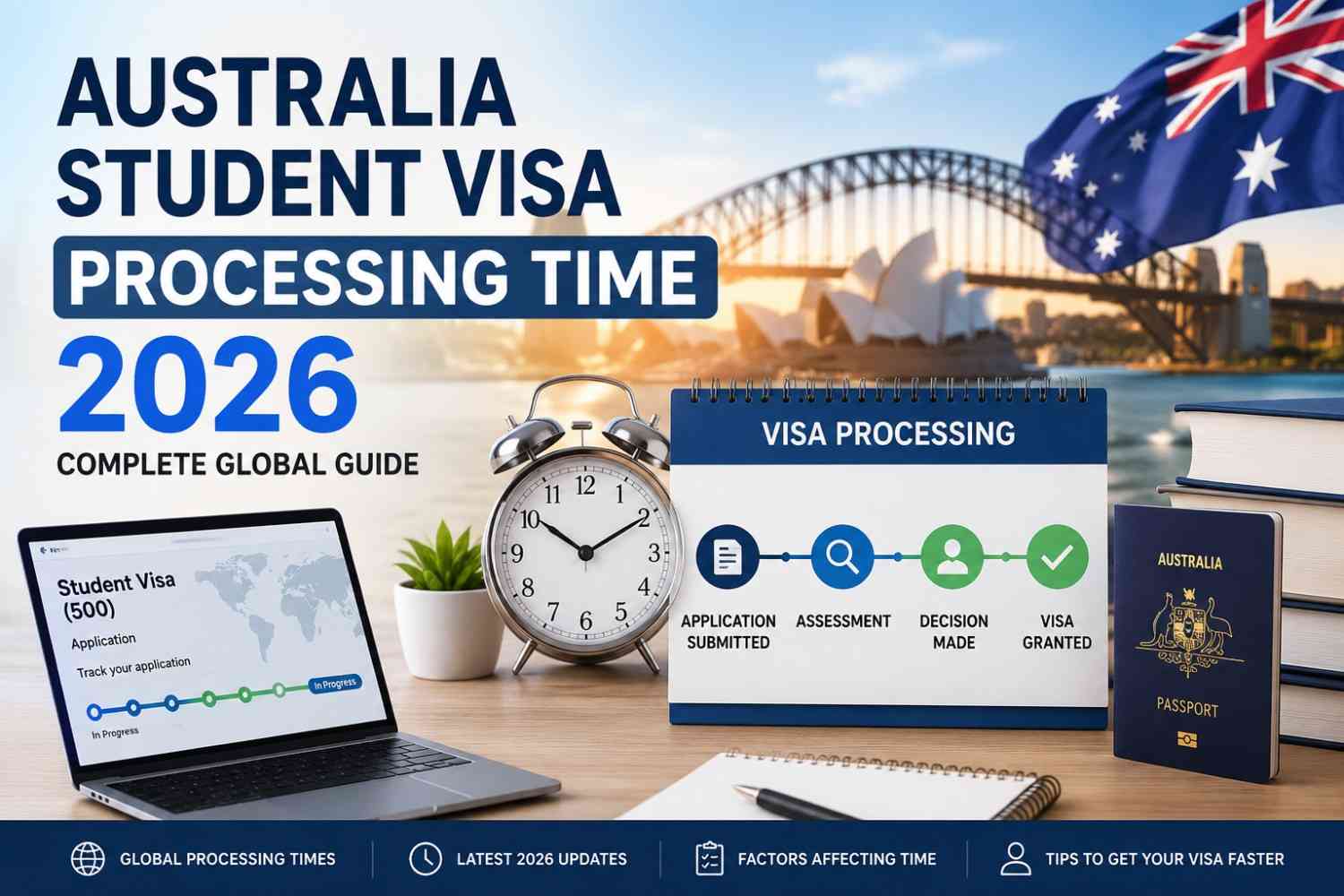
Australia Student Visa Processing Time 2026: Complete Global Guide
The Timeline That Could Make or Break Your Study Plans
Understanding the Australia student visa processing time is one of the most critical steps in planning your international education journey. Apply too late, and your enrolment is at risk. Apply without the right documents, and your timeline could stretch from weeks into months. The difference between a smooth application and a stressful one almost always comes down to preparation — and that starts with knowing exactly what to expect.
The Australian Subclass 500 Student Visa is one of the most applied-for student visas in the world, with hundreds of thousands of applications lodged each year from Asia, Africa, Europe, and South America. Processing times are not fixed — they vary significantly based on your education sector, nationality, document quality, and the time of year you apply.
This guide gives you everything: the current 2026 median timelines, a sector-by-sector breakdown, the five factors most likely to delay your application, and actionable steps to help your visa move as fast as possible. All data is sourced from the Australian Department of Home Affairs — but as timelines shift regularly, always verify current figures on their official website before planning your application.
Processing Times Visa Australia: Student Visas vs General Visitor Visas
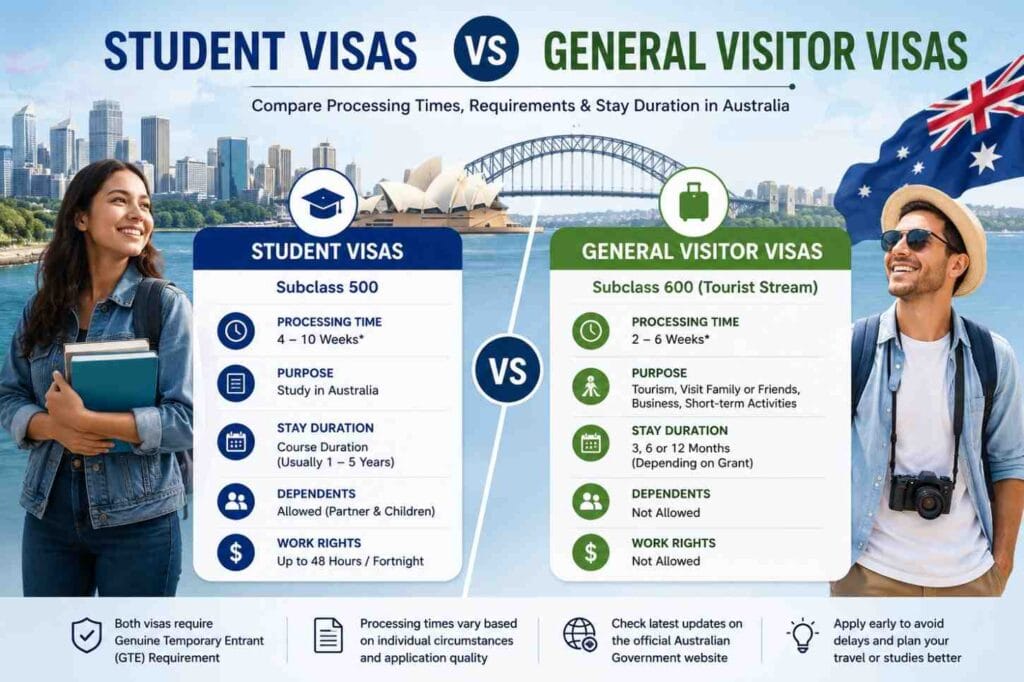
When people compare the processing times visa Australia issues for different visa categories, the difference between a tourist visa and a student visa is significant. A standard Visitor Visa (Subclass 600) can often be processed in as little as 7 to 21 days for many nationalities, particularly for applicants with strong travel histories and simple documentation requirements.
The Subclass 500 Student Visa is considerably more complex. It requires your Confirmation of Enrolment (CoE), financial evidence, health examinations, police clearances, English language test scores, and a Genuine Student (GS) statement — all of which must be assessed by a case officer against the specific criteria of your education sector and nationality.
As of 2026, the Australia student visa processing time median sits at approximately 28 days for straightforward applications. However, the realistic range for most international students is 35 to 61 days. Some applications — particularly in the VET and ELICOS sectors or those with pending health or character checks — can take significantly longer.
📌 Key 2026 Benchmarks
- Median processing time: ~28 days (decision-ready applications)
- Typical range for most students: 35 to 61 days
- Fastest sector: Higher Education at high-priority institutions
- Slowest sector: VET (Vocational Education and Training) — up to 9 months in complex cases
Subclass 500 Processing Times by Education Sector — 2026 Breakdown
The single most important factor influencing your Australia student visa processing time is your education sector. The Department of Home Affairs categorises student visa applications by the type of course you are enrolled in — and each sector has a different processing profile based on risk assessment, compliance history, and visa officer workload.
The table below reflects the current 2026 processing time ranges published and tracked by the Department of Home Affairs. These ranges represent the 25th to 90th percentile of applications — meaning 75% of applicants in each sector receive a decision within the upper figure, while 25% may experience faster processing. Always check the live processing time tool on the official Department of Home Affairs website, as these figures are updated monthly.
| Education Sector | Processing Time Range (2026) | Key Variables |
|---|---|---|
| Higher Education (Bachelor’s, Master’s, Graduate Diplomas) | 34 days – 7 months | University risk tier under MD115, GS statement quality, nationality |
| Postgraduate Research (PhD, Research Master’s) | 76 days – 7 months | Research proposal scrutiny, supervisor confirmation, character checks |
| Vocational Education & Training (VET) | 7 months – 9 months | Higher risk sector; stricter compliance checks, detailed financial review |
| ELICOS (English Language Courses) | 20 days – 8 months | Short course = faster in theory; nationality and provider registration matter most |
| Schools (Primary and Secondary) | 29 days – 6 months | Parent/guardian documentation; welfare arrangement evidence required |
| Non-Award / Foundation Programmes | 30 days – 5 months | Provider CRICOS registration, bridging course documentation |
The wide ranges above reflect the reality of how variable the Australia student visa processing time can be. A Higher Education applicant at a Group of Eight university with a clean application history might receive their visa in 5–6 weeks. An applicant in the VET sector with documentation gaps could wait the better part of a year. The goal of this guide is to help you land in the faster end of your sector’s range — consistently.
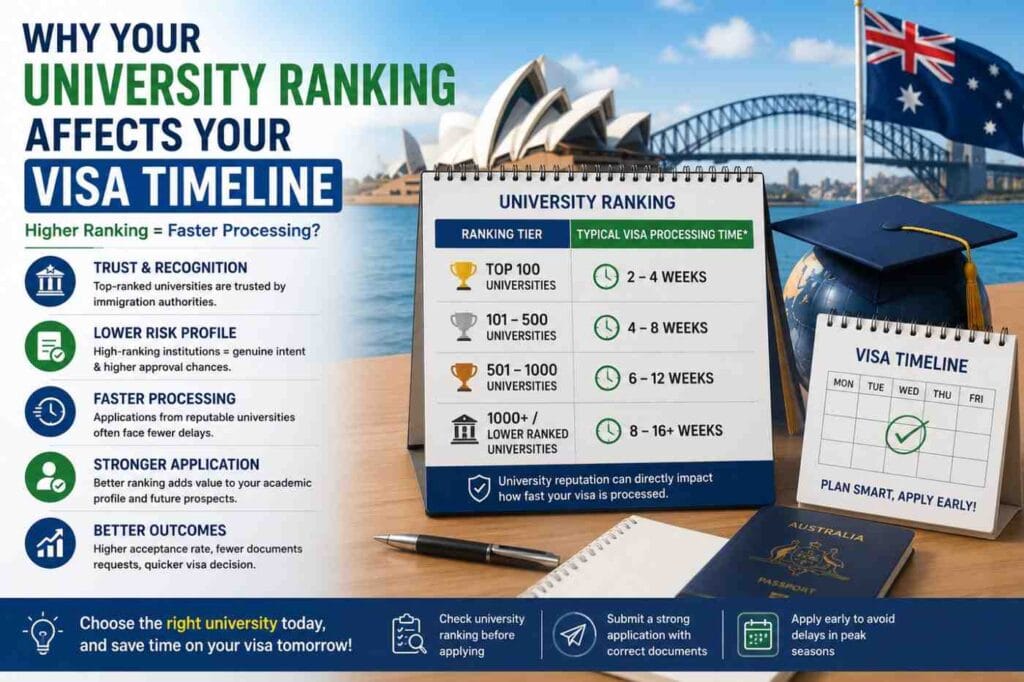
Ministerial Direction 115 (MD115): Why Your University Ranking Affects Your Visa Timeline
Ministerial Direction 115 (MD115) is one of the most significant policy frameworks affecting the Australia student visa processing time — and most applicants have never heard of it. Introduced to manage the processing workload more strategically, MD115 establishes a priority hierarchy that determines which student visa applications are processed first.
Under MD115, applications are prioritised based on the risk classification of your education provider. Institutions with strong compliance records, low visa refusal rates, and established oversight frameworks are assigned to higher-priority processing tiers. Applicants enrolled at these institutions — typically well-known public universities — move through the queue faster than applicants at lower-tier or newer providers.
Practically speaking, two students applying on the same day with identical documentation can receive decisions weeks apart if one is enrolled at a high-priority institution and the other at a lower-priority provider. When choosing between universities, this is a factor worth researching — particularly if your intake start date is time-sensitive.
⚠ Note: The Department of Home Affairs does not publish the full tiering list of providers under MD115. Check with your institution’s international student office or a registered migration agent to understand your provider’s priority classification and how it may affect your expected processing timeline.
The Genuine Student (GS) Statement: The Document Most Applicants Underestimate
In 2024, Australia replaced the long-standing Genuine Temporary Entrant (GTE) requirement with the Genuine Student (GS) statement. This change was not merely cosmetic — it fundamentally shifted how case officers assess an applicant’s intentions and directly affects Australia student visa processing time.
The GS statement asks you to demonstrate that your primary purpose in applying for a student visa is to study — and that you are the kind of student who is likely to succeed academically, adhere to visa conditions, and depart Australia after your course ends. A weak, generic GS statement that reads like a template is one of the most reliable ways to trigger additional case officer review, which extends your processing timeline significantly.
A strong GS statement addresses your academic background, your specific reasons for choosing Australia and your chosen institution, your career goals after completing your qualification, your ties to your home country, and your financial preparedness. Specificity is the key. A statement that names the exact programme, explains why Australian education is better suited to your goals than options in your home country, and articulates a clear post-study plan will always process faster than one that relies on generic phrases about pursuing quality education.
For help structuring this type of personal academic statement effectively, our guide on how to write a Statement of Purpose with copy-paste templates covers the same core principles applied to scholarship and university applications — the strategic thinking transfers directly to your GS statement.
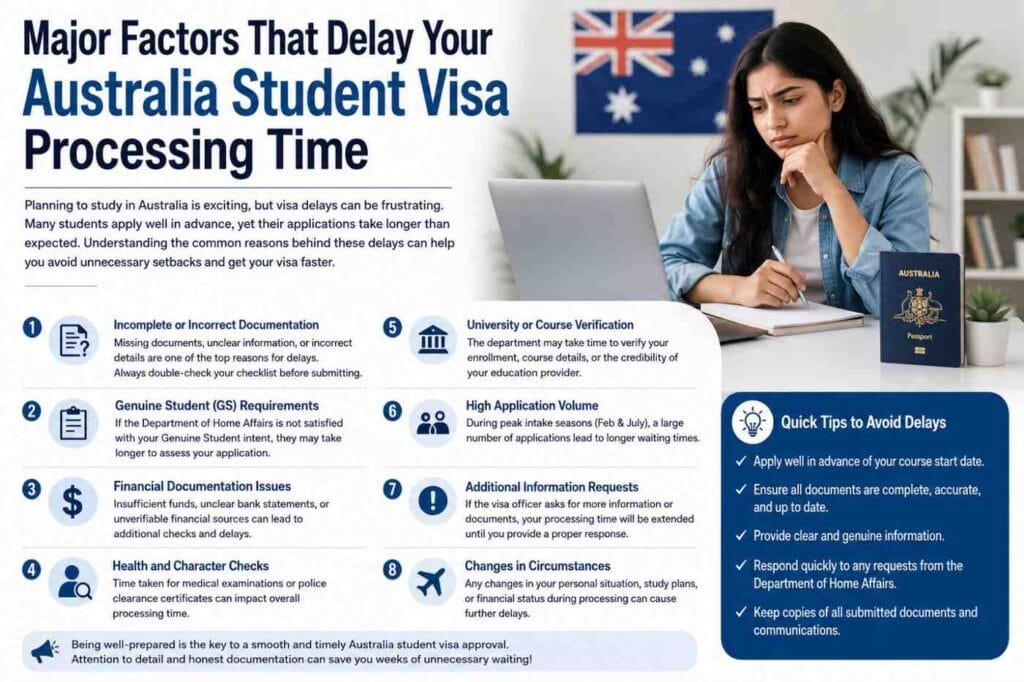
5 Major Factors That Delay Your Australia Student Visa Processing Time
Most delays in Australia student visa processing time are not random — they follow predictable patterns. Understanding these five factors before you apply gives you the power to eliminate most of them from your own application entirely.
Factor 1: Incomplete or Inconsistent Documentation
The number one cause of extended processing times is an application that is not “decision-ready.” This means documents are missing, translated incorrectly, outdated, or inconsistent with each other. A bank statement that contradicts the income shown in your tax returns. A CoE with a different name spelling than your passport. An academic transcript not accompanied by a certified English translation.
When a case officer encounters an inconsistency, they must either issue a Request for Information (RFI) — which freezes your application while you respond — or make a negative decision based on incomplete evidence. Either outcome extends your wait. Every document in your application must be current, certified, translated where necessary, and internally consistent before you submit.
Factor 2: Weak or Generic Genuine Student (GS) Statement
As discussed above, a GS statement that fails to convincingly demonstrate your genuine intent to study — and return home afterwards — places your application in a higher scrutiny queue. Higher scrutiny means more case officer time, which means a longer Australia student visa processing time.
Copy-pasted or template-based GS statements are among the most frequently flagged applications. Case officers who process hundreds of applications per week recognise a generic statement immediately. Write yours from scratch, specific to your programme, your institution, and your personal academic journey.
Factor 3: Pending Health Examinations
Australia requires health examinations for most student visa applicants. These must be conducted by a Bupa Medical Visa Services-approved panel physician in your country. The examination covers a chest X-ray and general health screening, and the results are lodged directly into your immigration file through the eMedical system.
If you complete your health examination before or at the time of lodging your visa, and the results upload successfully into your ImmiAccount file, there is no delay from health checks. If your health examination is pending, outstanding, or flagged for a specialist referral, your entire application is put on hold until the health assessment is finalised. Complete your health examination as early as possible — ideally before you lodge your visa application.
Factor 4: Police Clearance Certificates from Multiple Countries
If you have lived in any country other than your country of citizenship for 12 months or more (cumulatively) in the past 10 years, you are required to provide a police clearance certificate from each of those countries. This is a character requirement that is assessed alongside your criminal history check in your home country.
Police clearances from some countries — particularly those without fast-track official portals — can take 6 to 12 weeks to obtain. If you apply for your student visa while still waiting for a police clearance, your application remains on hold. Start gathering police clearances from all required countries the moment you accept your offer from an Australian institution.
Factor 5: Peak Intake Seasons — February and July
Australian universities run two main intakes: February/March (Semester 1) and July (Semester 2). In the weeks leading up to both intake periods, the Department of Home Affairs receives a significantly higher volume of student visa applications. This surge in volume increases the Australia student visa processing time across all sectors — even for well-prepared applications.
Students targeting February intake should aim to submit their visa application no later than October or November of the preceding year. Students targeting July intake should aim for April or May at the latest. Submitting during off-peak periods — when case officer workloads are lower — is one of the simplest and most effective ways to shorten your processing time without changing anything else about your application.
How to Fast-Track Your Australia Student Visa Application
You cannot pay to speed up your Australia student visa processing time — the Department of Home Affairs does not offer a premium processing lane for student visas. But you can make your application so complete and well-structured that a case officer can assess it and make a positive decision without needing to ask for anything additional. That is the only reliable fast-track strategy available.
- Submit a decision-ready application via ImmiAccount. Lodge your student visa through ImmiAccount, Australia’s official online visa portal. A decision-ready application means every required document is uploaded, every field is complete, your health examination is finalised, and your GS statement is thorough. Case officers prioritise applications they can assess and close without issuing an RFI.
- Complete your health examination before lodging. Book with a Bupa Medical Visa Services panel physician as soon as you receive your Confirmation of Enrolment (CoE). Attach evidence of the completed examination to your application at time of lodgement, or confirm it has been uploaded to your eMedical record.
- Apply well before peak periods. Avoid submitting in December–January (pre-February intake) or May–June (pre-July intake). Applications submitted in October–November or March–April process faster due to lower system load.
- Write a strong, personalised Genuine Student statement. Dedicate time to this document. It is the most subjective part of your application and the part where generic submissions create the most delays. Be specific about your institution, your programme, your career goals, and your plans after graduation.
- Gather all police clearances early. Identify every country where you have lived for 12+ months in the past 10 years and submit clearance applications to each immediately after accepting your study offer.
- Ensure financial documents are consistent and comprehensive. Your bank statements, sponsor letters, loan approval documents, and scholarship letters must tell a coherent, consistent financial story. Unexplained large deposits or inconsistencies between documents are the most common trigger for RFIs. For help preparing this part of your application, our complete guide to Australia student visa financial requirements 2026 covers every document in detail.
- Respond to any RFI within 24–48 hours. If the Department does issue a Request for Information, responding quickly moves your application back into the active processing queue. Delayed responses can extend your wait by weeks.
- Confirm your English proficiency test score is accepted. The Department of Home Affairs accepts IELTS, TOEFL, PTE Academic, and Duolingo English Test scores for most student visa applications. Ensure your score meets your institution’s minimum requirement and that your test result is current (within 2 years). Our comparison of PTE vs IELTS and our Duolingo English Test Format guide can help you choose the right test if you haven’t sat one yet.
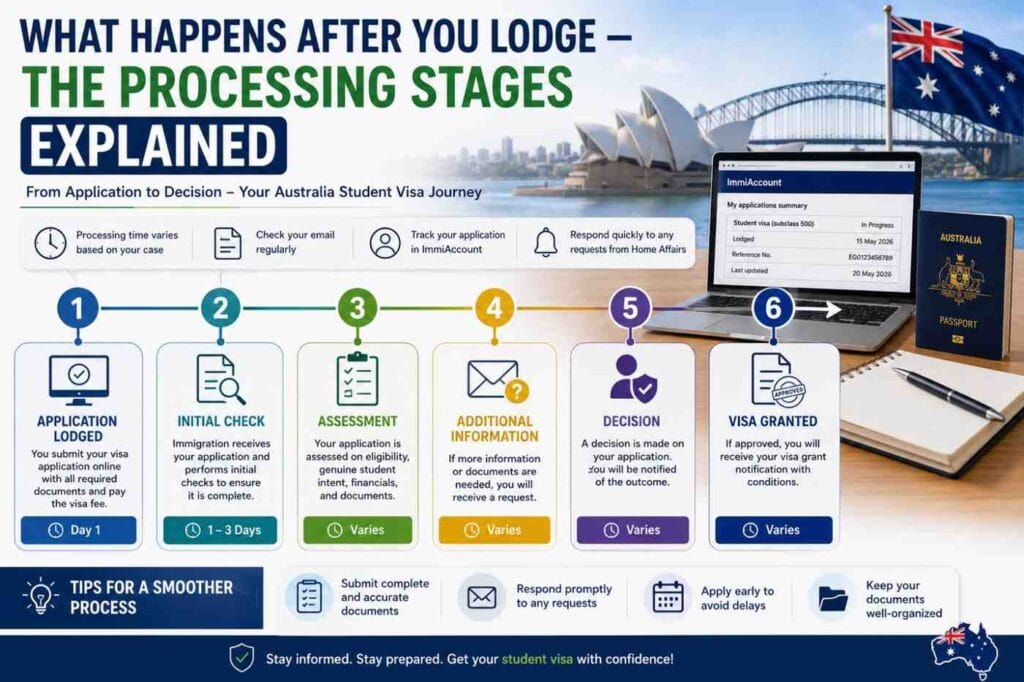
What Happens After You Lodge — The Processing Stages Explained
Many students lodge their application and then face weeks of silence, unsure whether anything is happening. Understanding the internal processing stages helps you interpret your ImmiAccount status correctly and know when to act versus when to wait.
Stage 1: Initial Allocation
After you submit, your application is received by the Department of Home Affairs and queued for allocation to a case officer. During this period, your ImmiAccount status shows “Received.” Allocation speed depends on current workload volumes and your provider’s MD115 priority tier. This stage can take anywhere from a few days to several weeks.
Stage 2: Health and Character Verification
Your case officer will verify that your health examination results have been received and that your police clearances are uploaded and satisfactory. If health or character checks are outstanding or require further review, your application enters a hold status until these are resolved. This is the stage where pre-completing your health examination pays off most significantly.
Stage 3: Financial and GS Assessment
Your case officer reviews your financial evidence against the Australia student visa financial requirements for 2026 and assesses your GS statement for genuineness. If your financial package is complete and your GS statement is convincing, this stage can be completed in days. If either requires clarification, an RFI is issued and the clock effectively pauses.
Stage 4: Decision
A decision is either a visa grant — communicated via email with your visa label and conditions — or a notice of intention to refuse, which gives you an opportunity to respond before a final negative decision. Visa grants typically come with your visa end date, work condition details (usually 48 hours per fortnight during term), and study conditions that align with your CoE.
Australia Student Visa Processing Time: Global FAQs
Q1: What is the current Australia student visa processing time in 2026?
The median Australia student visa processing time for a straightforward Subclass 500 application in 2026 is approximately 28 days. The realistic range for most international students — accounting for health checks, documentation review, and nationality-based assessment — is 35 to 61 days. Complex cases or applications in the VET sector can take 7 to 9 months. These figures are updated monthly by the Department of Home Affairs at their official website.
Q2: How early should I apply for an Australia student visa?
For February/Semester 1 intake, apply no later than October or November of the preceding year — giving yourself a minimum of 10 to 12 weeks of buffer before your course start date. For July/Semester 2 intake, apply by April or May. Always allow additional time if your application involves police clearances from multiple countries, pending health examinations, or complex financial documentation. The earlier you apply, the more buffer you have for any unexpected delays.
Q3: Can I check my Australia student visa processing status online?
Yes. You can track your application status through your ImmiAccount on the Department of Home Affairs portal. Status updates include “Received,” “In Progress,” and decision notifications. You can also use the Department’s official processing time check tool to see current estimated times for your specific visa subclass and sector. Note that calling the Department to enquire about your case will not speed up processing — status updates happen within the system.
Q4: Does my nationality affect my Australia student visa processing time?
Yes, indirectly. The Department of Home Affairs applies different levels of scrutiny based on the compliance history and visa refusal rates of applicants from specific countries. Nationalities with historically lower compliance rates — meaning higher rates of visa condition breaches or overstays — may receive more detailed assessment of their GS statement and financial evidence, which can add to processing time. This does not mean applicants from these countries are automatically refused — it means their applications are reviewed more thoroughly. Submitting a strong, complete, decision-ready application mitigates this significantly.
Q5: What is the fastest way to get an Australia student visa?
There is no paid fast-track option for the Subclass 500. The most reliable way to minimise your Australia student visa processing time is to submit a decision-ready application — complete documents, a strong GS statement, pre-completed health examination, all police clearances uploaded, and financial evidence that clearly meets the requirements without inconsistencies. Applications that require no additional information from the case officer are consistently processed faster than those that generate RFIs.
Quick Reference: Australia Student Visa Processing Time Summary
| Median processing time | ~28 days (decision-ready) |
| Typical range | 35 – 61 days |
| Higher Education | 34 days – 7 months |
| Postgraduate Research | 76 days – 7 months |
| VET Sector | 7 – 9 months |
| ELICOS | 20 days – 8 months |
| Best time to apply (Feb intake) | October – November |
| Best time to apply (July intake) | April – May |
Your Next Steps — Start Now, Not Later
The Australia student visa processing time is not something you can control once your application is lodged. What you can control — entirely — is the quality and completeness of what you submit. Students who plan ahead, prepare their documents thoroughly, and submit during off-peak periods consistently land in the faster end of the processing range. Students who scramble at the last minute consistently end up at the longer end — or miss their intake entirely.
Your preparation roadmap is straightforward. Accept your offer, obtain your CoE, book your health examination, start gathering police clearances, and prepare your financial evidence package. While those are in progress, write your Genuine Student statement — give it the time and specificity it deserves, because it is the most powerful variable in your application that you have complete control over.
For the financial documentation side of your application — which is the second most common source of delays — our complete guide to Australia student visa financial requirements 2026 covers every accepted document type, the minimum amounts for 2026, and a complete checklist specific to the Subclass 500. And if your financial situation includes an education loan or a parental sponsor, our guide on education loans without collateral for studying abroad explains how to structure loan documentation in a way that case officers find credible and sufficient.
Australia is one of the most rewarding study destinations in the world — and for good reason. With the right preparation and an understanding of how the Australia student visa processing time system works, your path from acceptance letter to visa grant can be as smooth and predictable as possible. Start early, apply smart, and let the timeline work for you rather than against you. Explore the full library of study abroad guides at StudyPathExp for every step of the journey from application to arrival.
Disclaimer: Processing time figures in this article are based on data published by the Australian Department of Home Affairs and are accurate as of July 2026. Visa processing times are updated monthly and change based on application volumes, staffing, and policy updates. Always verify current processing times at the official Department of Home Affairs website before planning your application timeline. This article is for general informational purposes and does not constitute migration advice. For complex applications, consult a registered Australian migration agent.