Missing Your Intake Because of a Visa Delay Is More Common Than You Think
The processing time for study permit Canada is the single most misunderstood part of the Canadian study abroad journey and missing it costs students their university seat, their accommodation deposit, and months of preparation. Some applicants assume it takes two or three weeks. Others prepare for six months. The reality is more nuanced than either extreme, and knowing exactly where you stand before you apply is what separates a smooth enrolment from a stressful scramble.
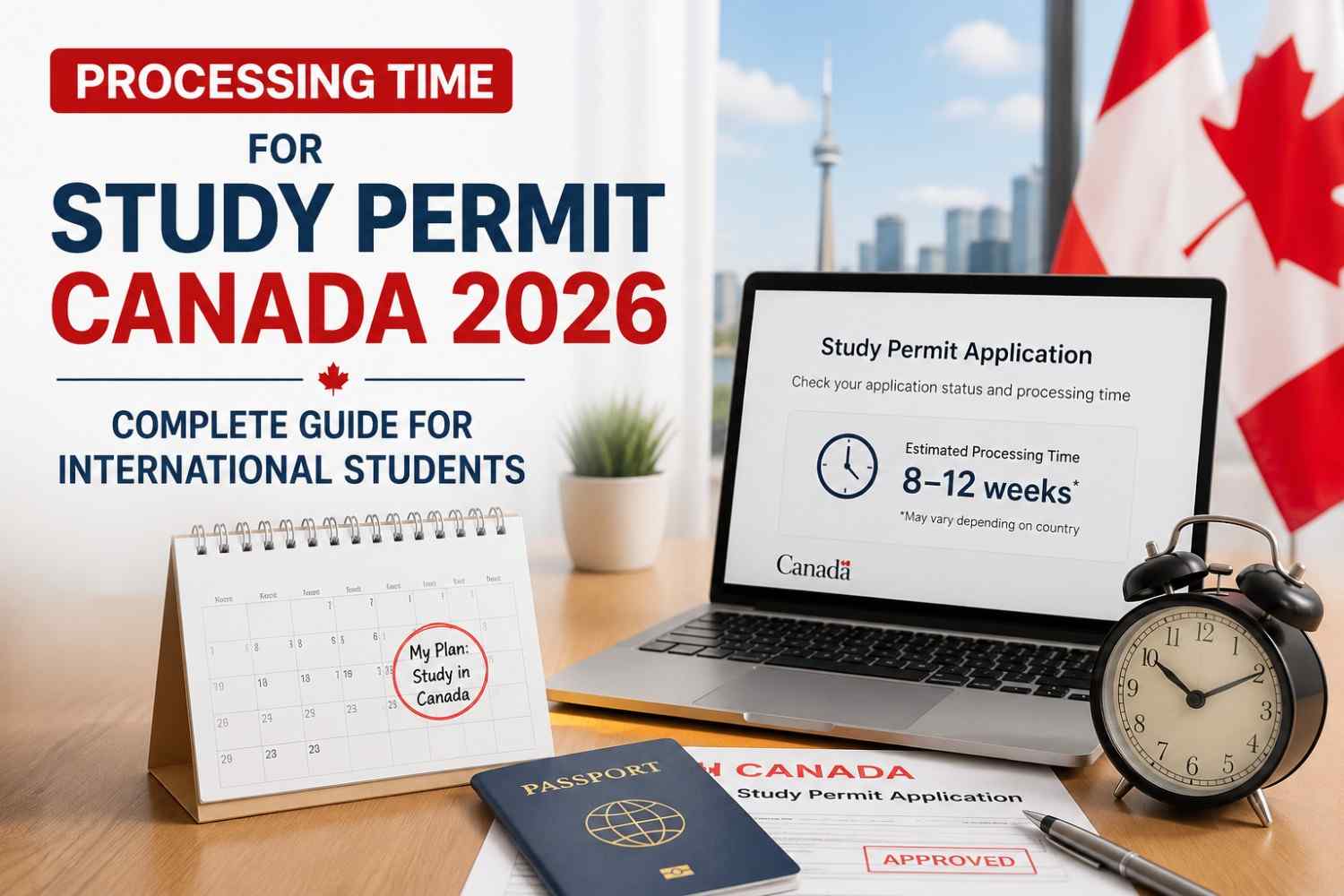
Canada offers two main pathways for a study permit the Student Direct Stream (SDS) and the Regular Stream and the processing times between them are dramatically different. SDS-eligible students from qualifying countries can receive a decision in as little as 20 business days. Regular stream applicants should plan for 8 to 16 weeks. If you are applying for studies in Quebec, add another 4 to 8 weeks for the provincial CAQ requirement on top of that.
This guide breaks everything down: the current 2026 timelines for both streams, what affects the processing time for study permit Canada at every stage, how to check your application status, a week by week application calendar, and the most common mistakes that turn a 4-week process into a 4-month wait. All information is based on guidance from Immigration, Refugees and Citizenship Canada (IRCC) always verify current timelines on their official website, as processing times update frequently.
⚡ 2026 At-a-Glance: Processing Time for Study Permit Canada
- Student Direct Stream (SDS): ~20 business days (approximately 4 weeks)
- Regular Stream: 8 to 16 weeks (varies by country and application volume)
- Quebec (with CAQ): Add 4–8 weeks to either stream above
- Online applications: Faster than paper — always apply online
- Biometrics (first-time applicants): Book immediately — adds 0–3 weeks if done early
What Is the Current Processing Time for Study Permit Canada in 2026?
The processing time for study permit Canada in 2026 depends primarily on which application stream you qualify for. IRCC publishes estimated processing times on their official website, updated regularly based on real application volumes. The figures below reflect the current 2026 benchmarks but always use the IRCC processing time estimator tool for the most current figures before submitting your application.
| Application Stream | 2026 Processing Time | Who Can Use It | Key Requirement |
|---|---|---|---|
| Student Direct Stream (SDS) | ~20 business days | Students from eligible countries only | IELTS 6.0+, GIC, upfront tuition payment |
| Regular Stream (Online) | 8 to 12 weeks | All countries | Letter of Acceptance from a DLI |
| Regular Stream (Paper) | 12 to 16 weeks | All countries (not recommended) | Letter of Acceptance from a DLI |
| SDS — Quebec | ~20 business days + CAQ time | SDS-eligible countries, Quebec institutions | CAQ + SDS requirements |
| Regular Stream — Quebec | 12 to 20+ weeks | All countries, Quebec institutions | CAQ must be obtained first |
The gap between SDS and regular stream is significant. If you qualify for SDS, it can be the difference between receiving your permit comfortably before your intake date and sweating through the final days before your programme begins. The IRCC processing time for the regular stream can extend further than 12 weeks during high volume periods particularly January and August, when most students are preparing for February and September intakes.
Student Direct Stream (SDS): The Fastest Processing Time for Study Permit Canada
The Student Direct Stream is IRCC’s dedicated fast track pathway designed to reduce the processing time for study permit Canada for students from specific countries who meet a defined set of requirements upfront. If you qualify, SDS is almost always the better choice — the 20 business day timeline is one of the most competitive student visa processing windows of any country in the world.
SDS Eligible Countries (2026)
SDS is available to students who are legal residents of the following countries at the time of application. Residency in the country not just citizenship is the determining factor for eligibility.
- 🇮🇳 India
- 🇨🇳 China
- 🇵🇭 Philippines
- 🇻🇳 Vietnam
- 🇲🇦 Morocco
- 🇵🇰 Pakistan
- 🇸🇳 Senegal
- 🇧🇷 Brazil
- 🇨🇴 Colombia
- 🇨🇷 Costa Rica
- 🇵🇪 Peru
- 🇦🇬 Antigua and Barbuda
- 🇹🇹 Trinidad and Tobago
⚠ Always Verify: IRCC updates the SDS eligible country list periodically. Confirm your country’s current eligibility on the official SDS page before applying.
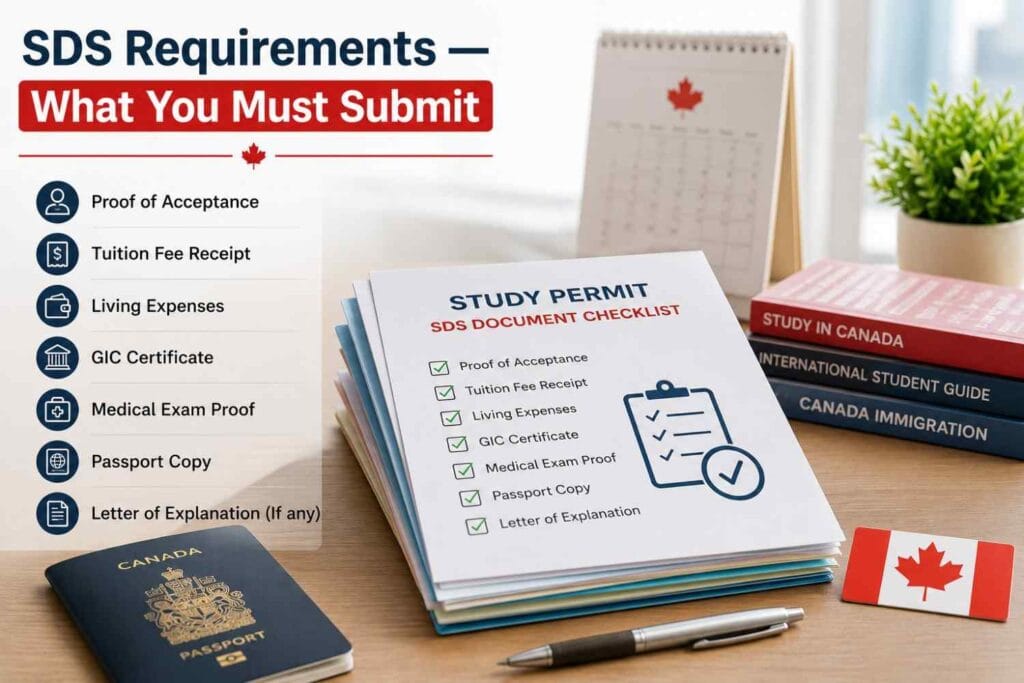
SDS Requirements — What You Must Submit
SDS has stricter upfront requirements than the regular stream — but that strictness is the reason the processing time for study permit Canada is so much faster under SDS. Because you submit more complete documentation upfront, IRCC officers can assess and close your application faster.
- ✅ Letter of Acceptance (LOA) from a Designated Learning Institution (DLI) in Canada
- ✅ IELTS Academic score of 6.0 overall with no band below 6.0 (TOEFL, Duolingo, or PTE not accepted for SDS)
- ✅ Guaranteed Investment Certificate (GIC) of CAD $20,635 from a participating Canadian financial institution, purchased before applying
- ✅ Proof of upfront tuition payment for the first year of your programme
- ✅ Medical examination completed by an IRCC-approved panel physician before or at time of application
- ✅ Proof of no active tuberculosis (included in the medical exam)
- ✅ Quebec Acceptance Certificate (CAQ) — if studying in Quebec only
The GIC requirement is the piece most students find unfamiliar. A GIC is essentially a guaranteed savings deposit held in a Canadian bank account that proves you have living funds available in Canada. The current SDS-required GIC amount is CAD $20,635, reflecting the updated cost of living threshold set by IRCC. This amount is accessible to you once you arrive in Canada — it is not a fee, it is your money held in your name. For context on how this compares to other proof of funds requirements for different study destinations, our guide on the proof of funds letter from bank covers how financial evidence works across multiple visa systems.
6 Factors That Directly Affect the Processing Time for Study Permit Canada
The processing time for study permit Canada is not fixed it responds to variables that are partly in your control and partly outside of it. Understanding these six factors before you apply is what allows you to plan a realistic timeline and avoid the most common causes of delay.
Factor 1: Biometrics — The Step Most Students Do Too Late
If you are applying for a Canadian study permit for the first time, you will be required to provide biometrics fingerprints and a photograph at a designated Visa Application Centre (VAC) in your country. Biometrics are valid for 10 years, so if you have previously provided them for a Canadian visa, you may not need to repeat them.
After you submit your online application IRCC sends you a Biometric Instruction Letter (BIL). You then book an appointment at your nearest VAC and complete biometrics. The waiting time for a VAC appointment in high-volume countries like Pakistan, India, and Nigeria can be 2 to 6 weeks. IRCC’s processing clock does not stop while you wait for your biometrics appointment but certain application steps cannot proceed until biometrics are received.
The practical fix: submit your study permit application online, receive your BIL, and book your biometrics appointment on the same day. Do not wait to receive one confirmation before acting on the next step.
Factor 2: Medical Examination Status
A medical examination from an IRCC-designated panel physician is required for most study permit applicants. For SDS applicants, the medical examination must be completed before submitting the application. For regular stream applicants, you may be asked to complete it after submission.
If your medical results show findings that require specialist review — which happens in a small percentage of cases involving chest X-ray findings your application enters a medical hold that can add several weeks to your total processing time. Completing your medical examination early, and with a physician experienced in immigration medicals, reduces this risk.
Factor 3: Application Completeness
An incomplete application missing documents, inconsistent information, or unsigned forms is returned or placed on hold by IRCC. A returned application must be resubmitted, effectively resetting your position in the processing queue. Every day lost to resubmission is a day closer to your intake date.
The most commonly missing documents in study permit applications from Pakistani and South Asian students are: certified English translations of academic transcripts, police clearance certificates, and financial sponsor letters that lack sufficient detail. Your Letter of Acceptance must also be from a Designated Learning Institution (DLI) not all private colleges are DLIs, so confirm your institution’s status before applying.
Factor 4: Country of Residence and Application Volume
IRCC processes applications from different countries through different visa offices, each with its own staffing levels and application volumes. Countries that generate high volumes of study permit applications including India, China, Pakistan, the Philippines, and Nigeria can sometimes experience slightly longer IRCC processing times due to workload. This is particularly notable in the regular stream, where officer level review is more intensive. SDS largely neutralises this variable by routing applications through a dedicated fast track processing system.
Factor 5: Quebec — The CAQ Requirement
If your programme is at an institution in Quebec including universities like McGill, Concordia, Université de Montréal, or Université Laval you need a Certificat d’acceptation du Québec (CAQ) from the Quebec provincial government before IRCC can finalise your study permit. The CAQ is a separate application with its own processing time of approximately 4 to 8 weeks.
You must apply for your CAQ first, wait for it to be issued, and then include it in your IRCC study permit application. This means Quebec bound students should add 4 to 8 weeks to whatever processing time for study permit Canada applies to their chosen stream. Start your CAQ application the day you receive your LOA.
Factor 6: Peak Application Seasons
Canadian universities run two main intakes September (Fall) and January (Winter). IRCC receives peak application volumes in May through July for September intake and in September through November for January intake. Submitting during peak periods doesn’t mean your application is rejected it means processing takes longer because more applications are being reviewed simultaneously.
For September intake, the ideal submission window is April to May. For January intake, aim for September to October. Submitting outside peak periods when IRCC workload is lower consistently produces faster outcomes across both SDS and regular streams.
How to Check Your Canada Study Permit Processing Time Online
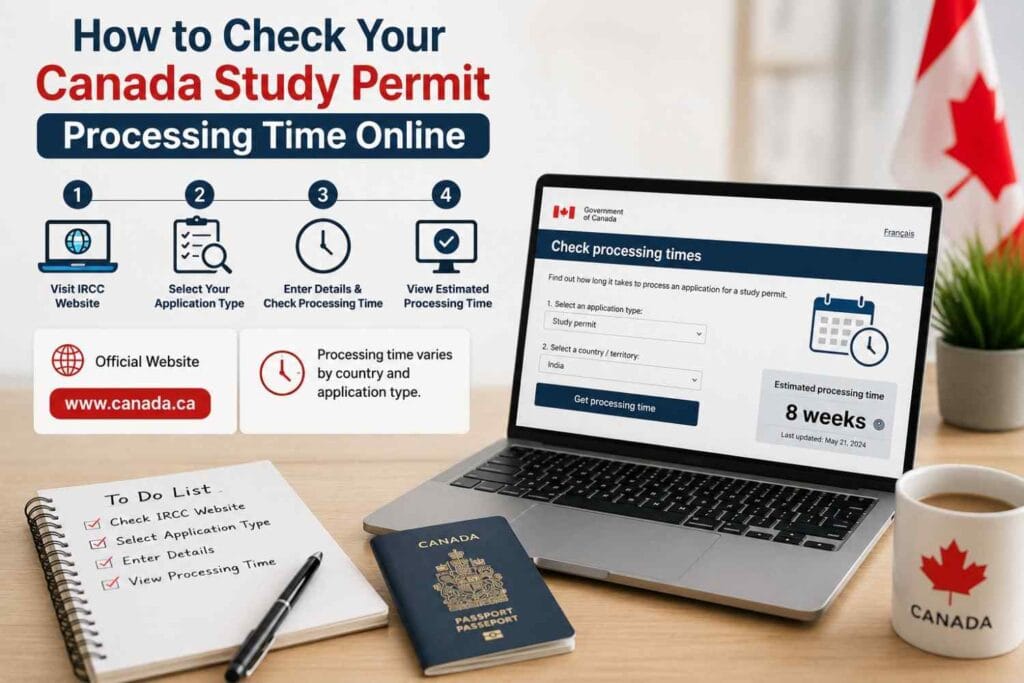
Once your application is submitted, there are two ways to monitor the processing time for study permit Canada as it relates specifically to your case.
- IRCC Online Account (MyCIC): If you applied online through your IRCC account, your application status is updated directly in the portal. Status messages include “Received In Progress,” “Decision Made” and notification of any outstanding requirements like biometrics or medical exams. Log in regularly and respond promptly to any requests.
- IRCC Processing Time Estimator: The official IRCC processing time tool allows you to input your application type, submission date, and country to get an estimated current processing timeline. This reflects real-time data based on recent application volumes. Use it both before you apply (to plan your timeline) and after submission (to gauge when to expect a decision).
💡 Expert Tip: IRCC does not provide individual case status updates by phone or email unless specifically requested. Do not call IRCC to enquire about your application unless your processing time has exceeded the posted estimate by more than 30 days. Contacting IRCC prematurely does not speed up your application and can occasionally create unnecessary flags on your file.
Week-by-Week Application Calendar: When to Apply for Each Intake
The biggest mistake students make when managing the processing time for study permit Canada is working backwards from their intake date without enough buffer. The calendar below shows the ideal application timeline for both September and January intakes, accounting for SDS and regular stream timelines plus the additional steps of biometrics, medical examinations, and Quebec CAQ where applicable.
| Activity | September Intake — Ideal Timing | January Intake — Ideal Timing |
|---|---|---|
| Receive Letter of Acceptance (LOA) | January – February | June – July |
| Apply for Quebec CAQ (if applicable) | Immediately after LOA — February | Immediately after LOA — July |
| Purchase GIC (SDS applicants) | February – March | July – August |
| Complete medical examination | February – March | July – August |
| Submit study permit application (SDS) | March – April | August – September |
| Submit study permit application (Regular) | April – May (latest) | September – October (latest) |
| Book and complete biometrics | Within 1 week of BIL receipt | Within 1 week of BIL receipt |
| Expected SDS decision | April – May | September – October |
| Expected Regular Stream decision | June – July (at latest) | November – December (at latest) |
| Programme start date | September | January |
Notice that SDS applicants have a comfortable 4 to 5 month buffer between permit decision and intake start. Regular stream applicants applying at the ideal time still have a 2 to 3 month buffer. Students who delay their application to June or July for a September intake are taking a real risk any complication with biometrics, medical results, or documentation gaps will likely result in missing their intake entirely.
How to Speed Up Your Canada Study Permit Processing Time
There is no paid expedite option for the processing time for study permit Canada unlike some other countries, IRCC does not offer a premium processing lane for individual study permit applicants. What you can do is make your application as complete and efficient as possible so IRCC officers can process it at the fastest possible pace for your stream.
- Apply under SDS if you qualify. This is the single most impactful step you can take to reduce your processing time. If your country is on the SDS eligible list and you can meet the IELTS, GIC, and upfront tuition requirements, always choose SDS over the regular stream.
- Apply online, never on paper. Online applications are processed faster, tracked in real time through your IRCC account, and far less likely to be lost or returned due to administrative errors.
- Complete your medical examination before submitting. SDS requires this upfront. Regular stream applicants who complete their medical exam proactively before being asked eliminate one of the most common mid process hold causes.
- Book biometrics immediately upon receiving your BIL. Do not wait until you have confirmed other steps. Go directly to your nearest Visa Application Centre website and book the earliest available appointment the same day your BIL arrives.
- Prepare a complete, decision ready application. Every document must be present, translated where necessary, certified, and internally consistent. Use the document checklist provided in the IRCC study permit guide and tick every item before submitting. An incomplete application loses its place in the queue.
- Write a strong study plan / purpose of study statement. IRCC officers review your intention to study genuinely and return home after your programme. A vague or generic study plan can flag your application for additional review. Our guide on how to write a Statement of Purpose covers how to structure this type of document convincingly.
- Apply well before peak seasons. For September intake, submit by April at the latest. For January intake, submit by September at the latest. Even a few weeks of buffer can make the difference if any single step runs slightly longer than expected.
Required Documents for Canada Study Permit Complete Checklist
📄 Canada Study Permit Document Checklist (2026)
- ☐ Letter of Acceptance (LOA) from a Designated Learning Institution (DLI)
- ☐ Valid passport — valid beyond your intended study period
- ☐ Academic transcripts and certificates — certified copies with English translation
- ☐ Proof of financial support — bank statements (personal + sponsor), GIC certificate (SDS), scholarship letter
- ☐ Proof of tuition payment (SDS applicants — first year upfront)
- ☐ GIC certificate from a participating Canadian bank (SDS applicants)
- ☐ IELTS score report — 6.0 overall, no band below 6.0 (SDS mandatory; regular stream — check DLI requirements)
- ☐ Medical examination results from an IRCC-approved panel physician
- ☐ Police clearance certificate — from all countries where you have lived 6+ months
- ☐ Passport-size photographs — per IRCC specifications
- ☐ Study plan / Purpose of study statement — explaining your choice of programme, institution, and career goals
- ☐ CAQ (Certificat d’acceptation du Québec) — Quebec institutions only
- ☐ Custodian declaration — minors under 17 years studying in Canada without parents
- ☐ Biometrics — completed after receiving Biometric Instruction Letter
Financial evidence is the part of this checklist that generates the most questions. If you are funding your studies through an education loan rather than personal or parental savings, our guide on education loans without collateral for studying abroad covers how to structure loan documentation in a way that satisfies IRCC’s financial capacity requirements. And if you need to produce a formal bank letter as part of your application, our proof of funds letter guide includes copy paste templates accepted by immigration authorities.
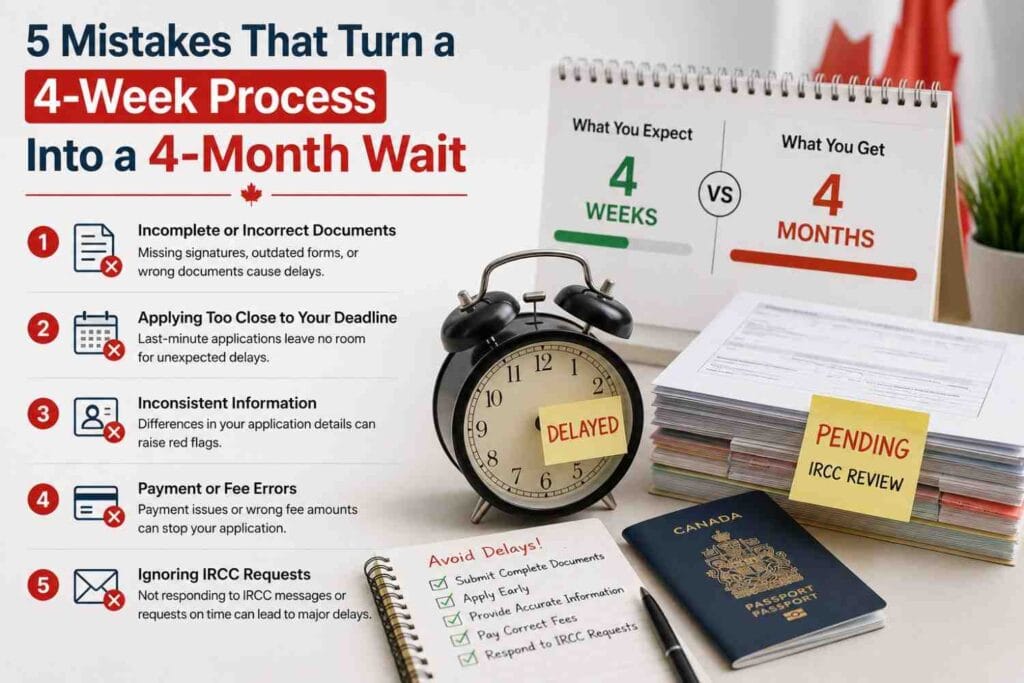
5 Mistakes That Turn a 4-Week Process Into a 4-Month Wait
Most avoidable delays in the processing time for study permit Canada come from the same recurring mistakes. These five errors appear repeatedly in applications that get returned, placed on hold, or refused and all of them are entirely preventable with advance awareness.
Mistake 1: Applying on Paper Instead of Online
Paper applications take significantly longer to process than online submissions and are more vulnerable to administrative errors. Unless you have a specific reason why you cannot apply online which is extremely rare always submit your study permit application through your IRCC online account. Paper applications also cannot be tracked in real time, leaving you with no visibility on where your application stands until a decision arrives.
Mistake 2: Delaying Biometrics
After receiving your Biometric Instruction Letter, many students wait a week or two before booking their VAC appointment. In countries where VAC appointment availability is limited which includes Pakistan, India, and Nigeria during peak periods this delay can push your biometrics appointment 4 to 6 weeks out, stalling your entire application. Book immediately when your BIL arrives.
Mistake 3: Not Confirming Your Institution Is a DLI
A Letter of Acceptance is only valid for a study permit application if it comes from a Designated Learning Institution (DLI). Not all colleges and private career institutions in Canada hold DLI status. If your LOA comes from a non DLI institution, your entire application is invalid. Always search the official IRCC DLI list to confirm your institution before accepting an offer.
Mistake 4: Using the Wrong English Test for SDS
SDS accepts IELTS Academic only with a minimum score of 6.0 overall and no band below 6.0. TOEFL, PTE Academic, and Duolingo are not accepted for the SDS pathway. Students who submit applications under SDS with a non IELTS test result find their application downgraded to the regular stream, losing the processing time advantage entirely. If you are deciding between IELTS and another test and Canada is your target country, our PTE vs IELTS comparison guide explains the trade offs in detail.
Mistake 5: Forgetting the Quebec CAQ
This is the most frequently overlooked step for students accepted to Quebec institutions. Many students receive their LOA, immediately apply for their IRCC study permit, and then discover they cannot receive it without the CAQ which requires a completely separate application to the Quebec government. The CAQ must be received and included in your IRCC application. Forgetting it entirely adds 4 to 8 weeks to your total canada study permit processing time 2026 sometimes enough to miss your intake date.
Processing Time for Study Permit Canada — Global FAQs
Q1: What is the processing time for study permit Canada in 2026?
The processing time for study permit Canada in 2026 is approximately 20 business days under SDS (for eligible countries meeting all SDS requirements) and 8 to 16 weeks under the regular stream depending on your country of residence, application completeness, and submission timing. Quebec applicants must add 4 to 8 weeks for the CAQ on top of whichever stream timeline applies to them. Always check the live IRCC processing time estimator for the most current figures before submitting.
Q2: How long does Canada study permit take for Pakistani students?
Pakistani students qualify for the Student Direct Stream, which means the processing time for study permit Canada can be as low as 20 business days if all SDS requirements IELTS 6.0+, GIC of CAD $20,635, upfront tuition, and completed medical exam are met and submitted correctly. Pakistani students applying through the regular stream should plan for 10 to 16 weeks given typical processing volumes for applications from Pakistan. Biometrics availability at VACs in Pakistan should also be factored in when planning your timeline.
Q3: What is the Canada SDS processing time in 2026?
The SDS Canada processing time is approximately 20 business days roughly 4 calendar weeks. This 20day target applies to applications that are fully complete at time of submission, with biometrics already provided, medical examination already completed, GIC purchased, and all required documents uploaded. Applications that are incomplete or require additional officer review may take longer even under SDS. The 20 day figure represents IRCC’s service standard for decision ready SDS applications.
Q4: Can I check my processing time for study permit Canada online?
Yes. Use the IRCC processing time estimator to check current timelines for your specific visa type and submission date. If you applied online, your individual application status is also visible through your IRCC online account (MyCIC), where you can see status updates, outstanding requirements, and decision notifications in real time.
Q5: Does the processing time for study permit Canada include weekends?
When IRCC states the SDS timeline as “20 business days,” this refers to working days Monday to Friday, excluding Canadian public holidays. Twenty business days is approximately 4 calendar weeks. Regular stream timelines are generally expressed in calendar weeks rather than business days. When planning your application, use calendar weeks as your reference point and build in buffer for any administrative steps like biometrics appointment wait times.
Q6: Does studying in Quebec take longer for a study permit?
Yes. Quebec bound students must obtain a Certificat d’acceptation du Québec (CAQ) from the Quebec provincial government before IRCC can finalise the study permit. The CAQ typically takes 4 to 8 weeks to process and must be included in the IRCC application. This makes the total process 4 to 8 weeks longer than the equivalent non Quebec timeline. Quebec SDS applicants should plan for a minimum of 6 to 8 weeks total (CAQ time + SDS processing), while Quebec regular stream applicants should plan for 16 to 24 weeks minimum.
Quick Reference Summary Processing Time for Study Permit Canada 2026
| SDS Processing Time | ~20 business days (decision-ready applications) |
| Regular Stream (Online) | 8 to 12 weeks |
| Regular Stream (Paper) | 12 to 16 weeks (avoid paper) |
| Quebec CAQ (additional) | 4 to 8 weeks extra |
| SDS IELTS requirement | 6.0 overall, no band below 6.0 |
| SDS GIC requirement | CAD $20,635 |
| Apply for September intake by | April (SDS) / May (Regular) |
| Apply for January intake by | August (SDS) / September (Regular) |
Final Word: Plan Around the Processing Time, Not Against It
The processing time for study permit Canada is predictable but only if you treat it as a fixed constraint to plan around rather than a flexible variable you can squeeze at the end. Students who start their application process the moment they receive their LOA, who choose SDS where eligible, who complete biometrics and medical examinations without delay, and who submit complete applications consistently receive their permits well before their intake date.
The ones who struggle are almost always those who underestimated one step the CAQ that added 6 weeks, the biometrics appointment that was booked two weeks late, the medical exam that flagged a finding requiring specialist review. None of these are catastrophic in isolation. Combined with a late application, any one of them can result in missing your intake.
Start early. Apply under SDS if you qualify. Submit online Complete biometrics and medical immediately. Build in buffer And use the resources linked throughout this guide from your study plan and SOP to your financial documentation to make every part of your application as strong as possible. If you are comparing study destinations and want to understand how Canada’s processing time compares to Australia’s, our Australia student visa processing time guide gives you the same level of detail for the Subclass 500. Explore the full study abroad resource library at StudyPathExp for every stage of your international education journey.
Disclaimer: Processing times, SDS eligibility requirements, GIC amounts, and CAQ procedures referenced in this article are based on information published by Immigration, Refugees and Citizenship Canada (IRCC) and are accurate as of July 2026. These figures change regularly. Always verify current processing times, eligibility criteria, and document requirements at the official IRCC website before submitting your application. This article is for general informational purposes only and does not constitute immigration advice. For complex applications, consult a regulated Canadian immigration consultant (RCIC).