You’ve received your offer letter from an Australian university. You’ve accepted it, paid your first semester fees, and now you’re waiting for something called a Confirmation of Enrolment. Your visa checklist says you need it. Your university hasn’t sent it yet. And nobody around you seems to know exactly what it is or how long it takes to arrive.
This confusion is more common than you’d think. Students from India, Pakistan, Nepal, the Philippines, Bangladesh, Sri Lanka, and Nigeria all Google this exact term in large numbers every year — not because the concept is complicated, but because nobody explains it clearly in one place.
So let’s fix that. This guide covers exactly what a Confirmation of Enrolment is, what it contains, when your university sends it, what you actually do with it, and what happens when things go wrong. By the time you finish reading, you’ll know more about the CoE process than most students who’ve already submitted their visa applications.
What Is a Confirmation of Enrolment?
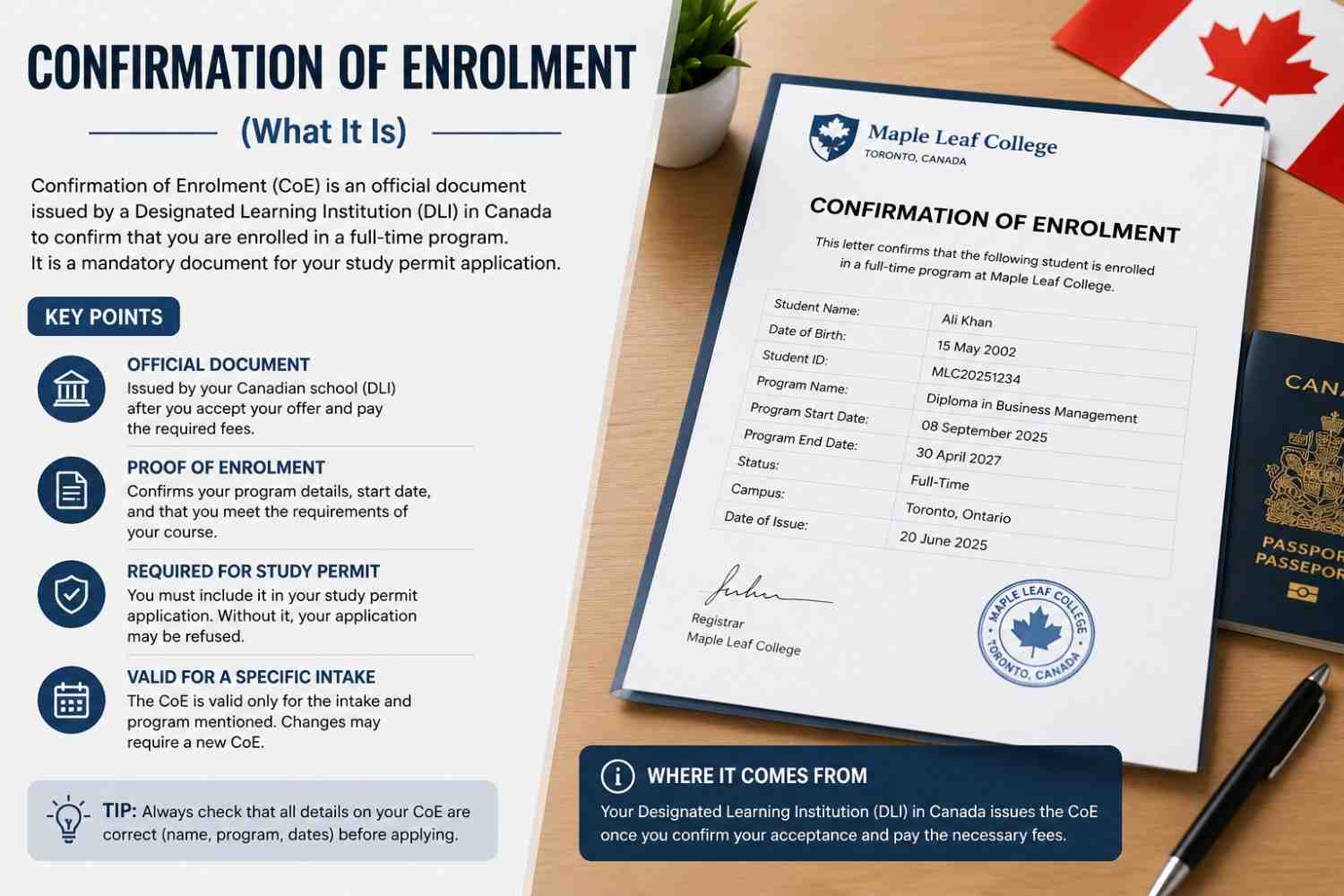
A Confirmation of Enrolment (CoE) is an official document issued by an Australian education provider confirming that you have been enrolled in a specific course at their institution. It’s not the same as your offer letter, and it’s not the same as your acceptance email. It’s a formal, government-linked document that only gets issued after you’ve fulfilled your pre-enrolment obligations, usually by paying your fees.
Every education provider in Australia that teaches international students must be registered on the CRICOS register (Commonwealth Register of Institutions and Courses for Overseas Students). When you enrol, your institution creates a CoE for you through a government system called PRISMS (Provider Registration and International Student Management System). That’s the backend database the Department of Home Affairs uses to verify your enrolment when processing your student visa.
In practical terms: without a valid Confirmation of Enrolment, you cannot apply for an Australian student visa (Subclass 500). It’s not optional documentation. It’s the foundation of your entire visa application.
📌 CoE at a Glance
- Full name: Confirmation of Enrolment
- Short form: CoE
- Who issues it: Your Australian institution (via PRISMS)
- When you get it: After accepting your offer and paying required fees
- Why you need it: Required for your Australian Student Visa (Subclass 500)
- Format: Digital document with a unique CoE reference number
Which Countries Search for “Confirmation of Enrolment” the Most?
This is an almost exclusively Australia-related term. Unlike “Letter of Acceptance” (which is used by Canada, the UK, and the US) or “Admission Letter” (a more general term), the phrase Confirmation of Enrolment is the specific language used in the Australian international education system.
The countries where this term is searched most heavily are the same countries that send the most students to Australia every year.
| Country | Why Students Search for CoE |
|---|---|
| 🇮🇳 India | Largest source of international students in Australia — CoE is a required document for GTE and visa applications |
| 🇨🇳 China | Second largest cohort — students frequently check CoE status for SDS and standard visa applications |
| 🇵🇭 Philippines | Large nursing and healthcare student cohort applying to Australian universities |
| 🇳🇵 Nepal | Fast-growing cohort — many first-time applicants unfamiliar with Australian visa documentation |
| 🇵🇰 Pakistan | Growing student numbers to Australia — CoE required alongside financial and health documentation |
| 🇧🇩 Bangladesh | Students in the engineering and IT sectors frequently apply to Australian institutions |
| 🇱🇰 Sri Lanka | Significant cohort applying for undergraduate and postgraduate programmes |
| 🇳🇬 Nigeria | African students applying via standard stream — CoE is a new concept for many first-time applicants |
| 🇻🇳 Vietnam | Third largest source country — students familiar with CoE process but seek updated 2026 guidance |
If you’re from any of these countries and applying to Australia, this guide is written specifically for you.
What Information Does a Confirmation of Enrolment Contain?
Your Confirmation of Enrolment is not just a one-line letter saying “yes, you’re enrolled.” It’s a structured document with specific data fields that the Department of Home Affairs reads directly from the PRISMS system. Every field matters. If something is wrong on your CoE, your visa application can be delayed or refused.
Here’s what a standard CoE contains:
- CoE Reference Number: A unique identifier for your enrolment record in the PRISMS database. You’ll enter this number directly into your visa application.
- Provider Name and CRICOS Provider Code: The official name of your institution and their government registration number as a CRICOS-approved provider.
- Course Name and CRICOS Course Code: The exact name of the programme you’re enrolled in and its government-registered course code.
- Course Start Date and Expected End Date: The official duration of your course as registered with the government. This determines your visa length.
- Student’s Full Name: Must match your passport exactly. Even a middle name mismatch can create problems.
- Date of Birth: Again, must match your passport perfectly.
- Tuition Fees: The total course fee and the amount you’ve already paid shown on the CoE.
- OSHC (Overseas Student Health Cover) Details: Whether your institution has arranged OSHC on your behalf and the coverage period.
- English Language Proficiency: Your IELTS, PTE, or other test score that met the institution’s entry requirements.
- Unique Student Identifier (USI): A government-assigned number required for all students studying in Australia.
Take your time reading through every field when you receive your Confirmation of Enrolment. Don’t just check that it arrived and file it away. Errors on a CoE are more common than you’d expect, and catching them before you submit your visa application saves weeks of delay.
When Does Your University Issue the Confirmation of Enrolment?
This is the question that causes the most anxiety. Students pay their fees and then spend days checking their email wondering where the CoE is.
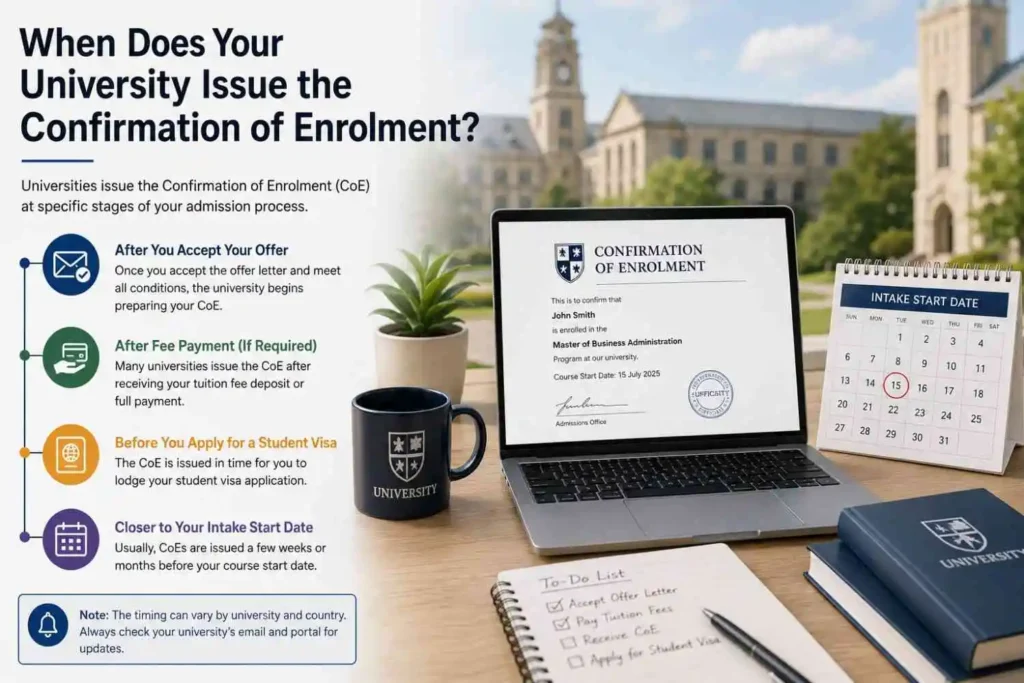
Your institution will issue your Confirmation of Enrolment after you’ve met all pre-enrolment conditions. The most common conditions are:
- Accepting your offer formally through the institution’s online student portal
- Paying the required upfront fees, which usually means at least the first semester’s tuition and OSHC premium
- Submitting any outstanding documents required by the institution, such as certified academic transcripts or English language test results
- Completing any online pre-enrolment forms the university requires before they finalise your enrolment in their system
Once all conditions are satisfied, most universities generate and send your Confirmation of Enrolment within 3 to 10 business days. Some large universities with automated systems send it almost immediately after fee payment is confirmed. Others, particularly smaller private colleges, can take up to two weeks.
⚠ Important: Paying your fees does not instantly generate a CoE. Your institution still has to process the payment, confirm it’s cleared, complete their internal enrolment steps, and then register your CoE in PRISMS. Allow at least 5 to 10 business days after fee payment before following up with your institution’s international office.
How to Get Your Confirmation of Enrolment: Step by Step
- Receive and review your offer letter. Read it carefully. Check the course name, duration, fees, and any conditions you must meet before enrolment is confirmed.
- Accept your offer through the official student portal. Most Australian universities use an online acceptance system. Follow the instructions in your offer letter exactly.
- Arrange your OSHC. Many universities arrange this on your behalf as part of the enrolment process. Others ask you to purchase it directly from an approved provider. Your CoE won’t be issued until OSHC is confirmed.
- Pay your required fees. Pay the upfront fees specified in your offer letter. Keep proof of payment. Bank transfer receipts, online payment confirmations, and fee invoices should all be saved somewhere accessible.
- Submit outstanding documents. If your offer was conditional on certified transcripts, IELTS scores, or other documents, submit them before chasing your CoE. The institution can’t finalise your enrolment while conditions remain unmet.
- Wait for the CoE. Give the institution 5 to 10 business days after all conditions are met. Your CoE will arrive by email, usually as a PDF attachment or a link to your student portal.
- Check every detail immediately. Name, date of birth, course name, course dates. If anything is wrong, contact your international student adviser the same day.
- Use the CoE reference number in your visa application. When completing your Australian Student Visa application on ImmiAccount, you’ll enter your CoE number directly. The Department of Home Affairs pulls your enrolment data from PRISMS automatically.
What Do You Do With Your Confirmation of Enrolment?
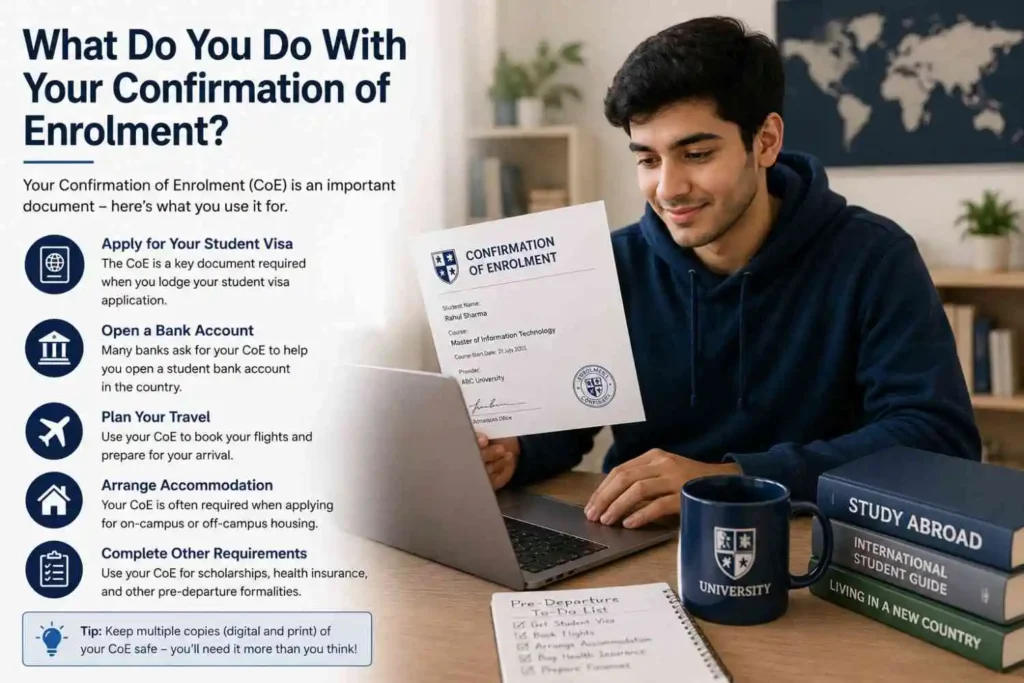
Your Confirmation of Enrolment is not a document you read once and file. It does several jobs across your whole pre-departure process.
1. Applying for Your Australian Student Visa
This is the main one. When you complete your Subclass 500 Student Visa application on the ImmiAccount portal, you enter your CoE reference number. The system pulls your enrolment details directly from PRISMS and links them to your visa application. The visa officer reviewing your case sees your course details, your institution’s CRICOS registration, and your course dates, all verified against what your university submitted.
Your Confirmation of Enrolment also determines the length of your visa. If your course runs from February 2026 to November 2028, your visa will generally be issued to cover that period plus a short buffer for travel.
2. Arranging Overseas Student Health Cover (OSHC)
If you’re arranging your own OSHC rather than through your university, you’ll need your CoE details to complete the OSHC application. The provider needs your course start date, end date, and institution details to calculate your premium and coverage period accurately.
3. Opening an Australian Bank Account Before You Arrive
Several Australian banks allow international students to open an account online before arriving in Australia. The Confirmation of Enrolment is typically one of the required documents for this process, alongside your passport and visa. Having a bank account ready before you land makes the first few weeks significantly smoother.
4. Student Concession Cards and Public Transport Discounts
Once you’re in Australia, you’ll need your CoE to apply for various student benefits including public transport concession cards in states like New South Wales, Victoria, and Queensland. Without proof of your enrolment status, you pay full adult fares.
5. Genuine Student Assessment
The Department of Home Affairs assesses every student visa applicant’s Genuine Student (GS) statement against their CoE. Your stated reasons for choosing a specific course at a specific institution need to be consistent with what your Confirmation of Enrolment shows. A CoE for a two-year nursing diploma but a GS statement focused on business management raises flags immediately.
Can You Have More Than One Confirmation of Enrolment?
Yes, and it’s more common than you’d think. A student might have multiple CoEs for completely legitimate reasons.
The most typical situation is a package deal: an English language course (ELICOS) followed by a university degree. These are two separate courses, so they each have their own CoE. Your institution will usually issue both CoEs at the same time, and you enter both numbers into your visa application. The Department of Home Affairs issues a visa covering the full combined duration.
Another situation is a course change. If you switch from one programme to another at the same institution, your original CoE is cancelled and a new one is issued for the new course. If you transfer to a completely different institution, the new institution issues a new CoE once you’re enrolled there.
The important thing to understand is that your Confirmation of Enrolment must always reflect your current, active enrolment. A CoE for a course you’ve transferred out of is no longer valid for visa purposes.
How Long Is a Confirmation of Enrolment Valid?
Your Confirmation of Enrolment is valid for the duration of your enrolled course. If your course runs for two years, your CoE covers those two years. There’s no separate “expiry” beyond your course end date.
Where things get complicated is when the course dates change. If you defer your start date, your institution updates the CoE to reflect the new start date. If your course is extended because you failed a subject or needed additional time, the CoE is updated. If you complete your course early, the CoE end date stays as originally issued, though your visa may be adjusted on departure.
One practical point: if you’re applying for a student visa and your CoE was issued several months ago, the visa officer will still accept it as long as the course hasn’t started yet or is currently ongoing. There’s no “freshness” requirement for CoEs the way there is for bank statements or police clearances.
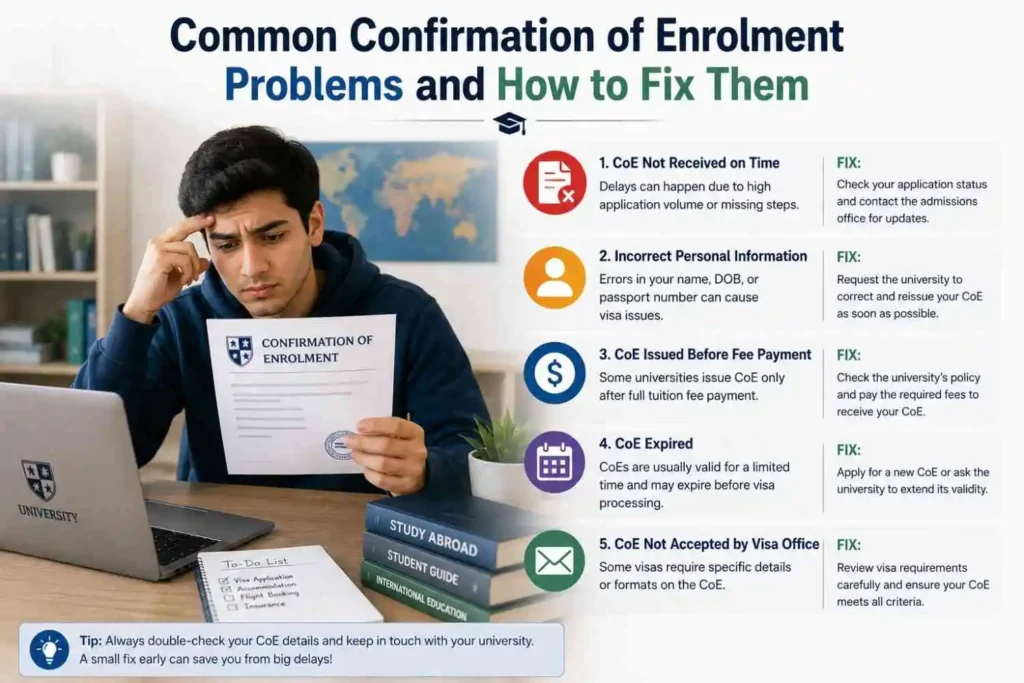
Common Confirmation of Enrolment Problems and How to Fix Them
Things go wrong with CoEs more often than they should. Here are the most common issues and what to do about each one.
Problem 1: Your Name on the CoE Doesn’t Match Your Passport
This is the most frequently reported CoE issue. It happens because students write their name differently on their university application form compared to how it appears in their passport. Maybe you used a nickname. Maybe you omitted a middle name. Maybe there’s a spelling variation between your home country ID and your passport.
The fix: contact your international student office immediately and request a CoE amendment. Provide a clear copy of your passport bio page. Most institutions process name corrections within 2 to 5 business days. Don’t submit your visa application with a name mismatch. The Department of Home Affairs will flag it, and it can delay your application significantly.
Problem 2: Wrong Course Start Date
Sometimes a CoE is issued with a start date that doesn’t match your actual intake. This might happen if your institution generated it before your specific intake date was confirmed, or if there was a data entry error on their end.
The fix: again, contact your international student office with documentation of your correct start date. They’ll update the CoE in PRISMS, and your updated document will follow. Don’t try to submit the application with an obviously wrong date hoping the visa officer won’t notice. They will.
Problem 3: CoE Not Received After Paying Fees
You paid. You’ve been waiting two weeks. Still nothing. This happens when payment hasn’t been reconciled on the institution’s end, when a pre-enrolment condition is still outstanding without anyone telling you, or when your CoE went to a wrong email address.
The fix: email your international student admissions officer with proof of payment and ask for a status update on your CoE. Most institutions have a dedicated international office specifically for this purpose. Check your spam folder first, because institutional emails sometimes land there. If you’re dealing with a private college, follow up by phone as well.
Problem 4: CoE Cancelled After Course Transfer
If you changed your mind about your course and switched to a different programme before arriving in Australia, your original CoE is cancelled in PRISMS and replaced with a new one. If you submitted your visa application using the old CoE number, the Department of Home Affairs will see a cancelled CoE, which raises serious questions about your enrolment status.
The fix: if you change courses or institutions before your visa is granted, contact your institution immediately to get the updated CoE and amend your visa application. If your visa hasn’t been lodged yet, simply use the new CoE. If it has been lodged, contact IRCC or DHA with an explanation and the new CoE as quickly as possible.
Problem 5: OSHC Dates Don’t Match the CoE Dates
Your OSHC must cover at least your full course duration as shown on your CoE. If your OSHC policy starts a month later than your CoE start date, the visa officer sees a gap in health coverage. That’s a refusal risk.
The fix: when reviewing your CoE, compare the course start date to your OSHC start date. They should match, or your OSHC should start before your CoE start date. If there’s a gap, contact your OSHC provider to adjust the policy, or ask your institution’s international office to assist.
Confirmation of Enrolment and Your Student Visa: The Full Picture
Your Confirmation of Enrolment sits at the centre of your Australian student visa application, but it doesn’t exist in isolation. The visa officer reviewing your case looks at your CoE alongside your financial evidence, your Genuine Student statement, your health examination results, your police clearances, and your biometrics.
A strong CoE from a well-regarded CRICOS institution in a high-priority processing tier (under Ministerial Direction 115) genuinely speeds up your application. A CoE from a lesser-known private college in a lower-priority tier takes longer to process, even when everything else in your application is in perfect order. This is the reality of how the Australian visa system works, and it’s worth knowing before you make your university choice.
For more on what the full financial side of your Australian student visa application requires alongside your CoE, our complete guide to Australia student visa financial requirements 2026 breaks down every document you’ll need. And if you’re trying to understand how long the overall process takes after you submit everything, our Australia student visa processing time guide gives you realistic timelines for every education sector.
Frequently Asked Questions About Confirmation of Enrolment
How do I check if my Confirmation of Enrolment is registered in PRISMS?
You can verify your CoE registration by visiting the PRISMS public portal and entering your CoE reference number. If your CoE is active and correctly registered, it will appear in the system. If it doesn’t appear, your institution may not have completed the registration yet, or there could be an issue that needs to be resolved with your international student office.
Can I apply for a visa before receiving my Confirmation of Enrolment?
No. The Confirmation of Enrolment reference number is a required field in your Australian student visa application. You cannot submit a complete visa application without it. Don’t try to submit and add the CoE later, because the ImmiAccount portal requires the CoE number to link your enrolment data to your application.
What’s the difference between an offer letter and a Confirmation of Enrolment?
Your offer letter says: “we want to offer you a place.” It’s conditional, often subject to things like fee payment and document submission. Your Confirmation of Enrolment says: “you are enrolled.” It’s issued after all conditions from the offer letter have been met. The offer letter has no direct role in your visa application. The CoE does.
Will my Confirmation of Enrolment be cancelled if I defer my start date?
Not cancelled, but updated. If you defer your start date, your institution amends your CoE in PRISMS to reflect the new start date. The CoE reference number typically stays the same, but the dates change. After deferral, always download the updated version of your CoE and confirm the new dates are correct before submitting or resubmitting your visa application.
What happens to my Confirmation of Enrolment if I don’t meet my academic conditions?
If you were given a conditional offer and fail to meet the academic conditions (such as achieving a specific grade or completing a bridging programme), your institution can cancel your enrolment and cancel your CoE. A cancelled CoE means your visa application becomes invalid if it hasn’t been processed yet, or your existing visa may be affected if you’re already in Australia. If you’re at risk of not meeting your academic conditions, talk to your institution’s international office before the situation escalates.
Does my Confirmation of Enrolment show my IELTS or PTE score?
It may show that you’ve met the institution’s English language requirement, but it typically doesn’t display your actual test score in detail. Your IELTS or PTE score report is a separate document that you submit alongside your CoE in your visa application. If you’re still working on your English test scores, our PTE vs IELTS comparison guide can help you figure out which test is the better option for your situation.
Can I use my Confirmation of Enrolment to open a bank account before arriving in Australia?
Yes. Several Australian banks, including Commonwealth Bank, NAB, and ANZ, allow international students to open accounts online before arrival using their passport, visa details, and CoE. Having a bank account ready before you land makes your first week in Australia significantly less stressful, especially when you need to set up accommodation payments, buy a SIM card, and cover living costs before your first scholarship or allowance payment arrives.
One Document, Many Moving Parts
The Confirmation of Enrolment might seem like a straightforward bureaucratic document, and in many ways it is. But it’s also the single most load-bearing document in your Australian student visa application. Everything else, your financial evidence, your health clearance, your Genuine Student statement, is assessed in the context of what your CoE shows.
Get it right, and your visa application has a solid foundation. Miss a detail or ignore an error on your CoE, and you risk delays, requests for more information, or in worst cases, a refusal that could have been completely avoided.
The practical advice is simple. The moment your Confirmation of Enrolment arrives, open it immediately, read every field, cross-check your name and date of birth against your passport, verify the course dates match what you agreed to, and confirm the OSHC period is correct. If anything is off, contact your institution before you do anything else. A CoE correction takes a few days. A visa refusal takes months to recover from.
If you’re still in the earlier stages of preparing your Australian study application, our guides on financial requirements for the Australian student visa, proof of funds documentation, and how to study abroad on a budget cover the parts of the process that come before and after your CoE arrives. The full study abroad resource library at StudyPathExp is built around helping students from Pakistan, India, and across South Asia navigate every step of this process without paying a consultant for information that should be free.
Disclaimer: Information in this article about the Confirmation of Enrolment process, PRISMS, CRICOS, and Australian student visa requirements is based on publicly available guidance from the Australian Department of Education and the Department of Home Affairs as of August 2026. Policies and procedures are updated regularly. Always verify current requirements with your institution’s international office and the official Department of Home Affairs website before submitting your visa application.