What Is a Gap Certificate? (Featured Answer)
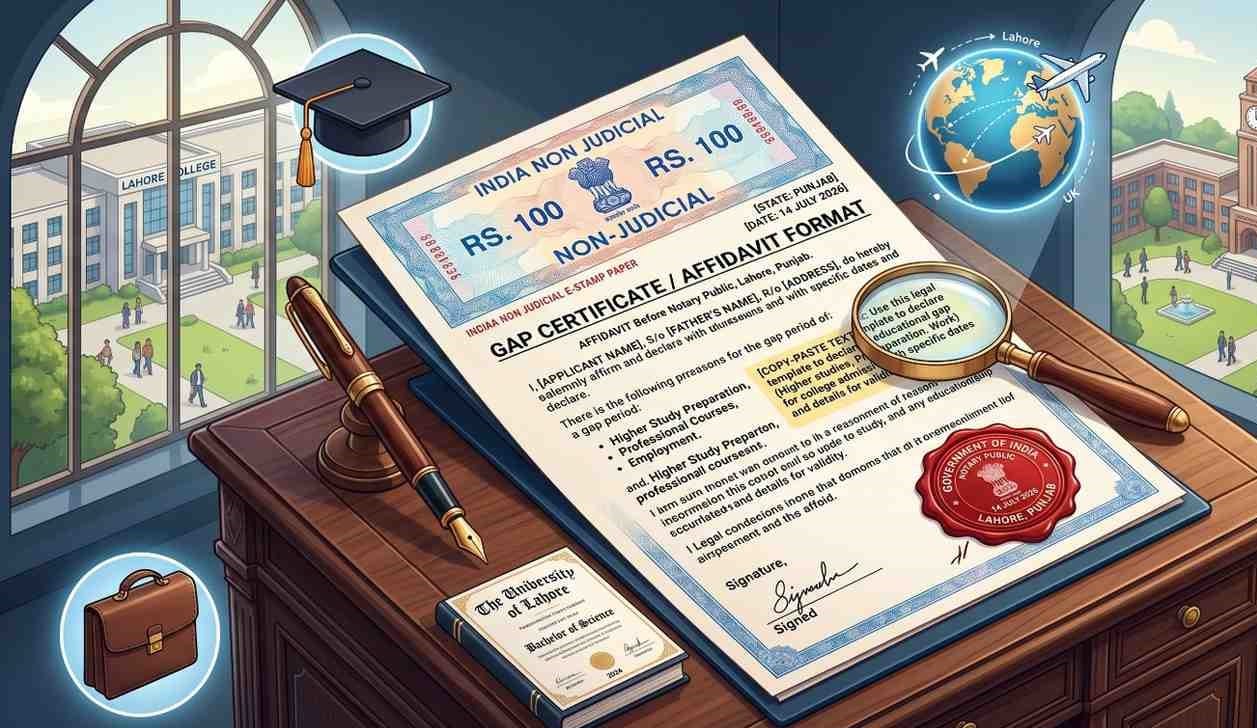
A gap certificate format is a sworn affidavit, executed on non-judicial stamp paper and attested by a notary public or oath commissioner, in which a student formally declares the reason for a break in their academic education between completing one qualification and enrolling in the next. It is legally accepted by universities, colleges, embassies, and employers across India and internationally as an official explanation of a year gap certificate period.
That is the answer Google is looking for. Now here is everything else you need to actually create one — without downloading a single PDF.
No Downloads. No Sign-Ups. Just Copy, Print, and Notarise.
Every time you search for a gap certificate format, Google throws you at a university’s PDF that either won’t open on mobile, requires Adobe Acrobat, or asks you to log in to Scribd to view a document that should be publicly accessible. None of that is useful when you have an admission deadline in 48 hours.
This page gives you four complete, legally sound gap certificate format templates in plain text. Read them on your phone. Copy them on your laptop. Paste directly into Microsoft Word. Print on Rs. 50 or Rs. 100 non-judicial stamp paper. Get it notarised. Done. No account creation, no payment, no PDF viewer required.
A gap in education is completely normal. NEET droppers take one or two years to prepare. Students sometimes delay due to illness, family emergencies, financial constraints, or the time needed to arrange funds and documentation for study abroad. None of these reasons disqualify you from admission or a visa. What disqualifies you is failing to document the gap correctly. That is exactly what this guide solves.
Who Needs a Gap Certificate Format — and When?
Understanding whether you actually need a gap certificate format — and for which specific purpose — determines which template below is right for you. Not all gaps require the same type of documentation, and submitting the wrong format to a university or embassy is one of the most common reasons applications face unnecessary delays.
- Domestic college/university admissions: Any gap between Class 12 and undergraduate enrollment, or between graduation and postgraduate enrollment, is flagged during document verification. A notarised gap affidavit submitted alongside your application resolves this immediately.
- NEET droppers and engineering entrance repeaters: Students who spend one or two years preparing for competitive entrance exams like NEET or JEE are a specific category that most medical and engineering colleges explicitly require a NEET dropper affidavit or gap declaration for.
- Study abroad visa applications: UK, Canada, Australia, Germany, and USA visa applications all ask applicants to explain any gaps in education. An unsigned, undated, vaguely worded explanation is the fastest route to a visa refusal. A properly notarised affidavit with a clear study gap justification is what embassies and consulates actually need.
- Medical and health-related gaps: If the gap was caused by illness, surgery, or a mental health period, a gap affidavit combined with a supporting medical document from a registered doctor is the required combination.
- Job applications: Some employers, particularly in the government sector, banking, and defence, verify educational timelines during background checks. A gap certificate on record prevents questions from arising during the verification process.
Components That Make a Gap Certificate Format Legally Valid
A gap certificate format is not just a typed letter. It is a sworn legal declaration — an affidavit — and it must contain specific elements to be accepted by any authority. Missing even one of these components can result in rejection, which wastes time and money because you then need to redo the stamp paper, get it notarised again, and resubmit.
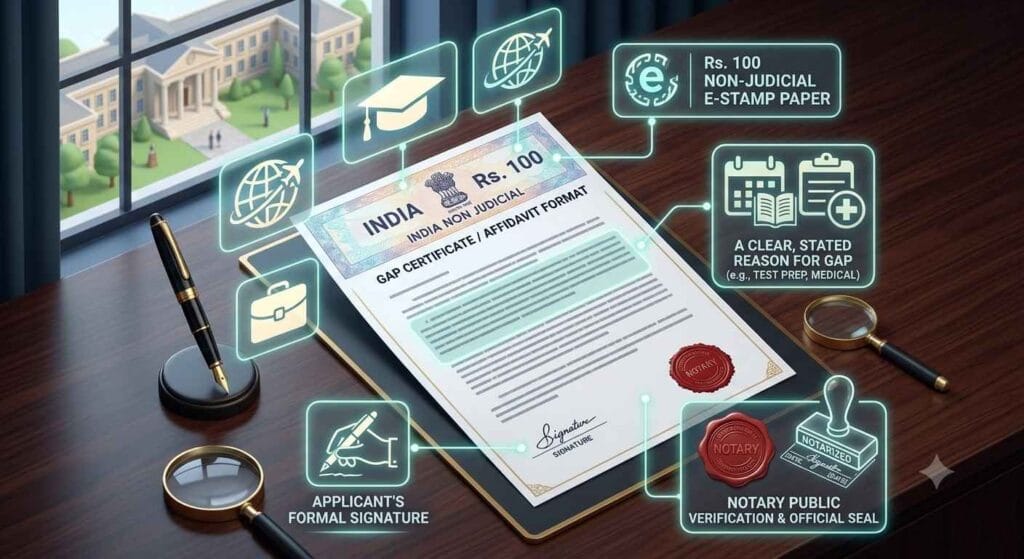
- Affidavit Header: The words “AFFIDAVIT” or “DECLARATION” at the top, clearly establishing the nature of the document.
- Deponent’s Full Identity: Your full legal name exactly as it appears on your Class 10 or 12 marksheet, your date of birth, your father’s name, your full permanent address, and your Aadhar card number or national identity number. Discrepancies between this and your educational certificates will cause rejection.
- Precise Gap Period: The exact start date and end date of the gap — month and year at minimum, specific date where possible. “I took a gap for about one year” is not acceptable. “I had a gap from June 2023 to July 2024” is.
- Clear and Specific Reason: The reason must be concrete and verifiable. Vague reasons like “personal work” or “family issues” without further detail are the single most common cause of visa refusal on gap-related grounds. The reason section is where your document either earns credibility or loses it.
- Activities During the Gap: What were you doing? Preparing for an exam, attending coaching, arranging funds, receiving medical treatment, supporting a family member? Even if the gap was unproductive, be honest — but frame it accurately.
- Solemn Oath Statement: The deponent must declare that the contents of the affidavit are true to the best of their knowledge and belief, and that nothing material has been concealed. This oath is what gives the document legal weight.
- Notary Public or Oath Commissioner Seal: Without the notary public or oath commissioner attestation, stamp, registration number, and signature, the document is just a typed page. It has no legal standing. The notary’s seal and signature are what convert a declaration into a legally binding affidavit.
- Non-Judicial Stamp Paper: The affidavit must be typed or printed on non-judicial stamp paper of Rs. 50 or Rs. 100 denomination (varies by state). This is purchased from authorised stamp vendors or through the court’s e-stamp facility in many states.
4 Copy-Paste Gap Certificate Format Templates — Use Directly
Each gap certificate format below is written for a distinct, real situation. Before copying, read the brief context paragraph — it tells you exactly which template fits your case and what supporting documents to attach. Replace all text in square brackets with your own real information. Do not leave any brackets unfilled in the final document.
Template 1: Standard Gap Certificate Format for College or University Admission
This is the most universally required version of the gap certificate format — used when you are applying to a college or university in India after a gap following your Class 12 examinations or your graduation. Most Indian universities, autonomous colleges, and medical and engineering institutions require this at the time of document verification. It is also accepted by state counselling bodies during online admission processes.
For this template to be accepted, attach a copy of your Class 12 marksheet or graduation certificate showing your passing year, your Aadhar card copy, and any supporting evidence of what you did during the gap — coaching institute enrollment letter, self-study declaration, or medical certificate as applicable. Print on Rs. 50 or Rs. 100 non-judicial stamp paper.
📋 TEMPLATE 1 — College / University Admission Gap Affidavit
AFFIDAVIT
I, [Your Full Name], son/daughter of [Father’s Full Name], aged [Age] years, a permanent resident of [Full Permanent Address], do hereby solemnly affirm and declare as under:
1. That I passed my [Class 12 / Graduation] examination from [Institution Name], [Board/University Name], in the year [Year of Passing], securing [Percentage / CGPA].
2. That there has been a gap of [Duration — e.g., one year / two years] in my academic career from [Month, Year] to [Month, Year].
3. That during the aforementioned period, I was [State Reason — e.g., preparing for competitive entrance examinations including NEET / JEE / engaged in self-study and coaching at [Coaching Institute Name, if applicable] / attending to a family emergency / recovering from a medical condition].
4. That I was not enrolled in any regular academic programme or institution during the said gap period.
5. That I have not been involved in any criminal activity or legal proceedings during this period.
6. That I am now seeking admission to [Programme Name] at [Institution Name] for the academic year [Year].
I, the above-named deponent, do hereby verify that the contents of this affidavit are true and correct to the best of my knowledge and belief, and nothing material has been concealed or misrepresented herein.
Solemnly affirmed at [City Name] on this [Date] day of [Month], [Year].
____________________________
Signature of Deponent
[Your Full Name]
Verified before me,
____________________________
Notary Public / Oath Commissioner
Seal & Registration Number
Date:
Template 2: Gap Certificate Format for Study Abroad and Visa Application
This version of the gap certificate format is specifically designed for students applying for international study visas — UK Student Visa, Canadian Study Permit, Australian Student Visa, German Student Visa, or US F-1 Visa. Embassies and high commissions are far stricter than domestic institutions when reviewing gap explanations. Vague reasons are a direct path to visa refusal. This template provides the level of specificity that immigration officers require.
The most common acceptable reasons for study abroad gap applications are: IELTS/TOEFL preparation, gathering financial resources, preparing the required documentation, family responsibility, or health-related reasons. This template is built around the IELTS preparation and financial arrangement scenario, which is the most frequently cited and most universally accepted explanation. Adapt the reason section honestly to your actual circumstances. Attach your IELTS score card (if available), bank statements showing fund accumulation, your offer letter from the foreign institution, and your Aadhar card copy. For a full understanding of what visa application packages require, our guide on the proof of funds letter from bank covers the financial documentation side in detail.
📋 TEMPLATE 2 — Study Abroad / Visa Application Gap Affidavit
AFFIDAVIT — EXPLANATION OF STUDY GAP PERIOD
I, [Your Full Name], son/daughter of [Father’s Full Name], born on [Date of Birth], holding Aadhar Card Number [XXXX XXXX XXXX], residing at [Full Permanent Address, City, State, PIN], do hereby solemnly affirm and declare as follows:
1. That I successfully completed my [Degree — e.g., Bachelor of Science in Computer Engineering] from [Institution Name], [University Name], [City], India, in the month of [Month] and year [Year], with an overall aggregate of [Percentage / CGPA].
2. That following the completion of my degree, there exists a gap period of approximately [Duration] from [Month, Year] to [Month, Year], during which I was not enrolled in any formal academic programme.
3. That during this period, I was engaged in the following productive activities:
(a) Preparing for and appearing in the IELTS / TOEFL English Language Proficiency examination, which is a mandatory requirement for admission to [Country] universities. I appeared in the examination on [Date] and achieved a score of [Score / Band — if available].
(b) Researching and identifying suitable universities and programmes abroad that align with my academic background and career goals, and subsequently completing and submitting my applications.
(c) Arranging the financial resources required to fund my studies abroad, including compiling bank documentation, arranging for an education loan, and obtaining the necessary sponsorship commitments from my family.
4. That I have now been offered admission to [Programme Name] at [University Name], [City], [Country], commencing [Month, Year], and I am in the process of applying for a student visa to pursue this programme.
5. That during the entire gap period, I was not involved in any employment, criminal activity, or legal proceedings of any nature.
6. That all the information provided above is accurate, complete, and verifiable, and I undertake to provide supporting documentation upon request by the relevant visa authority or institution.
I solemnly verify that the contents of this affidavit are true to the best of my knowledge and belief, and I understand that providing false information in a sworn affidavit constitutes a criminal offence under the laws of India.
Signed at [City] on [Date].
____________________________
Deponent’s Signature
[Full Name]
[Aadhar Number]
Attested before me on [Date],
____________________________
Notary Public / Oath Commissioner
Seal, Name, Registration No., Date
Template 3: Gap Certificate Format for Medical or Health Reasons
Health-related gaps are among the most legitimate and universally accepted reasons — but they are also the category most frequently mishandled in affidavit format. Universities and visa authorities are not unsympathetic to medical gaps. What they reject is a medical gap claim that has no supporting documentation, no specific diagnosis, and no clear timeline. This gap certificate format is written to pair with a supporting doctor’s certificate or medical records, and it uses language that directly addresses what verification authorities look for.
Attach this affidavit with a certificate from your treating doctor on their official letterhead confirming your condition, the period of treatment or recovery, and a statement that you were medically advised to discontinue studies during that period. Without the supporting medical certificate, this affidavit alone will not be sufficient for a visa application — though it may be accepted for domestic admissions at many Indian colleges.
📋 TEMPLATE 3 — Medical / Health Reasons Gap Affidavit
AFFIDAVIT OF STUDY GAP — MEDICAL GROUNDS
I, [Your Full Name], son/daughter of [Father’s Full Name], aged [Age] years, residing at [Full Permanent Address], do hereby solemnly affirm and declare on oath as under:
1. That I passed my [Last Qualification — Class 12 / Graduation / Post-Graduation] examination from [Institution Name, Board/University], in [Month, Year].
2. That subsequent to the completion of my said examination, I was diagnosed with [Nature of Illness or Condition — e.g., a serious illness / a physical health condition / [specific condition if comfortable disclosing]], for which I was required to undergo medical treatment from [Month, Year] to [Month, Year].
3. That on the advice of my treating physician, Dr. [Doctor’s Name], [Specialisation], [Hospital/Clinic Name], I was required to temporarily discontinue my academic activities and focus entirely on medical treatment and recovery during the aforementioned period.
4. That during this gap period of [Duration], I was therefore unable to pursue any formal academic programme or appear in any competitive examination.
5. That I have now fully recovered and am medically fit to resume my studies, as confirmed by the attached medical fitness certificate from Dr. [Doctor’s Name].
6. That I am now seeking admission to [Programme] at [Institution] for the academic year [Year], and I request that my application be considered with the understanding of the medical circumstances described above.
7. That all facts stated herein are true and correct to the best of my knowledge. I am fully aware that misrepresentation in a sworn affidavit is a punishable offence under the Indian Penal Code.
Solemnly affirmed at [City] on [Date].
____________________________
Signature of Deponent
[Full Name & Aadhar No.]
Before me,
____________________________
Notary Public / Oath Commissioner
Registration No. / Seal / Date
Template 4: Short Notary Affidavit Gap Certificate Format
Sometimes a full-length affidavit is more than what is needed. Many domestic colleges, some private universities, and certain employer verification processes will accept a short, clean one-page sworn declaration. This version of the gap certificate format is concise by design — it covers all legally required elements but in under 250 words. It is particularly well-suited for NEET droppers submitting to medical college counselling processes, where document volumes are high and administrators need to process quickly.
This is also the format most notaries are familiar with and will process fastest — reducing the time you spend at the notary office explaining what kind of document you need. Print on Rs. 50 stamp paper. Most notaries will charge between Rs. 50 and Rs. 200 for attestation, depending on the city.
📋 TEMPLATE 4 — Short Notary Affidavit (NEET Dropper / Quick Format)
AFFIDAVIT
I, [Full Name], son/daughter of [Father’s Name], resident of [Address], do hereby solemnly affirm and state as follows:
1. I completed my Class 12 / [Last Degree] from [School/College Name], [Board/University], in the year [Year].
2. I had a gap in my studies from [Month/Year] to [Month/Year] due to [Reason — e.g., preparation for NEET entrance examination / personal and family reasons / medical reasons].
3. I was not enrolled in any regular course or institution during this period.
4. I have not been convicted of any criminal offence during this period.
5. The above facts are true to the best of my knowledge and belief.
Declared at [City] on [Date].
____________________________
Deponent
[Name | Aadhar No. | Date]
Verified before me,
____________________________
Notary Public
Seal | Enrolment No. | Date
Step-by-Step: How to Make Your Gap Certificate Format Legally Valid in India
Having the right gap certificate format text is only Step 1. The document only becomes legally binding after it goes through the proper execution process. Here is exactly what you do, in order.
- Copy the template and fill in your details. Replace every bracketed placeholder with your real, accurate information. Read the completed document twice to check for any inconsistency between the affidavit details and your actual documents (name spelling, date of birth, pass year, institution name).
- Buy Non-Judicial Stamp Paper. Go to an authorised stamp vendor near your local court or taluka office. In most states, Rs. 50 or Rs. 100 non-judicial stamp paper is the accepted denomination for educational affidavits. Some states have moved to e-stamp paper — ask your notary which format is currently accepted in your state.
- Print or type the affidavit on the stamp paper. You can get it typed at any typing centre near the court for Rs. 20 to Rs. 50. Make sure the text begins on the stamp paper itself, not on a separate sheet stapled to it. If the text extends beyond one side of the stamp paper, it continues onto a plain white sheet, which is then attached and signed across the junction.
- Visit a Notary Public or Oath Commissioner. Find a registered Notary Public near your district court. They are usually located in the court complex or in offices adjacent to it. Present the filled stamp paper affidavit, your Aadhar card (original for identity verification, photocopy for their records), and your passport-size photograph.
- Sign in front of the notary. The notary or oath commissioner will administer the oath to you, confirm your identity, and then sign, stamp, and add their registration number and date to the document. This attestation is what makes the affidavit legally valid.
- Make certified copies if required. If you need multiple copies — for example, if you are applying to several universities or need one for a visa and one for college admission — ask the notary to attest multiple copies at the same time. Getting additional copies notarised on separate visits costs more time and money.

Required Documents to Attach With Your Gap Certificate Format
The affidavit alone is rarely sufficient. Every authority that requests a gap certificate format — whether a domestic college, a university abroad, or a visa officer — expects supporting documentation that corroborates the reason stated in the affidavit. The table below shows what to attach based on your gap reason.
| Gap Reason | Mandatory Attachments | Additional Supporting Documents |
|---|---|---|
| NEET / JEE Preparation | Class 12 Marksheet, Aadhar Card copy | Coaching Institute enrollment letter, Admit cards for attempts |
| Study Abroad Preparation | Last Degree Certificate, Aadhar, Passport copy | IELTS/TOEFL score card, Bank statements, Offer letter |
| Medical / Health | Aadhar, Last Marksheet | Doctor’s certificate on letterhead, Medical records, Fitness certificate |
| Financial Constraints | Aadhar, Last Marksheet | Self-declaration of financial hardship, Bank statements showing recovery |
| Family Emergency | Aadhar, Last Marksheet | Supporting letter from parent/guardian, Death certificate (if bereavement) |
| Employment During Gap | Aadhar, Last Marksheet | Appointment letter, Salary slips, Experience certificate from employer |

5 Fatal Mistakes That Get Gap Certificate Formats Rejected
These five mistakes are responsible for the overwhelming majority of gap affidavit rejections by both Indian universities and foreign embassies. Each one is entirely avoidable — and understanding them before you submit your document could save you weeks of delay and additional costs.
Mistake 1: Vague or Inconsistent Reason
“Personal reasons” and “family issues” are the two most rejection-prone phrases in any gap certificate format. They are not reasons — they are placeholders. Visa officers and university administrators are trained to look for specific, verifiable explanations. “I was caring for an ill parent” is better. “I was the primary caregiver for my father, who was hospitalised with [condition] from [date] to [date], as confirmed by the attached medical certificate” is what actually gets accepted. Specificity is not optional — it is the entire point of the document.
Mistake 2: Date Errors and Timeline Inconsistencies
If your Class 12 marksheet says results were declared in June 2023 but your affidavit states the gap started from March 2023, an alert visa officer will catch that discrepancy immediately. Similarly, if your gap ends in July 2024 but the offer letter from your university shows your programme starts in September 2025, that gap needs to be explained — you cannot have a 12-month gap after your gap ends. Cross-check every date in your gap certificate format against every supporting document you are submitting before you get it notarised.
Mistake 3: Missing Notary Seal or Expired Notary Registration
A self-sworn declaration typed on plain paper and signed by yourself is not a notarised affidavit. It is a note. Similarly, an affidavit signed and stamped by a notary whose registration has lapsed is legally defective and can be challenged. When you visit the notary public or oath commissioner, ask to see their current registration certificate. Their enrolment number and validity dates should be visible on the stamp they apply to your document. A valid, currently registered notary’s seal on the correct stamp paper denomination is the non-negotiable minimum for a legally accepted gap certificate format.
Mistake 4: Name or Date of Birth Mismatch
Your name in the affidavit must match your name on your marksheets, your Aadhar card, and your passport exactly — including middle names and spelling variations. If your marksheet says “Mohammed Raza Khan” and your passport says “Mohammad Raza Khan” and your affidavit says “M. R. Khan,” you have three different identity representations in the same document package. This triggers a flag. If you have a genuine name inconsistency across documents, a separate name correction affidavit may be required before the gap affidavit will be accepted.
Mistake 5: Not Getting the Affidavit Apostilled for International Use
For use in countries that are signatories to the Hague Apostille Convention (including the UK, USA, Australia, Germany, Canada, and most EU countries), a notarised affidavit from India may additionally need to be Apostilled by the Ministry of External Affairs (MEA) to be accepted as a legally valid foreign document. Many students prepare a perfectly notarised gap certificate format and submit it to a foreign embassy without the Apostille, only to have it returned. Check with the specific embassy or consulate whether Apostille is required for your destination country before you finalise your document package.
Cost Breakdown — What Does a Gap Certificate Format Actually Cost?
One of the most searched questions around the gap certificate format is how much it costs. The answer varies by state and city, but the structure is consistent across India.
| Component | Approximate Cost (India) | Notes |
|---|---|---|
| Non-Judicial Stamp Paper (Rs. 50) | Rs. 50 | Rs. 100 for higher-value declarations or as required by state |
| Typing / Printing on Stamp Paper | Rs. 20 – Rs. 60 | Available at typing centres near district courts |
| Notary Public / Oath Commissioner Fee | Rs. 50 – Rs. 300 | Higher in metro cities; lower in tier-2 / tier-3 cities |
| Photocopies of Attachments | Rs. 10 – Rs. 30 | For documents you must submit alongside the affidavit |
| Apostille (If required for abroad) | Rs. 50 per document (MEA) | Plus MEA processing time of 2–5 working days |
| Total (Domestic Use) | Rs. 130 – Rs. 440 | Varies by state and notary |
| Total (International / Visa Use) | Rs. 180 – Rs. 540 + Apostille | Budget additional Rs. 500–Rs. 1,000 for courier to MEA if needed |
Frequently Asked Questions About Gap Certificate Format
Q: Is a gap certificate format mandatory for all admissions?
Not universally — but increasingly yes. Most medical colleges, engineering colleges, and central universities in India require a gap certificate for any student whose last qualifying examination was more than one year before the date of admission. For study abroad applications, virtually all countries that require English proficiency test scores (UK, Canada, Australia, USA) will also scrutinise any unexplained gap. The risk of not submitting a gap certificate format when one is required is that your application is either rejected outright or placed on hold pending clarification — which wastes months of your time.
Even when it is not explicitly listed as a mandatory document, submitting one proactively demonstrates transparency and organisation — qualities that admissions committees and visa officers respond well to. If you are unsure whether your specific institution requires it, call their admissions office and ask directly.
Q: How long is a gap certificate valid for?
There is no universal fixed expiry date for a gap certificate, but practically speaking, you should treat one as valid for six to twelve months from the date of notarisation. The reason is not legal — the affidavit itself does not expire — but practical: a visa officer or admissions committee who sees a gap certificate dated 18 months ago will question whether your circumstances have changed since then. For visa applications in particular, documents dated within the last three to six months carry significantly more credibility than older ones.
If your gap affidavit is more than six months old and you are still in the process of applying, it is worth getting a fresh one prepared. The cost is minimal, and having a freshly dated document eliminates any potential query from the reviewing authority.
Q: Can I get a gap certificate format notarised online?
As of 2026, online notarisation is legally permitted in India under the Information Technology (Amendment) Act, but its acceptance by specific institutions and embassies varies significantly. Some Indian universities and state counselling processes accept e-notarised affidavits through platforms that use Aadhaar-based e-signature and a registered online notary. However, most foreign embassies — including the UK Home Office and Canadian IRCC — still require physical notarisation with a wet ink signature and rubber stamp. Always check the specific acceptance policy of your receiving authority before opting for online notarisation.
For domestic admissions where a physical submission is required, the traditional notary office route remains the safest and most universally accepted method. Online notarisation is most useful for supplementary affidavits submitted as part of digital application portals that explicitly permit it.
Q: Do I need a separate gap certificate if I have a medical certificate?
Yes — you need both, and they serve different functions. A medical certificate from your doctor tells the institution what condition you had and for how long you were under treatment. The gap certificate affidavit is your sworn declaration that you did not attend any other institution or engage in any activities that would need to be disclosed separately during the gap period. One corroborates the other.
Think of it this way: the doctor’s certificate explains the medical reality. The notarised affidavit provides the legal declaration that your academic record during that period is accurately represented. Universities and visa authorities want both — not one as a substitute for the other.
Q: My gap was unproductive — I simply didn’t study or work. What do I put as the reason?
Be honest, but frame it accurately. An unproductive gap is not automatically disqualifying for most domestic Indian admissions. Many NEET droppers or students who faced genuine confusion about career direction simply did not do much during the gap year. The correct approach is to state the factual situation: “I was in the process of exploring suitable academic programmes and clarifying my career goals, and during this period I engaged in self-directed study to improve my subject knowledge for competitive examinations.”
What you should not do is fabricate activities that did not happen — claiming coaching you did not attend, or certifications you did not complete. Authorities can and do verify these claims, and a false statement in a sworn affidavit is a serious legal offence. Honesty, framed professionally and contextually, is always the correct approach in a gap certificate format.
One Last Thing Before You Submit
A correctly prepared gap certificate format is a document that works entirely in your favour when done right. It removes doubt, demonstrates transparency, and shows the admissions committee or visa officer that you understand and respect the formal requirements of the process. Done poorly — with vague reasons, mismatched dates, or missing notarisation — it creates the exact opposite impression.
Use the templates on this page as your starting point. Fill them honestly. Check every detail against your supporting documents before printing. Get it notarised by a registered notary at your district court. Keep two attested copies — one for submission and one for your personal records. And if your gap certificate is going to a foreign embassy, check whether Apostille is required for your destination country before sealing the envelope.
Your academic gap does not define your future. How you document and explain it does. The rest of your application package — from your Statement of Purpose to your proof of funds letter — builds the full picture of who you are as a candidate. Get the gap certificate right, and everything else has a clean foundation to stand on. For more academic documentation guides and study abroad resources, explore the full library at StudyPathExp.
Disclaimer: The templates provided in this article are general formats intended as starting points. Legal requirements for affidavits, stamp paper denominations, and notarisation procedures vary by Indian state and by the requirements of the specific institution or embassy receiving the document. Always consult a registered legal professional or notary in your jurisdiction before finalising any sworn affidavit. This article does not constitute legal advice.